
Conventional members’ clubs continue to account for the majority of golf that is played on the British Isles, and most still operate primarily thanks to the efforts of volunteers such as captains, committee members, club secretaries, and honorary presidents. But with the majority of clubs needing to boost and diversify their income streams, it has become increasingly common to employ someone at the helm to oversee all parts of the operation on a continual basis.
“Obviously at a resort, a destination-type facility where there’s hotels, it was more common to have managers there, but at these traditional members’ golf clubs managers didn’t exist,” says Joe Kelly, head of membership support at the PGA.
Read more Business HQ Monthly:
In conjunction with the British and International Golf Greenkeepers Association (BIGGA) and the Golf Club Managers’ Association (GCMA) based in Bristol, the PGA launched its diploma in golf club management in 2016 to meet growing demand for accredited qualifications in this field. Mr Kelly says this was a natural step for the association, which has transformed since it was set up in 1901 along with the industry.
“Some of our founder members were greenkeepers, were golf club makers, or made golf balls or were caddies, and as the industry has ebbed and flowed and evolved, the PGA has evolved with it,” he said.
“So I don’t see this as a sudden decision-making of our membership to go this way. It’s just another role within the industry that our members are very good at and have the ability to develop and train to be successful at, and which they are choosing to take on as a career.”
“At the heart of the club”
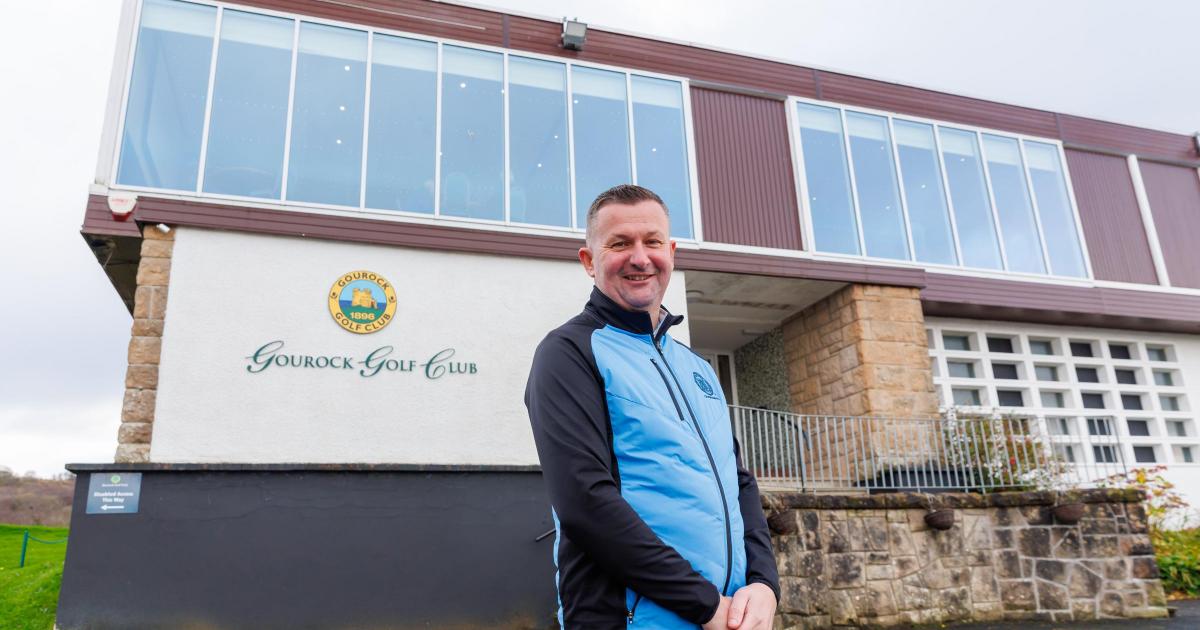
A member of the PGA for 27 years, Derek Watters took on the role of general manager at Gourock Golf Club 10 months ago, adding that to his duties as head professional there for the past 18 years.
“We never had a GM position at our club – it wasn’t part of our frame of the club, we were very much committee-led – but over the last five years we started to move towards the GM position,” he said. “We’ve had some people doing it on a kind of volunteer basis, but the club recognised that as the heart of the golf club and the face of the golf club, and to be honest the person with all of the contacts all over Scotland, they offered me the chance to go and start doing it, which I appreciate them doing.”
Derek Watters took over as general manager at Gourock Golf Club 10 months ago (Image: Colin Mearns)
With paid support from a part-time secretary, clubhouse manager, assistant clubhouse manager, and a dozen or so further bar, greenkeeping and contract catering staff, Mr Watters has a hand in all aspects of the club which serves about 800 members. In an operation with so many moving parts, management continuity is vital.
“Before it was the old-fashioned golf club scenario of 12 people sitting around a table at a monthly committee meeting and thinking that is enough to run the golf club and a three-quarters of a million pound business,” he said.
Read more:
“It’s been very much recognised and understood now that on a day-to-day basis, golf clubs need some form of management – whether that be management of the bar staff, management of the catering staff, whether it be management of the ladies’ committee and the gents’ committee and the junior committee – that there needs to be a lynchpin there somewhere to pull it all together and deal with members’ requests and visitors and corporate clients, trying to increase revenue and bring more business into the golf club as a whole.”
With a combination of golf expertise, business training and experience of membership relations, their proponents say PGA pros have a unique combination of skills making them ideally suited to club management. Mr Watters further highlights their connections to the “outside world” as a key strength.
“Golf clubs tend to be very insular places and to just focus on themselves, but really there’s so many other things going on out there that we can learn from,” he said.
“I suppose that’s where the club managers’ association kicks in, and it’s where the PGA kicks in. It’s about the rebranding and the realisation of that fact that we are the most educated people in the building, so if we can add a few other things to what we do then we become that overall person that can manage the whole place.”
Diminishing returns
In addition to being a PGA professional, Mr Watters is also a member of CMAE Scotland, which was known as the Scottish Golf & Club Managers Association until earlier this year. CMAE is open to all club managers and its internationally-recognised CMDip club management diploma forms part of the pathway to the global certified club manager (CCM) designation.
Christopher Spencer, company secretary of CMAE Scotland, says about 10% of his members are PGA professionals, a “definite” increase from a decade ago.
Read more Business HQ Monthly:
“Being a traditional golf club professional is getting tougher and tougher, especially on the hardware side of things,” he said. “People will shop around and go online to see if they can find this driver or whatever, and whilst you need your PGA professional to get custom fit for a driver or a set of irons, there are those who will just buy it off the shelf.
“So I think that, from a purely business perspective, a lot of professionals are looking at whether they want to get into club management, do they want to become a director of golf and leave, if you like, the retail side behind.”
David Scott, general manager of Dumbarnie Links in Fife and outgoing captain of the PGA in Great Britain and Ireland, says financial security is a factor.
“The golf professional’s role at the golf club has now changed significantly, down to the internet mainly because back in 1980s and 1990s a lot of golf professionals’ income was actually selling hardware – selling golf clubs, selling merchandise in the shop, and giving lessons. With the internet now, as everybody knows, you can buy a brand new driver or set of irons through the internet and get the very best price, and get it sent out to you within 48 hours.”
David Scott says the opportunities to make money in a golf shop have ‘diminished significantly’ with the internet (Image: Alan Richardson)
In nearly half a century of working in golf, Mr Scott has been a club professional, a playing professional, a facility manager and a resort manager.
Born and raised in St Andrews, he began playing golf as a youngster and turned professional at the age of 19. His first job was as an assistant professional at Blairgowire Golf Club before eventually making his way to Balbirnie Park on the outskirts of Glenrothes as the club’s first professional.
It was there during the late 1990s that he began thinking of trading in a life of self-employment as a conventional club professional, and started taking business classes part-time at Glenrothes College. Three years later he was asked to join the newly-opened Kingsbarns, and was there for eight years before taking over at the Dukes course owned by the Old Course Hotel in St Andrews and its parent company, US-based Kohler.
A “one-stop shop”
“There’s security being in an employed position, which doesn’t give you quite as much control perhaps – you’re answering to a boss, in that case – but I was OK with that providing that the position was exciting for me as it was as director of golf at Kingsbarns Golf Links,” Mr Scott said.
“Not that that was on the horizon when I started my business studies some two years beforehand; I just felt that I needed to learn more, I needed to do more with my time, rather than the same old groundhog thing in the shop each day and hoping that things were going to be OK in the future.”
At the Duke’s he initially managed about 40 members of staff including the food and maintenance teams, further expanding his skill set. In 2013, when the general manager of the entire Old Course Hotel resort stepped down, he was asked to take on the post on an interim basis. He wound up holding the position, with 350 people under his charge, for two and a half years.
Now in his fifth year as general manager of Dumbarnie Links, Mr Scott believes more will follow in his footsteps.
“I think it’s a certainty that more PGA professionals will become managers at golf clubs, the reason being that a PGA professional is like a one-stop shop,” he said. “He or she has got so many skills that they can bring to the table and offer to the position.
“First of all, they should gain a lot of respect by having the PGA title after their name. They are obviously a good player, a good coach, and they’re a good communicator generally speaking, and they understand golf.
“They understand golf rules, they understand and will have run golf competitions, they understand running a golf event and hosting golf days, so putting that skill set down on a CV versus somebody who is not a PGA professional – what skill sets do they have compared to a PGA professional? I would say they’d be very limited.”
Joe Kelly says golf facilities run by PGA professionals demonstrate ‘extremely high levels of performance’ (Image: Contributed)
Mr Kelly says facilities around the world that are run by PGA professionals demonstrate “extremely high levels of performance”. He believes there are a number of reasons for their success.
“Every PGA member has been an accomplished player at some stage in their life,” he explains. “So if you are at that elite level of golf, or a very good level of golf, you have spent an inordinate amount of time in and around the golf industry. There are very few people who have reached that level of ability to play that didn’t start the game as a child.
“So you have this understanding of the culture of golf clubs, the needs of golf clubs, the politics of golf clubs – it’s just part of your DNA because you’ve spent an inordinate amount of time there. If you then layer on the education and development that’s provided by the association, the PGA, that adds another layer of expertise and experience.
“Also, there is something that is inherent in a sportsperson – they want to be consistent, they want to achieve, they are always looking to get better, they are normally part of a team, and they’re normally outcome-driven as well. These are all inherent to sportspeople, and it’s not uncommon for business to look to people from a sporting background because of these inherent qualities.”
Mr Kelly says a further important intangible is the PGA professional’s love of the game. While many may have had alternative career prospects, their calling into the golf industry is vocational.
“When you love something you become committed to it, and you are very invested in the success of it as well,” he said. “So there’s many, many layers that lend themselves to PGA professionals in management.”