
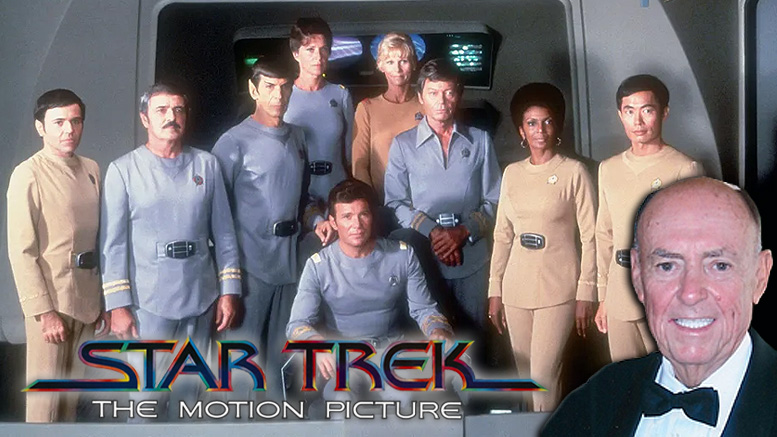
On December 7, 1979, Star Trek: The Motion Picture was released, with fans finally able to see their heroes on board the USS Enterprise once again, over ten years after the original Star Trek series went off the air. Much has been written and said about the long journey and challenges that faced the movie that launched a 13-film franchise for Paramount Pictures, but today we want to focus on one man.
When you think of TMP you think of Star Trek creator and the film’s producer Gene Roddenberry, stars William Shatner and Leonard Nimoy, director Robert Wise, writers Alan Dean Foster and Harold Livingston, visual effects pioneer Douglas Trumbull, and who can forget the iconic score from Jerry Goldsmith. Of course, there are many more from behind and in front of the camera who shepherded Star Trek from cancelled TV show to a Paramount’s biggest film release for 1979. To celebrate the 46th anniversary of The Motion Picture, we want to talk about someone rarely spoken about, yet may have had a profound impact on the franchise.

Leonard Nimoy, Robert Wise, Gene Roddenberry, DeForest Kelley, and William Shatner (Michael Ochs Archives/Getty Images)
Arthur Barron – accountant champion of Star Trek
Looking back to the birth of Star Trek: The Motion Picture, the story is populated by some of the most significant Hollywood executives of the last century. This includes (future head of Disney) Michael Eisner, President of Paramount as well as (another future head of Disney and co-founder of DreamWorks) Jeffrey Katzenberg, who was tasked with overseeing the tumultuous project. And of course you have to consider Barry Diller, who before founding Fox Broadcasting and IAC (and becoming a billionaire), was Paramount CEO through most the ’70s and into the early ’80s. And it is thanks to Diller’s new memoir (Who Knew, released in May) that we have the story of a lesser known Paramount exec, but one who played a key role in bringing Star Trek back.
Accountants can get a bad rap when it comes to the entertainment business. Often derided, these number crunchers take the blame and come under derision, from strangling the budgets of film projects (ask William Shatner about Star Trek V) to getting TV shows pulled from streaming services (see Star Trek Prodigy). But according to Barry Diller, it was an accountant who was Star Trek’s biggest champion back when it was just a cancelled TV show in the 1970s. In chapter 13 of Who Knew, Diller recounts some of the moments of his time at Paramount, coming off a series of highlights from the early to mid seventies, when Star Trek enters the story:
Our successes were becoming ridiculously expected. There was a sense we could do no wrong. But when we first thought of making a movie out of the Star Trek series, which had ended ten years previously and had a relatively small audience, no one in Hollywood could believe that such great geniuses would try to take a middling, long-ago-canceled TV series and turn it into an actual movie.
Our self-described “shiny-ass accountant,” Art Barron, Paramount’s chief financial officer, was obsessed with resurrecting Star Trek. Ever since I arrived at Paramount [in 1974], every once in a while, shyly, given his purely financial position, Art would say to us, “We ought to do something with Star Trek.”
And every time he brought it up, we ignored him. We thought it’d be ridiculous to make a movie of that clunky old show.

Paramount CEO Barry Diller in 1974 (Bettmann Archive/Getty Images)
So it was Arthur Barron speaking into the ear of the man running Paramount, starting five years before Star Trek: The Motion Picture arrived (and years before a little movie called Star Wars changed Hollywood in 1977). It was in this era in the mid-1970s that Diller first began dreaming of launching a new network to rival the triumvirate of ABC, CBS, and NBC. Note that at this time, CBS was still decades away from being part of the same corporate family. Diller sought to launch a “Paramount Television Service,” and once again it was Arthur Barron chiming in with that old TV show. Again from Who Knew:
Our intrepid chief accountant turned show barker again suggested we ought to revive Star Trek as our first series. We found out that there actually were lots of die-hard fans of the show and that would at least give us a known quantity to promote.
Thus began what was dubbed Star Trek: Phase II, which was to be a new television series for the new Paramount network, with most of the new cast returning in their original roles, the main holdout being Leonard Nimoy. In the end, Paramount’s parent company Gulf+Western couldn’t be convinced it made financial sense (accountants, again!) so the new TV network project was shelved. Diller’s memoir skips over a lot of Star Trek history from this era including a couple of early attempts to make a feature film (see The God Thing and Star Trek: Planet of the Titans), but he notes:
The idea of doing something with Star Trek gained momentum. If not a television series then maybe a new movie. The moment we announced it, there was a huge positive public reaction.
And so today fans should remember Arthur R. Barron as they celebrate Star Trek: The Motion Picture. It was this “shiny-ass accountant” who was the lone voice in the corporate suites of Paramount in the mid 1970s when Star Trek could have simply faded away like many other forgotten sci-fi shows. We don’t know if he was a fan himself, but Barron was a holdover from the Desilu era, joining Star Trek’s original production company back in 1963. So he was witness to the birth of the franchise before Gulf+Western purchased both Desilu and Paramount. Barron would go on to run Paramount Communications, Inc. until his retirement in 1989. He returned to the entertainment business again as Chairman of Time Warner until retiring again in 1995. He passed away in 2011.
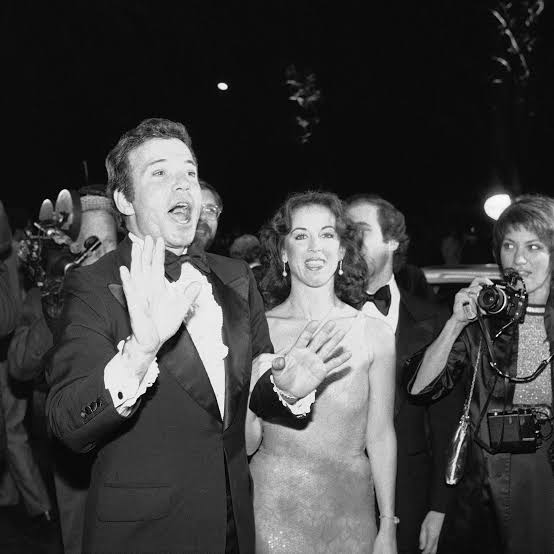
William Shatner and Marcy Lafferty at premiere of Star Trek: The Motion Picture (AP)
Katzenburg’s pennies
Diller’s account then moves to some of the familiar ground covered in other histories of this era, including how they locked themselves to a Christmas season 1979 release, pre-selling the movie to exhibitors before they even figured out how they were going to make a movie. One of the biggest challenges was how the studio had no real experience with visual effects, adding “before we shot a single scene we went through $7 million in abandoned effects.” And back then $7 million was big money. The entire budget of Star Wars was $11 million.
Diller recounts how this early period of trying to get Star Trek onto the big screen were difficult times:
I now had no faith that the movie would be any good. I just wanted it to open and break even and get out with our lives. I had gotten so concerned that I thought we needed to assign one person from our staff to do nothing but make sure the movie was delivered on time. We absolutely could not default on getting these huge guarantees.
At the time, Jeffrey Katzenberg was a junior member of the production staff, but he was chosen to make sure the film actually got into theaters on time. So according Diller, he told Katzenberg, “I don’t care what you have to do; I don’t care what it looks like; just deliver it.”
In the end, after many difficulties, Star Trek: The Motion Picture arrived for its premiere event, satisfying the head of the company. In his memoir he recounts the release, and the passive aggressive way (likely due to how much over budget the project went) the studio thanked Katzenberg:
With prints still wet from the lab, Star Trek opened… By noon there were lines around the block at every theater it was playing in across the country. Jeff had recently bought a small house on Carmelita Avenue in Beverly Hills. The next day I had a truck pull up to to the driveway and dump $25,000 in pennies on his front lawn as our thanks for saving us.
He called me up and said, “You destroyed my lawn!” But he was very proud of those pennies.

(via startrek.com)
So today, think of Jeffrey Katzenberg and his poor lawn as well.
The human adventure is just beginning
46 years later Star Trek is still going. After cancellation the series had seen success in syndication, but Star Trek: The Motion Picture cemented it as a genuine franchise. It was followed soon after with a series of movies starring the TOS crew into the 1980s, and a syndicated TV franchise launching in 1987 with Star Trek: The Next Generation, which borrowed Goldsmith’s Oscar-nominated theme from The Motion Picture. Of course more TV shows followed, including the 1995 premiere of Star Trek: Voyager on the United Paramount Network (UPN), finally fulfilling Barry Diller’s dream.
We are now heading into the 60th year of the franchise with original Star Trek shows on Paramount+ and a whole new feature film in development. Hopefully there are still people like Arthur Barron inside the corporate suites of Paramount advocating for the franchise for decades to come.
You can relive what it was like, with the original trailer for Star Trek: The Motion Picture below.
Famously the film was a bit rushed to make Barry Diller’s deadline, so in 2001 director Robert Wise was able to work with Paramount and a new visual effects team to create a Director’s Edition of the film. This version was remastered in 4K HD for a new release in 2022. You can check out a trailer for that below.
What are your TMP memories? Let us know in the comments below.
Keep up with all the latest on Star Trek history at TrekMovie.