In June 1975, Pink Floyd were in Abbey Road nearing completion of their ninth album, Wish You Were Here. One day a stranger walked into the studio: a dishevelled looking man, overweight and shaven-headed. Except after closer inspection, Roger Waters realised it wasn’t a stranger: it was, incredibly, Syd Barrett, the band’s former psychedelic leader.
None of the members of Pink Floyd – Waters, Dave Gilmour, Nick Mason or Richard Wright – had seen Barrett since 1969. He had left the band in 1968, becoming a recluse after a drug-induced mental health breakdown. Aubrey “Po” Powell, longstanding friend of the band and creator of their album artwork, lived with Barrett in London in the late 60s. “It was over a long weekend,” Powell says. “One day he was there, all bouncing and bubbly. And then by the Tuesday, his eyes were black, and he’d spent the weekend taking vast amounts of LSD. Something happened whereby it burnt out his brain. He was definitely gone. He couldn’t play the guitar. He couldn’t function.”
Yet there Barrett was, borderline unrecognisable (Waters was the only one who realised it was him), looking, as Waters later put it, like “a great, fat, bald mad person”. Before Barrett had got to Abbey Road he had turned up at the Hipgnosis studio in Soho, where Powell was based with his partner, the art director Storm Thorgerson. Barrett had been asking for Pink Floyd. “I was shocked, and I was stunned at the state of him,” Powell says. “It was everything that I’d heard that had happened to him.”
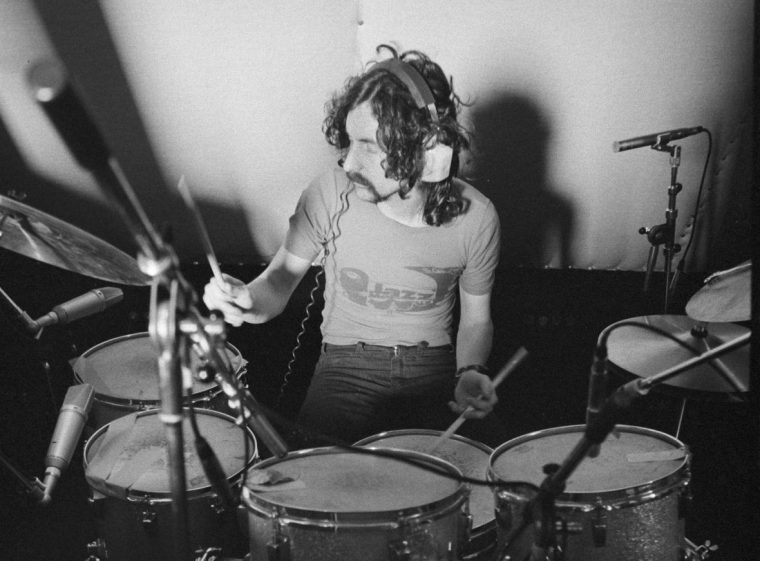 Nick Mason in the studio (Photo: JD Mahn/Sony Music Entertainment)
There are various versions as to what exactly happened that day. Some say Barrett was asking for a guitar, expecting to play. Apparently, he told people there the music Pink Floyd were working on “sounds old”. Another story says he took out a toothbrush and started dancing around brushing his teeth. But whatever happened, he was no sooner there than he was gone. None of the members would ever see Barrett again. “I think it freaked everybody out,” says Powell. “They were a bit shaken by it.”
One of the strangest, most surreal incidents in rock music history was actually a rather apt one. “It was very appropriate that he suddenly turned up,” Powell says. Wish You Were Here was a reckoning of sorts for Pink Floyd: with the mammoth success of 1973’s The Dark Side of the Moon and their newfound fame; with a music industry that they found fake and immoral; and yes, with their history with Barrett, whose shadow the band had struggled to escape.
“It took them a while to find their mettle after Syd,” Powell says. Themes of absence and alienation ran through the album, with Barrett a haunting presence. The album’s opening and closing nine-part, 26-minute opus “Shine On You Crazy Diamond”, was a tribute to their erstwhile guiding light. They had written about Barrett before – notably 1973’s “Brain Damage” – but this was heartfelt and direct. In bizarre, barely believable serendipity, the band were working on the final mix of “Shine On You Crazy Diamond” when Barrett walked into the studio.
“Wish You Were Here is partly dedicated to that,” Powell says. “But only partly. People think it’s an album about Syd. It’s not. It’s partly. It’s also very much an album about absence, particularly the absence of sincerity.”
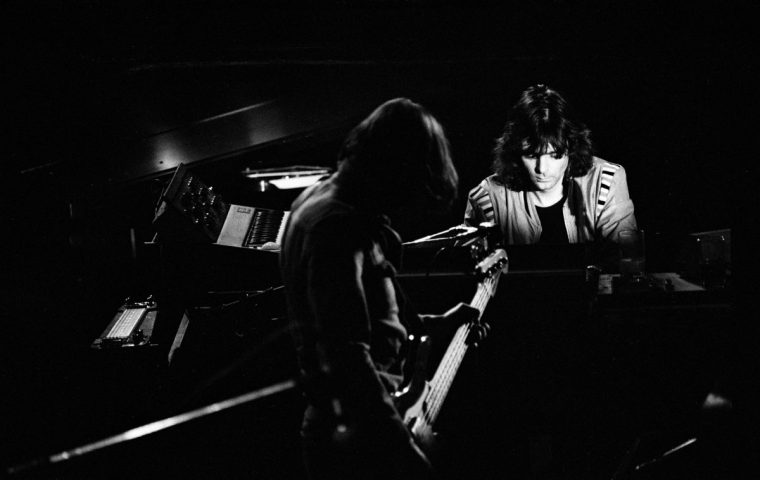 The band were shaken by Barrett’s absence (Photo: Storm Thorgerson/Sony Music Entertainment)
The incredible success of The Dark Side of the Moon – 45 million album sales and counting – had taken Pink Floyd from cult band to rock aristocracy. It sat uneasily with them. In the aftermath they felt emotionally depleted, cynical and suspicious of their success and the industry at large, and with a looming question: what next? “It was the end,” Waters once said. “We’d reached the point we’d been aiming for since we were teenagers. There was really nothing more to do.”
Gilmour concurred, later saying: “The success… scared us. You do start thinking, was that a fluke?” In hindsight, it was the moment the band began to rupture. “In 1975 they were still tight as a band and very friendly, but the money had allowed them to drift apart as a unit,” Powell says. “The success and the money – it was overwhelming. It allowed them to have separate lives.”
It seemed it was Waters who felt the most disenchanted. “That’s true,” Powell says. “Roger’s always liked fame, and he’s always liked money. But nevertheless, he at that time was definitely disillusioned with the way that record companies ran. And I think he was slightly confused by The Dark Side of the Moon’s success. And being Roger, all he could do was write about it in his lyrics.”
It made the process of writing and recording Wish You Were Here protracted and arduous. “After Dark Side we really were floundering around,” Gilmour later said. Pink Floyd actually began work on a follow-up to Dark Side in October 1973, when they started an album they called Household Objects, which was as literal as it sounds: they were writing songs using everyday appliances as instruments. The idea was soon ditched, but the sound of wine glasses can be heard in the introduction to “Shine On You Crazy Diamond”.
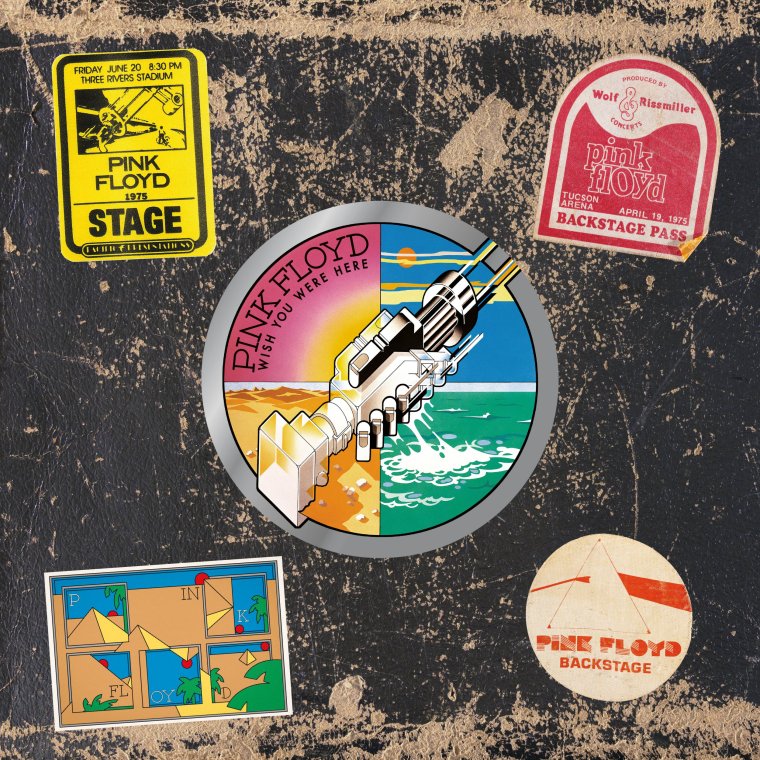 The album was recorded between tours (Photo: Sony Music Entertainment)
The band were in and out of the studio between tours of the US and Europe that proved difficult. In November 1974, the famous rock critic Nick Kent wrote a scathing review of their show at Wembley Arena, particularly the new songs “Raving And Drooling” and “Gotta Be Crazy,” saying Pink Floyd “seem incredibly tired and seemingly bereft of true creative ideas”.
After three months of no headway at Abbey Road, in March 1975, Waters called an emergency meeting to clear the air. Deciding to scrap the new songs other than “Shine On Your Crazy Diamond”, he told the band they needed to write some new songs that “have some relevance to the state we were in at the time”. They then wrote three songs that made up the rest of the album. “Have a Cigar”, with Roy Harper on vocals due to the song being beyond Waters’ vocal range, was a diatribe against the record industry, which included the sarcastic line: “Oh by the way, which one’s Pink?”
“That is a true story,” Powell says. ‘The band went to Capitol Records in LA and walked into the managing director’s office and he said, ‘Oh, hi guys. By the way, which one of you is Pink?’ I mean, that’s how removed the labels were in those days.”
The title track became one of the band’s most loved songs, the most straightforwardly beautiful and mournful Pink Floyd ever got. Again, the ghost of Barrett is evident, but the song goes further: Waters once said the song was “battling elements within myself”, which included the separation from his first wife, Judith.
Wish You Were Here’s themes extended to the album cover, iconic even in an era of classic – and expensive – artwork: two businessmen shaking hands, with one of them on fire – literally. Powell says for previous Pink Floyd covers, he and Thorgerson would never listen to the music or read the lyrics before creating it. But Wish You Were Here was different. “In this case, we’d been to Abbey Road and heard the record and knew what the thing was about.” He recalls how during creative brainstorming, the artist and Hipgnosis collaborator George Hardie made an off-the-cuff comment. “He just happened to say, ‘In business, somebody’s always getting burnt.’ That gave Storm the idea.”
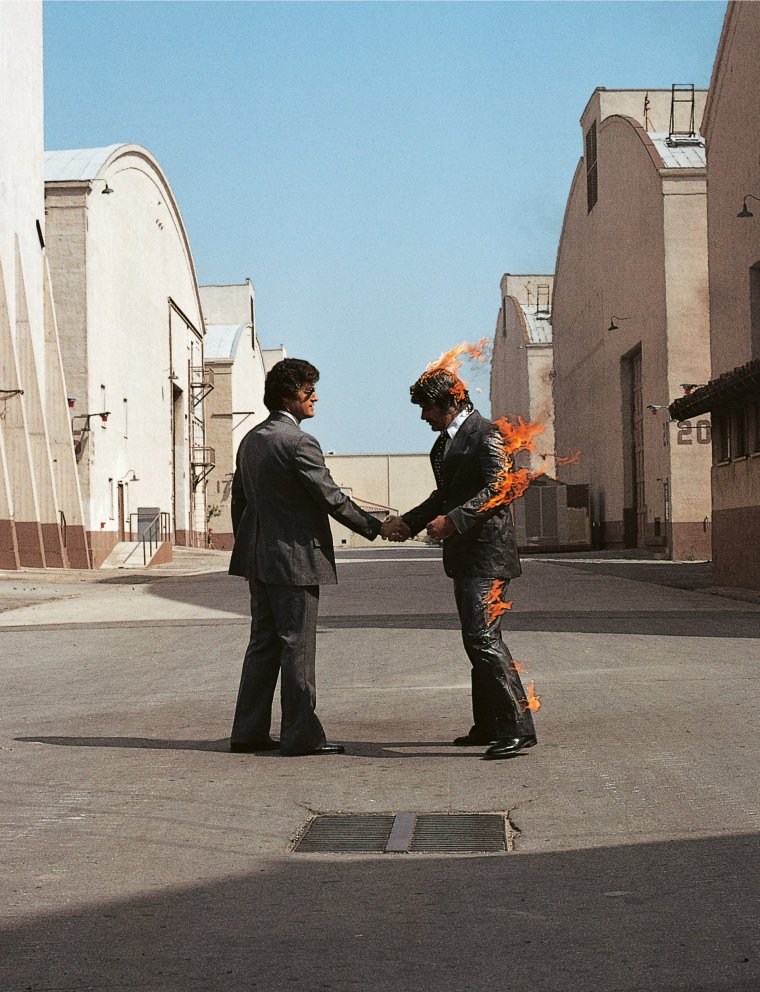 The iconic album artwork cost £50,000 (Photo: Sony Music Entertainment)
Waters made them present the idea to not just the band, but the entire staff of Abbey Road, cleaning ladies and all. “We were very nervous. At the end of it, everybody gave a big round of applause.” Why do you think Waters did that? “This is typical Roger. Roger is Roger – there’s no accounting for why he does things.”
But it presented Powell with a problem. “I said, ‘How the f**k are we going to do this?’ Because there was no digital apparatus in those days. And Storm said, ‘Well, we’re just going to set a man on fire.’” Stuntman Ronnie Rondell Jr, who’d made the 1974 film The Towering Inferno starring Steve McQueen and Paul Newman, agreed to do it, with the shoot taking place at the backdrop of Warner Bros studios in Burbank, California.
After trying having Rondell run towards him (“it looked shit”) they eventually decided to have him shake hands with another man while his back was on fire. “He said, ‘This is a dangerous stunt.’” They dressed him in a special asbestos suit with napalm. “It was very dramatic. After the 15th time, the wind came up and blew his face and singed his moustache. He said, ‘Right I’m done.’ He was furious.”
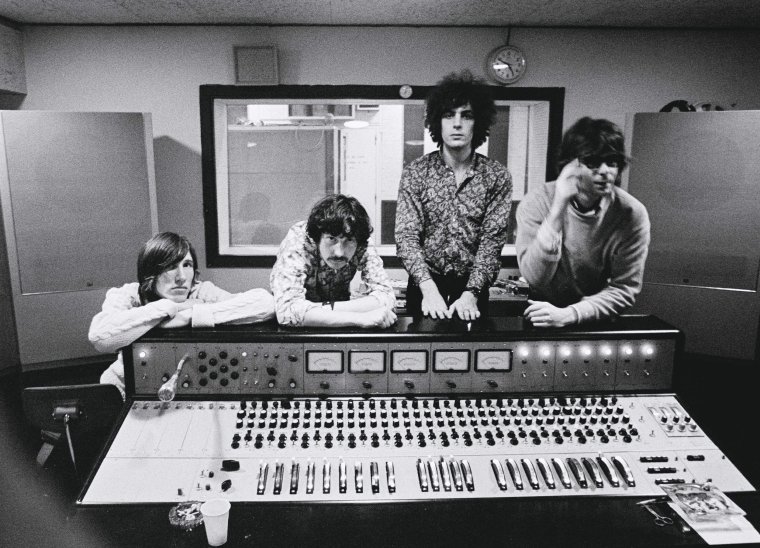 From left, the band in Barrett’s era: Roger Waters, Nick Mason, Barrett and Rick Wright (Photo: Andrew Whittuck/Redferns)
But Powell had his shot. He added some similarly thematic (and expensive) shots to the inner sleeve, most famously a man diving into Mono Lake in California. “That is about absence, because he’s making the perfect dive, but there’s no splash. Then there’s the invisible businessman, who’s very representative of the record company.” The album cover cost a staggering £50,000. “Budgets were unlimited in those days,” Powell says. Yet the album first went on sale in the shops with the record cover hidden from view, wrapped in black shrink-wrap. “The record company went apoplectic,” Powell smiles. “But it was the ultimate symbol of absence.”
When it was finally released into the world on 12 September 1975, Wish You Were Here was given a mixed reception. While there were some good reviews – Sounds magazine heralded it as “light years better than The Dark Side Of the Moon” – others were less positive. “Wish You Were Here sucks!” was Melody Maker’s verdict.
But Pink Floyd had won the people over: Wish You Were Here topped the charts in both the UK and America, and has now sold more than 23 million copies. And retrospective consensus heralds it as a classic (in the new 50th-anniversary box-set reissue, Poet Laureate Simon Armitage writes a poem in tribute).
It is often thought of as the last truly cohesive record Pink Floyd made. “I think that is true,” Powell says. “Because they went on to make Animals, which was, without any doubt, Roger’s complete invention. And Roger and the band at that point was becoming rather fractious. And it is a magnificent record. It is one of the most important records Pink Floyd ever made.”
‘Wish You Were Here 50‘ is out on Friday
Your next read