

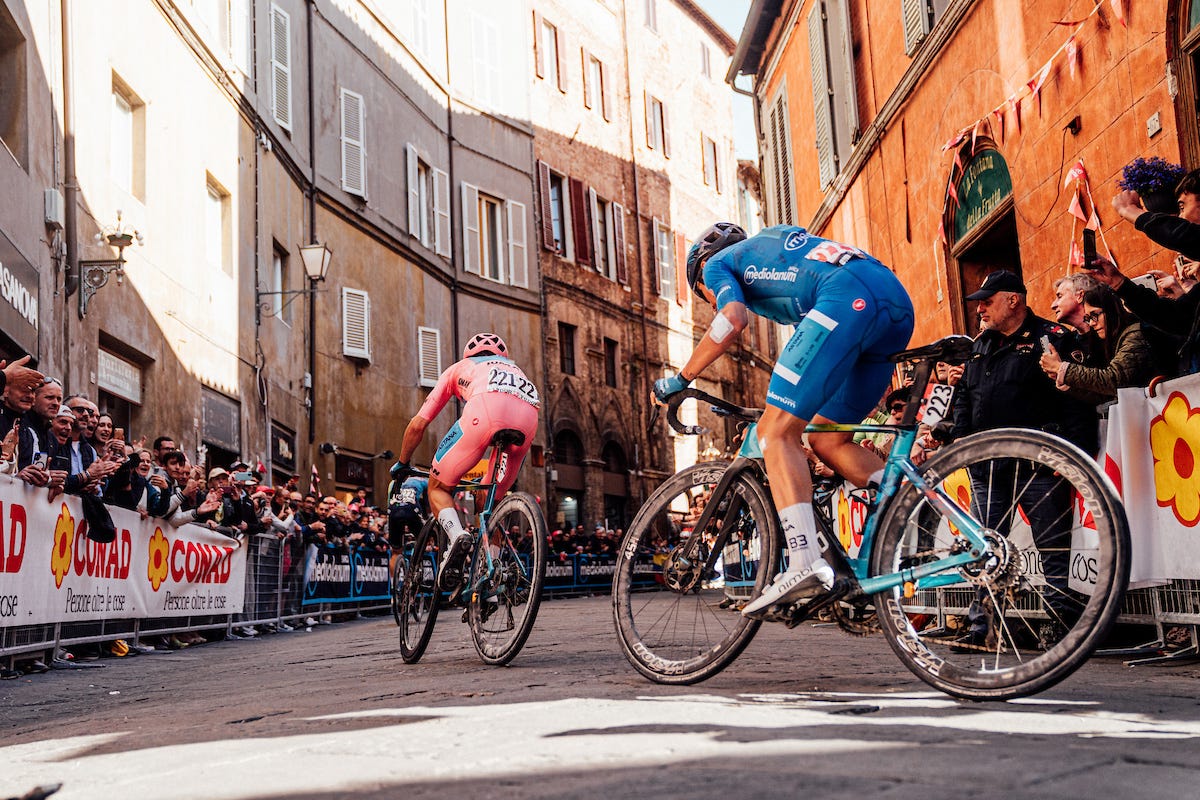
 XDS Astana saved their WorldTour status in 2025. Photo courtesy of SWpix.
In 2009, the Tour Series was launched in the UK. It featured city centre criterium racing with a unique twist: the winner at each event wasn’t the rider with their arms raised, but rather the team with the three best-placed riders across the line.
Nice idea.
Different, I suppose.
The riders did try for a while to make this format work, too. The tactics in the race were all about increasing numbers up front. It didn’t matter if you had the best or fastest rider in the break. If he was outnumbered, then it was a bad situation that you needed to resolve.
If there were equal numbers from each team in the break (the case more often than not, as it was the only combination anyone allowed to go down the road), then you had to work out ways to pack the rest of the available placings that night with the rest of the team.
Part one: 🚨 Ranking the top 100 cycling transfers ahead of 2026 – Nos 100-71
Part two: 🚨 Ranking the top 100 cycling transfers ahead of 2026 – Nos 70-41
Follow me on: Twitter 🟢 — Instagram 🔴 — Bluesky 🔵
Like I said, nice idea. It was fun. But it didn’t work. People wanted to see a rider lift his hands as the winner, be happy they saw a race, and go home and forget about it. What they did not want to see was a rider win, raise his arms (you can’t help it), and then be told that he actually wasn’t the winner, as three riders finished 5th, 6th, and 9th behind him.
The Tour Series is dead now. RIP. But I do wonder if, as teams become much, much more sensitive to the UCI points system, we will soon see this sort of nonsensical tactical stalemate racing take up a large part of the UCI calendar.
The UCI points system is now very much a thing. We’ve already arrived at the point where we’ve learned that it doesn’t matter who isn’t happy about it, nor does it matter if there are glaring issues, or even if the UCI moves the goalposts mid-cycle – the system relegates teams and moves into its next cycle.