
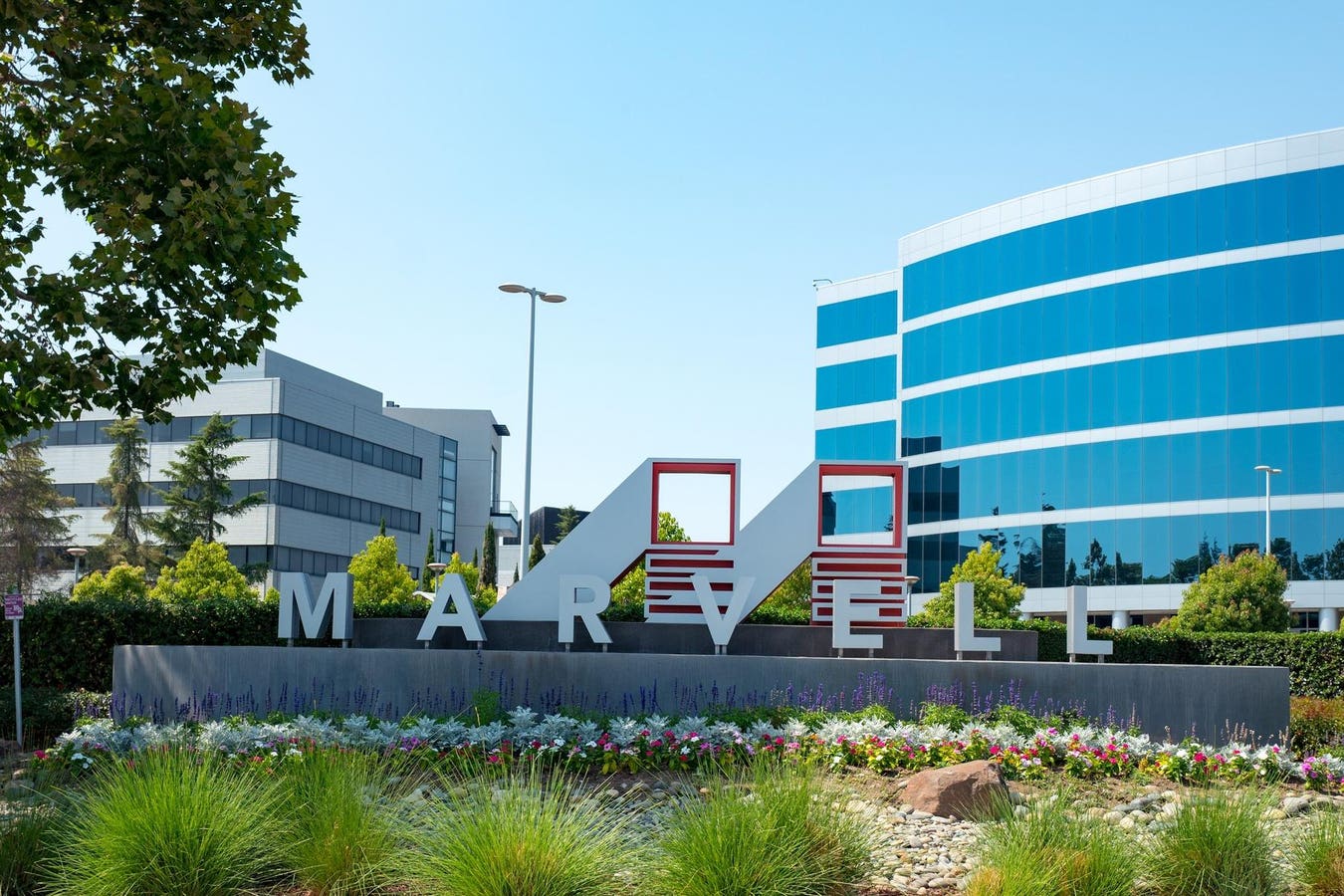
Monday served as a harsh reminder that in the semiconductor industry, customer concentration is a double-edged sword. Just a few days after Marvell Technology (MRVL) celebrated a blowout earnings report driven by AI demand, the stock shed 7% in a single session.
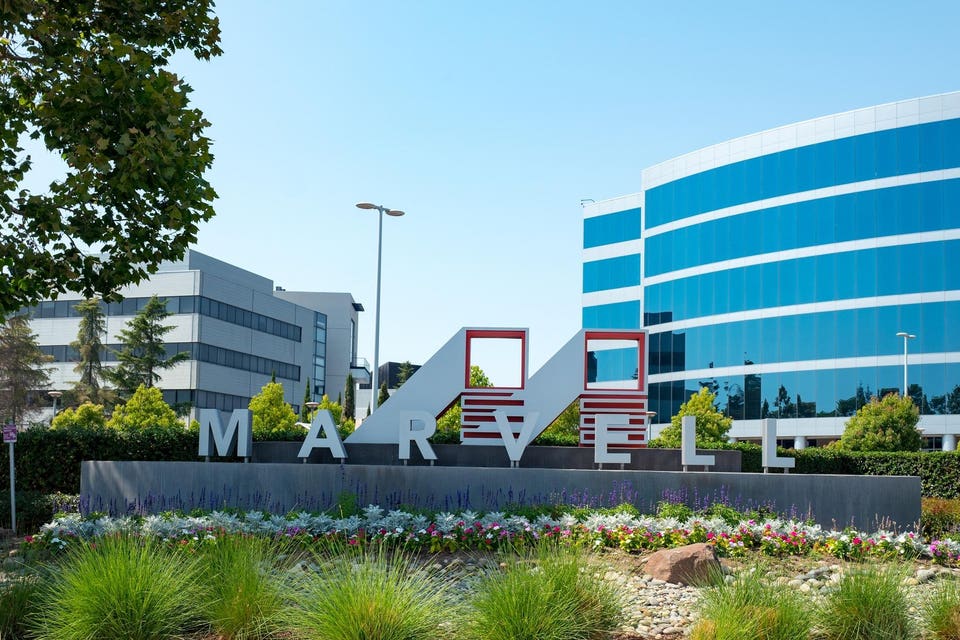
Signage with logo at the Silicon Valley headquarters of semiconductor company Marvell, Santa Clara, California, August 17, 2017. (Photo via Smith Collection/Gado/Getty Images).
Getty Images
The original catalyst—a report suggesting Microsoft is in discussions with Broadcom to co-design future custom AI chips—was quickly eclipsed by a more definitive threat: a key analyst downgrade citing the likely loss of Amazon’s next-generation Trainium chips. Separately, see NVDA Stock: High Valuation, High Growth, And High Risk?
For investors, the confluence of these two events strikes a major blow to the core bull thesis. Marvell has long positioned itself as the “Switzerland” of silicon—the neutral, flexible alternative to Broadcom’s “Landlord.” If the company is facing setbacks with two big hyperscaler custom silicon customers (Amazon and Microsoft), the custom chip growth story is in serious jeopardy.
Let’s strip away the panic and analyze the structural reality of this potential shift.
The “Switzerland” Strategy Under Siege
To understand why the market reacted so violently, you have to understand Marvell’s specific role in the AI ecosystem.
The Positioning: Broadcom is known for being aggressive and restrictive with its IP. Marvell markets itself as the flexible partner that allows Hyperscalers (like Amazon and Microsoft) to retain more control over their chip designs.The Threat: Marvell’s growth premium was built on the expectation that it would win the “Non-Google” custom silicon market. This expectation was fundamentally anchored by its role as the lead partner for Amazon’s Trainium chips and a strong position with Microsoft’s Maia chips. Amazon was the primary customer for Marvell’s XPU business.The Shift: The reported loss of the next-generation Amazon Trainium 3 and 4 chips to competitor Alchip is a tangible breach of the “Switzerland” thesis and strikes at the heart of Marvell’s custom revenue base. It suggests that flexibility alone is insufficient, and Hyperscalers are prioritizing the best technology/execution across multiple ASIC houses.
Valuation: Pricing in a Duopoly, Not a Monopoly
Following Monday’s correction, Marvell’s valuation has compressed, widening the gap with its rival.
Marvell Price-to-Sales: 10x.Broadcom Price-to-Sales: 30x.
The Analysis: The market is actively discounting Marvell because its revenue is “lumpier” and less guaranteed than Broadcom’s.
The Bull View: At 10x sales, Marvell is priced as a standard semiconductor supplier. However, its Data Center revenue grew 38% last quarter. If the rumors turns out to be a “Second Source” strategy (using both suppliers) rather than a replacement, the stock could be mispriced relative to its growth.The Bear View: If Marvell loses the next generation of Microsoft’s “Maia” chip to Broadcom, its custom silicon revenue could flatten, justifying the discount.
The Strategic Reality: Why Hyperscalers Need Dual-Sourcing
While the headlines regarding both Amazon and Microsoft are scary, the core business logic for all Hyperscalers suggests a “Winner Takes All” outcome is highly unlikely. We must analyze the fundamental Customer Incentives that drive their custom silicon strategy.
The “Hostage” Problem: Hyperscalers (AWS and Azure) are already heavily dependent on Nvidia for the most powerful GPUs. The entire point of spending billions on custom chips (Trainium, Maia) is to gain leverage and reduce this dependenceThe Risk of New Monopolies: Hyperscalers must avoid simply trading one monopoly for another. If Microsoft were to rely 100% on Broadcom (notorious for aggressive pricing leverage, as seen with VMware), it would create a new, similar pricing risk. Likewise, Amazon may not solely rely on Alchip for Trainium 3/4, forcing it to maintain viable relationships with other ASIC houses like Marvell to ensure supply chain resilience and prevent any single supplier from gaining excessive pricing power on future designs.The Incentive: It is in the existential interest of both Amazon and Microsoft to keep Marvell (and other players like Alchip) alive and thriving. They need a viable #2 and #3 player to force price competition, ensure supply chain resilience, and diversify technological risk.
The Optical Firewall
It is also critical to remember that “Custom Silicon” is only half of Marvell’s AI story. The other half—Optical Connectivity—remains untouched by this rumor.
Marvell dominates the market for DSPs (Digital Signal Processors) inside optical cables. Even if Microsoft buys chips from Broadcom, they could likely still connect them using Marvell’s optical DSPs, especially as data center speeds move to 1.6 Terabit.
The Moat – While compute sockets (chips) are highly contested, the connectivity layer has higher barriers to entry. This segment provides a defensive floor that the market ignored in yesterday’s sell-off.
Our Take
The 7% drop in Marvell could turn out to be a knee-jerk reaction to a “headline risk” that fundamentally misunderstands Hyperscaler strategy.
The concern surrounding the custom silicon market is likely overblown. The long-term trend could be that giants like Amazon and Microsoft will shift toward a Dual/Multi-Sourcing model. The strategic rationale to prevent monopoly pricing (from the likes of Broadcom or Alchip) ensures that these Hyperscalers have an existential incentive to keep Marvell’s custom business alive as a crucial, balancing partner.
Moreover, the investment’s big upside remains untouched: Marvell is seen as one of the primary beneficiaries of the “Optical Supercycle.” This high-margin business, completely insulated from the custom chip competition, provides the defensive floor for the valuation.
By removing the “perfection” premium from the stock, this pullback offers a compelling opportunity. For investors focused on the infrastructure build-out, Marvell at $85-$88 represents a more attractive entry point into the optical monopoly, even if the custom silicon market sees some headwinds.
The Best Investors Think In Portfolios
Stocks soar and sink – the key is staying invested. A balanced portfolio keeps you in the market, boosts gains and reduces single stock risk.
The Trefis High Quality (HQ) Portfolio, with a collection of 30 stocks, has a track record of comfortably outperforming its benchmark that includes all three – the S&P 500, S&P mid-cap, and Russell 2000 indices. Why is that? As a group, HQ Portfolio stocks provided better returns with less risk versus the benchmark index; less of a roller-coaster ride, as evident in HQ Portfolio performance metrics.