
This story is being published as part of an investigation into the UK Government bankrolling fossil fuel projects in Africa, which you can read in full here.
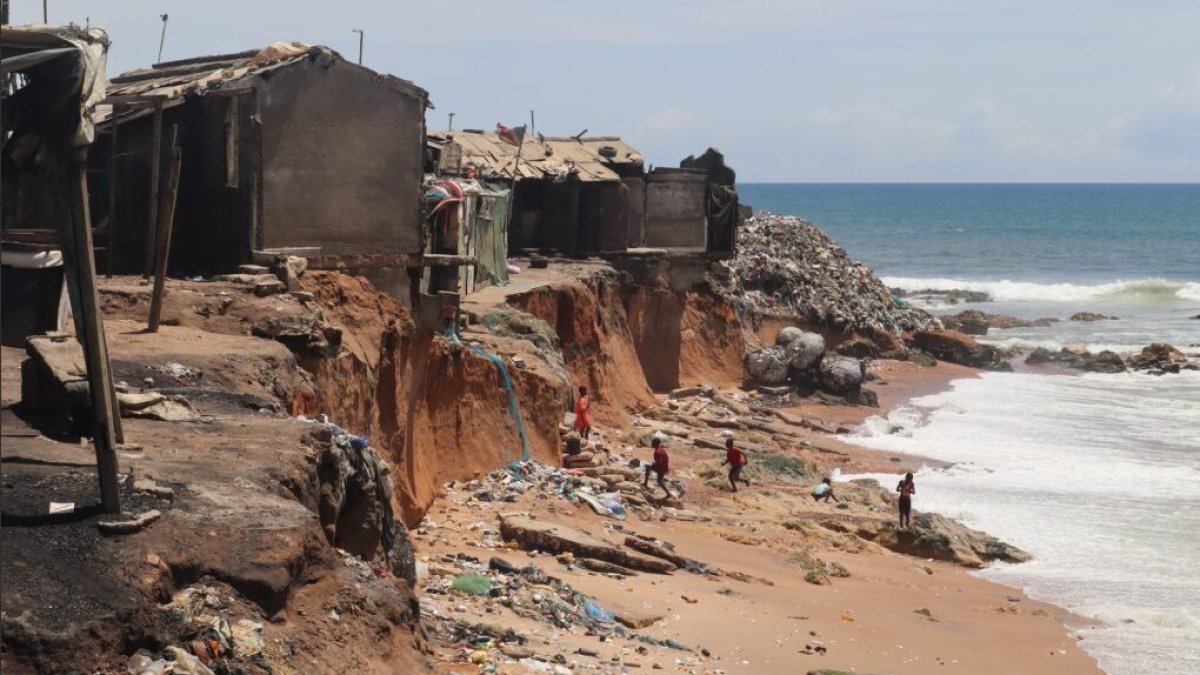
Along the coastline of Awudum, a suburb in south-eastern Ghana, houses balance precariously over a slope, waiting to be swallowed into the Gulf of Guinea.
“This is the main street of the town,” says Emmanuel Davies. 28, pointing to a road just metres from the edge. “The sea is coming.”
Davies is one of thousands of Ghanaians who have lost their homes to coastal erosion and storm surges in recent years.
Locals say the problem has been exacerbated by the expansion of an industrial port that sits a couple of miles along the coastline. The expansion includes a new gas import terminal, partly funded by the British Government.
The i Paper travelled to Awudum as part of an investigation into the UK’s fossil fuel investments in Ghana, and discovered the devastating impact climate change is having on coastal communities.
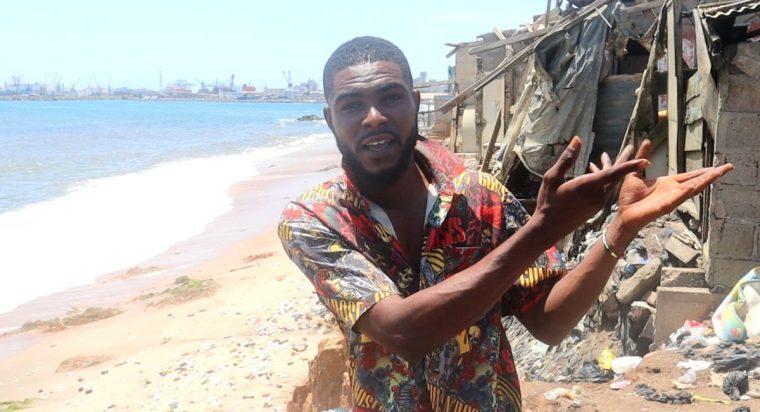 Emmanuel Davies lost his home in Awudum due to coastal erosion (Photo: Sulley Lansah)
Awudum is a suburb of the city of Tema, Ghana’s industrial hub, and has a view of the country’s largest port, which giant shipping containers pass in and out of every day. The rising sea level due to climate change is the key driver behind the destruction there.
‘The sea has spoiled everything’
Standing on the spot where he once lived, Davies is now surrounded by litter and rubble. Below the cliffs, children play on the beach in the shadow of the half-destroyed buildings that teeter over the edge.
“If it falls down he or she will die,” Davies says, gesturing below. “That’s why I don’t have a kid, because of my area.”
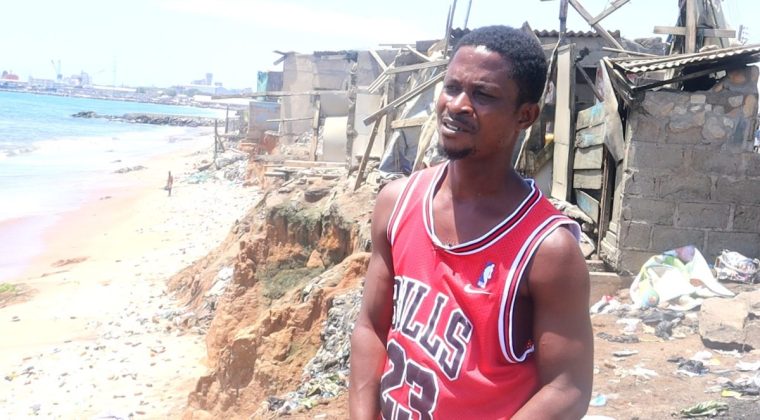 Isaac Quansah says the erosion has threatened people’s livelihoods (Photo: Sulley Lansah)
“It’s more than 100 houses that we lost here,” says Isaac Quansah, 35, who has also watched his home fall into the sea.
Despite its proximity to heavy industry, fishing remains the main source of livelihood for this community, but this is being threatened.
“This is where my grandmother used to smoke fish,” Davies says, pointing to a former communal site that has been destroyed. Smoking fish, including mackerel, catfish and tuna, is a major source of livelihood for women in Ghana.
Quansah says the loss of these sites is a serious concern in a community without access to refrigeration, where there is no other way of preserving their main source of protein. “When the fish comes there’s nothing we can do. Some of them get spoiled without any good use,” he says.
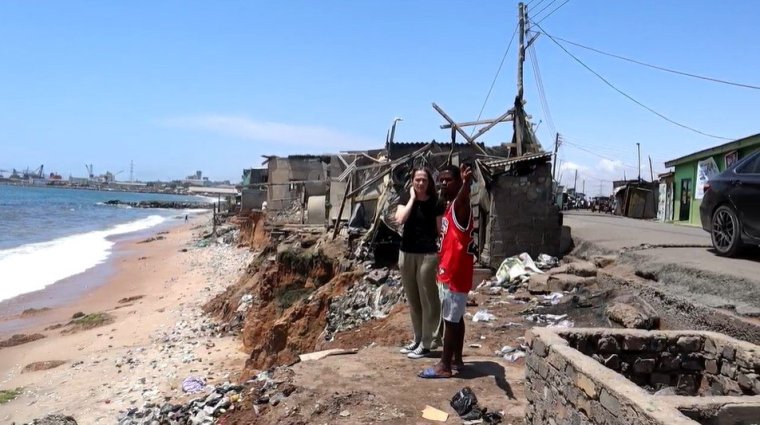 Isaac shows The i Paper the devastation caused by coastal erosion in Tema (Photo: Sulley Lansah)
Coastal erosion has been a growing problem here for decades, with rising sea levels pushing waves further inland, grinding beaches away at an aggressive rate. Heavy rainfall has weakened the foundations of the homes in Awudum, Davies explains, making them more liable to collapse when battered with heavy tidal waves.
Quansah believes climate change is playing a role in the community’s demise. “Everything depends on the weather,” he says.
Thousands of people displaced
Awudum is one of dozens of communities in Ghana facing an existential threat due to rising sea levels. Around a quarter of the country’s 35 million population lives near the coast, which is eroding at an average rate of two metres per year, according to a report by Unesco. Some areas have recorded up to 17 metres of erosion in a single year.
In 2021, the village of Fuveme, about 100km east from Awudum, lost 200 buildings, including a school, following a tidal surge.
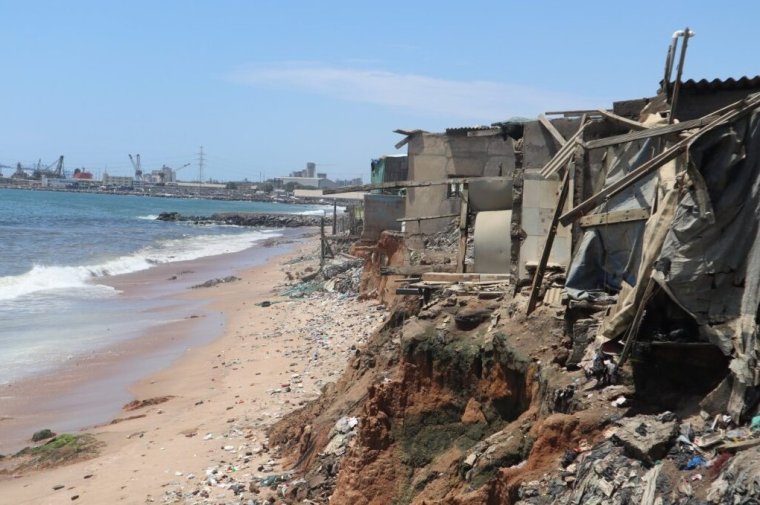 Crumbling cliffs are a danger to local people (Photo: Sulley Lansah)
Cultural heritage sites are also under threat. Two slave-trading forts built by Danish traders in the 18th century, Fort Kongenstein and Fort Prinzenstein, are heavily affected by coastal erosion. The same fate awaits several other landmarks, including the Cape Coast Castle.
‘Global South countries need assistance’
The fate of Ghana’s coastal communities illustrates how developing countries bear the brunt of climate change despite contributing little to greenhouse gas emissions.
At this year’s COP30 conference in Brazil, African nations called on rich countries such as the UK to boost the amount of money they provide developing countries to help them adapt to climate change.
“There is simply no way that many Global South countries can adapt their economics and societies to climate change without assistance,” says Nick Dearden, director of Global Justice Now.
However, the UK has resisted calls to increase funding for developing nations and will slash its international aid budget to 0.3 per cent of GDP.
A spokesperson for British International Investment (BII), which is owned by the UK Foreign Office and has funded power plants and pipelines in Ghana, said: “BII is a global leader in tackling the climate emergency in emerging economies. Our climate finance portfolio is now four times the value of those legacy fossil fuel assets.”
The Ghanaian government has built several sea defence projects along the coastline in recent years, and work is under way on a major five-mile project to protect towns in the vulnerable south-eastern coastal area. Some of these schemes have received funding from the World Bank.
However, with roughly 340 miles of heavily populated coastline, the country is struggling to keep pace with the threat.
Quansah says: “If there’s nothing done fast I don’t know what will happen.”