
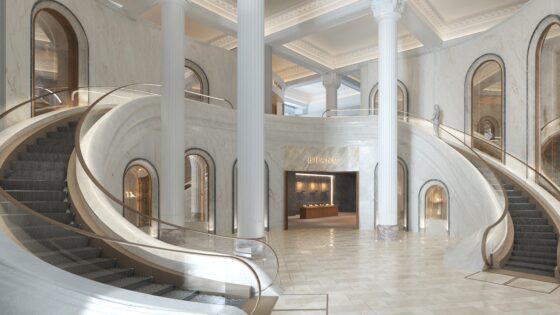
The scheme for the Grade II*-listed landmark on Brompton Road was given consent by Kensington and Chelsea council through delegated powers earlier this month.
Make’s multi-million pound proposals include major internal alterations to the existing watches and jewellery departments, which will be combined and expanded.
That requires the creation of a double-height space, new retail areas and new partitions inside the two sections of the Charles William Stephens-designed building.
The consented scheme also features new portals, refurbished columns and the reinstatement of a heritage-inspired ceiling, entrance doors, a decorative mosaic floor and external elements.
More space will be created for the watch and jewellery department through the lowering of the ground floor slab and relocation of back-of -house facilities to a sub-basement area. This will leave room for new customer lifts.
Make says the centrepiece of the development will include the first curved escalators outside of the United States and Asia, which the practice describes as a ‘a striking architectural centrepiece that reflects a commitment to innovation within a heritage setting’.
The practice has a long-running relationship with Harrods, including refurbishment of the Basil Street Escalator Hall, Grand Entrance Hall and restoration of the façade.
Katy Ghahremani, director at Make and project lead, said: ‘We are pleased to have worked alongside Harrods, Historic England and conservation officers at the Royal Borough of Kensington and
Chelsea to celebrate Harrods’ Edwardian heritage while enhancing and upgrading the current fine jewellery and watches department for future use.
‘Make’s reimagined design of the Grade II*-listed building creates an impressive sense of arrival, emulating the original Edwardian sales rooms. We are reintroducing new double-height halls and creating a sequence of spaces that can be read as a series of rooms, while providing Harrods with the individual brand boutiques that form an essential part of modern-day luxury retail.’
Construction is expected to begin in 2026.