
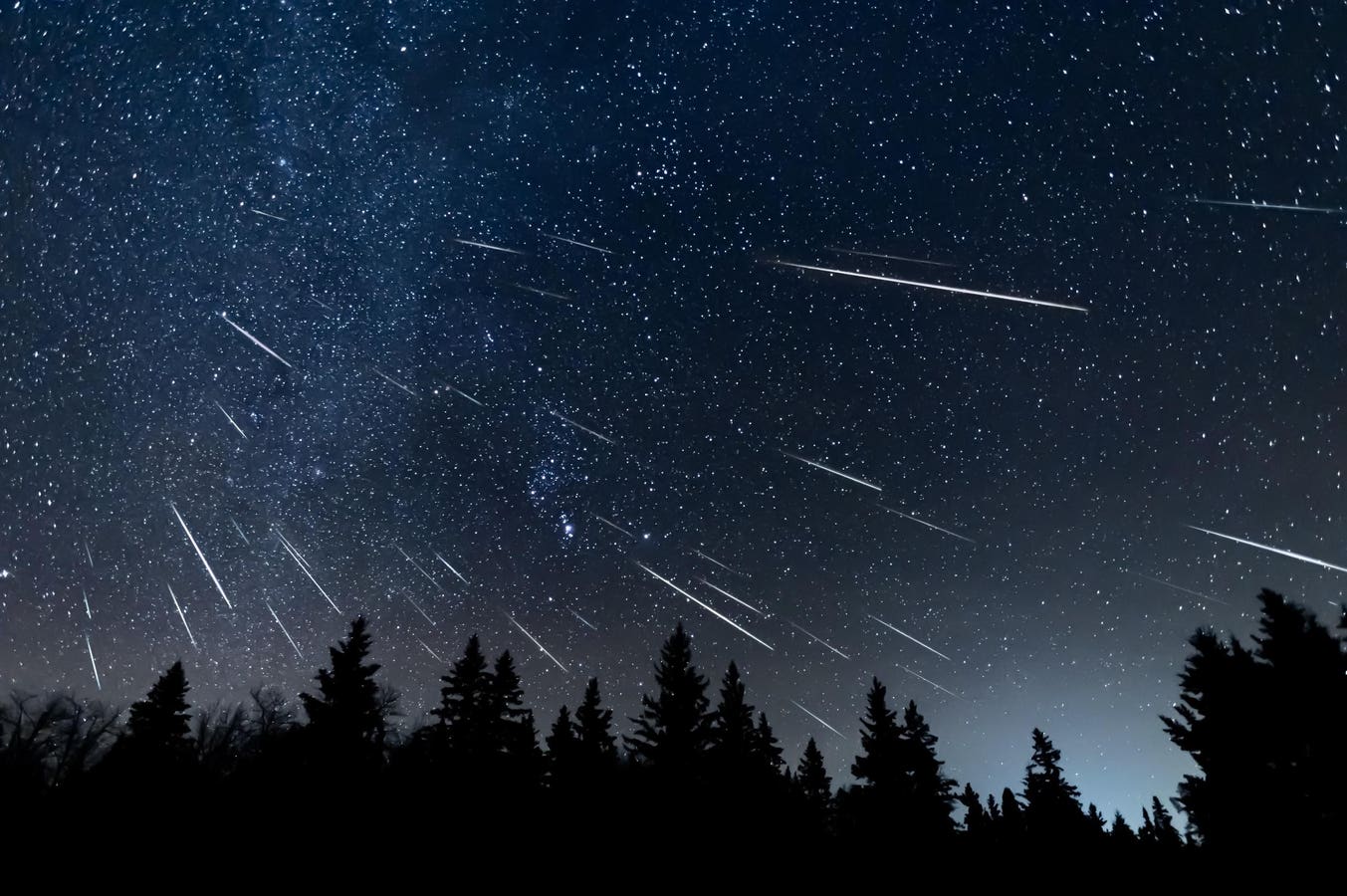
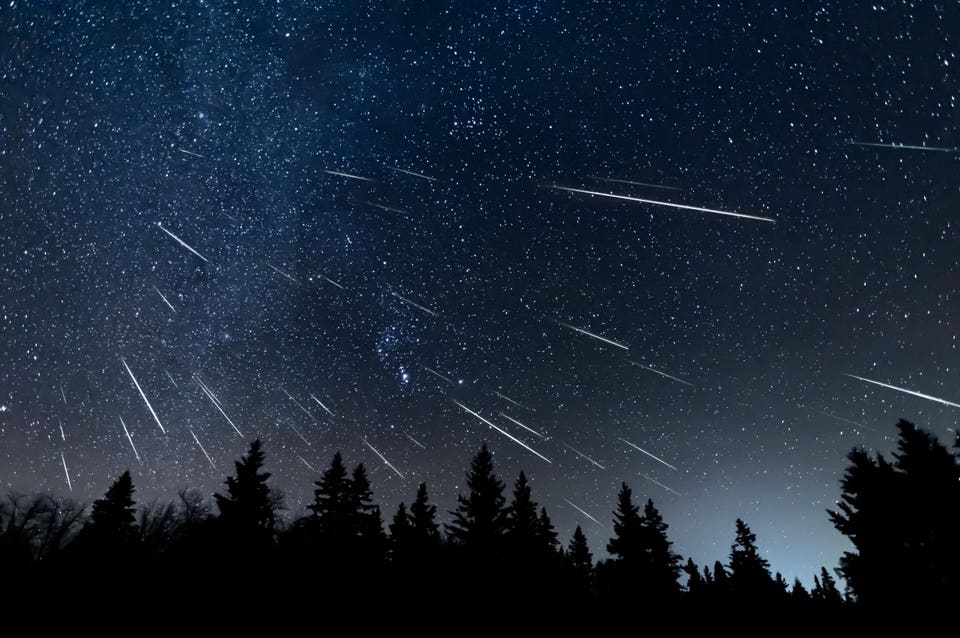
A composite photo from the Geminid meteor shower, which peaks overnight on Saturday and Sunday, Dec. 13 and 14, 2025
getty
When is the Geminid meteor shower? The most prolific and impressive display of “shooting stars” will peak overnight on Saturday and Sunday, Dec. 13 and 14, giving skywatchers the chance to see up to 100 meteors an hour under perfect conditions. There will also be a bonus view of bright planet Jupiter shining in the shower’s radiant constellation.
A “shooting star” is a meteor that burns up in the Earth’s atmosphere after striking it at about 22 miles/sec (35 kilometers/sec). As the particles glow brightly before being destroyed, a streak of light lasting a split second is seen from Earth. As a bonus, Geminids tend to be colored — typically greenish, but sometimes blueish and yellowish.
ForbesWhat That Bright ‘Christmas Star’ In The East Really IsBy Jamie CarterGeminid Meteor Shower Explained
First observed in 1862 and thought to be intensifying every year, the Geminids — caused by an asteroid rather than a comet — are one of the best and most reliable annual meteor showers. In theory, up to 150 per hour can be seen at the peak, though in practice it’s less due to the limits of human peripheral vision as well as less-than-dark night skies.
“You can expect to see perhaps up to 100 meteors an hour, so that might be one or two a minute, which would be a brilliant view — it is one of the strongest showers of the year,” said Dr. Robert Massey, deputy executive director at the Royal Astronomical Society in London, in a video explainer. “The great thing about a meteor shower, including the Geminids, is that the naked eye is the best way to see them … you want to be lying down, looking up at the broad panoply of stars, and watching for meteors.”
Geminid meteors can flash into view anywhere in the late-night sky. But if you follow their paths back far enough, they all appear to diverge from a point in the constellation Gemini. The meteors’ perspective point of origin is called the shower’s radiant. The planet Jupiter shines brilliantly not too far from the radiant. Don’t expect to see several meteors at once! This diagram is meant only to show their divergence from the radiant point.
Sky & Telescope diagramGeminids: What Time To See The Most Meteors
Conditions for viewing the Geminids in 2025 are almost perfect. Meteor showers tend to be at their best when the radiant point — in this case, the constellation Gemini — is highest in the darkest sky. That’s about 10 p.m. through 2 a.m. local time. Given that a 25%-lit crescent moon will rise around 2 a.m., that gives three strategies for seeing the most Geminids, according to Robert Lunsford at the International Meteor Organization.
1. Watch for ‘Earthgrazers’ as soon as it becomes dark
Although rates will be at the lowest point of the night, those you see will likely skim the atmosphere, making them visible for longer. The later you stay up, the more you’ll see and the faster they’ll become. “Face eastward and expect most of the long earthgrazers to appear low in the northern and southern sky, shooting toward the west,” Lunsford explained.
2. Observe until 10 p.m.
By this time, expect around 30 Geminid meteors per hour — if you face toward the east.
3. Observe from midnight to 4 a.m.
At around 2 a.m., rates will peak, with up to 60 meteors seen per hour in a dark rural night sky, but dropping off as the moon rises in the east and the constellation Gemini sits in the western sky.
Meteor showers often appear strongest in the pre-dawn hours, when Earth is rotating into the direction of the oncoming particles as at left in the diagram. On the “sunset” side (at right), the particles strike Earth’s atmosphere at slower speeds.
Sky & Telescope diagramGeminid Meteor Shower: Observing Tips
It goes without saying that you’ll need to keep warm, hydrated and observe in bursts. Moving around can stave off the cold when outside for long periods. But the only other thing you really need is patience. “Meteor-watching is easy — you need no special equipment other than your eyes,” said Edwin L. Aguirre, associate editor at Sky & Telescope. “But you’ll see more of them if you allow at least 20 minutes after going outside for your eyes to adapt to the darkness.”
Geminids are easy to recognize. You’re looking for “a short streak of light that generally lasts maybe half a second or so,” said Massey. “It’s usually so quick it’s impossible to point out to someone you’re with, so you need to keep your eyes up.”
If you can, travel to avoid two things: clouds and urban glow. You can escape the latter by heading about 40 miles from urban areas to somewhere that looks dark on a light pollution map, or simply find a park using the Dark Sky Place Finder. Check weather forecasts before you head out because you’ll also need a completely clear sky.
Forbes600 Days To The ‘Eclipse Of The Century’ — How To Plan A TripBy Jamie CarterHow To Photograph The Geminid Meteor Shower
“Shooting stars” are way too fast to take out a smartphone and photograph one, but anyone with a DSLR or mirrorless camera with manual controls can easily try. With a tripod and a wide-angle lens (14–35mm) set to f/2.8 or wider, spend a while framing a great image of the night sky. Try ISO 1600–3200 and a shutter speed of about 25 seconds, remembering to focus manually on a star (or using the infinity setting on the dial, if that works for your lens). Point your camera east or overhead and let it continuously shoot for at least an hour or two. Check test shots for sharp stars and exposure balance — then just leave it to take shot after shot (use the built-in time-lapse feature, a wired shutter release cable on lock or an intervalometer).
After the shoot, scan your frames for meteors and consider stacking them into a composite image using free tools like StarStaX to show multiple meteors in one scene, as well as a star trail.
What’s Next In The Night Sky
If clouds ruin the Geminids, the (albeit less impressive) Ursid meteor shower offers another chance on Dec. 21, peaking after dark and coinciding with the winter solstice.
Wishing you clear skies and wide eyes.