
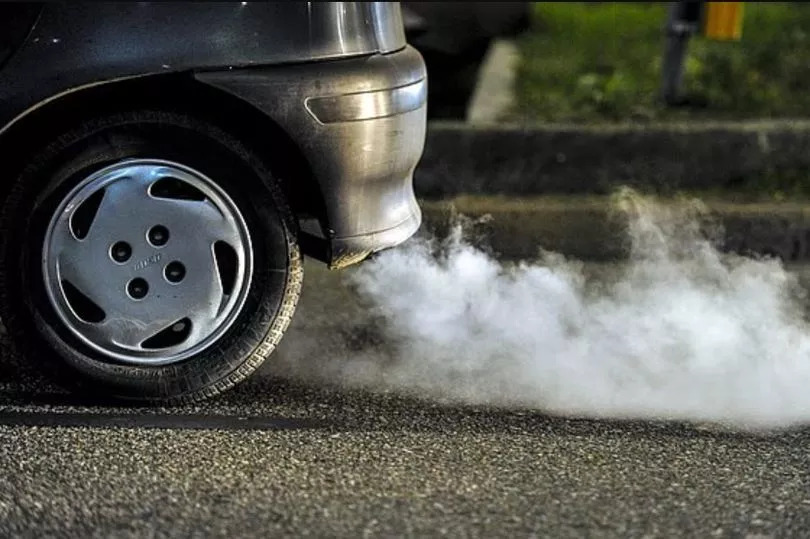
Households with cheaper cars are ‘contributing disproportionately to their local urban air quality problems’, according to a new study. Scientists from the University of Birmingham said the findings ‘reverse the usual pattern’ where wealthy households typically cause more greenhouse gas emissions through higher consumption.
The newly-published report is based on analysis of over 50,000 vehicles being driven on UK roads. Scientists used ‘advanced remote sensing technology’ to measure real-time emissions on the city’s streets as motorists passed and combined this with ‘machine learning-based price estimation’ to make its calculations.
The report found that more expensive vehicles produced fewer harmful pollutants, including nitrogen dioxide (NO₂) and oxide (NOx), carbon monoxide (CO), and particulate matter (PM).
READ MORE Drivers face crackdown on rule councils previously had ‘limited power’ to enforce
Report co-author Professor Francis Pope said: “Our study provides the first clear evidence to support vehicle price being a reliable indicator of emission performance – powerfully illustrating how citizens’ economic capacity can directly influence environmental outcomes and urban air quality.
‘”Individuals from lower-income households may be more likely to own older, cheaper, and higher-emitting vehicles – contributing disproportionately to local air pollution.”
Report co-author Dr Omid Ghaffarpasand said: “Our findings underscore the need for targeted policy interventions to address environmental injustice.
“Lower-income communities bear the brunt of local air pollution due to limited access to cleaner vehicles – exacerbating health risks and pollution exposure in disadvantaged urban areas.”
A report by the International Energy Agency last year claimed expensive SUVs are responsible for ‘over 20 per cent of the growth in global energy-related CO2 emissions’ in 2023.
“If SUVs were a country, they would be the world’s fifth largest emitter of CO2,” it stated.
“[They] weigh 200 to 300kg more than an average medium-sized car, and typically take up nearly 0.3 m2 more space – emitting roughly 20 per cent more carbon dioxide.
“The trend towards heavier and less fuel-efficient cars increases energy demand, including oil and electricity use, as well as demand for basic metals and critical minerals needed for battery production.
“Over the course of 2022 and 2023, global oil consumption directly related to SUVs rose by a total of over 600,000 barrels per day, accounting for more than a quarter of the overall annual growth in oil demand,” it said.