

AG
Addleshaw Goddard
More

Addleshaw Goddard is an international law firm, almost 250 years in the making. We’re trusted by over 5000 organisations, including 50 FTSE 100 companies, to solve problems, deliver deals, defend rights, comply with regulations and mitigate risk. Our work spans more than 50 areas of business law for clients across multiple industries in over 100 countries worldwide. And while the challenges our clients bring us may vary, we approach and solve them with the same, single-minded focus: finding the smartest way to achieve the biggest impact.
The UK is progressing digital money regulation through several workstreams led by the Government, industry, and regulators.
United Kingdom
Finance and Banking
To print this article, all you need is to be registered or login on Mondaq.com.
Article Insights
Addleshaw Goddard are most popular:
within Environment, Media, Telecoms, IT, Entertainment and Privacy topic(s)
in United Kingdom
The UK is progressing digital money regulation through several
workstreams led by the Government, industry, and regulators. HM
Treasury and the Bank of England are considering a digital pound to
complement cash and deposits, aiming to boost the digital economy.
Industry collaboration is also underway, notably the Regulated
Liability Network initiative, which experiments with programmable
money for wholesale payments and settlement. Regulation of
cryptoassets and stablecoins has accelerated, with the Financial
Conduct Authority establishing a new regime for stablecoin issuers
and custodians in May, and the Bank of England publishing a
consultation paper in November outlining the proposed regulatory
framework for systemic stablecoins. This issue examines these
developments, key milestones, and future directions as the UK
continues to adapt to the challenges and opportunities presented by
digital money.
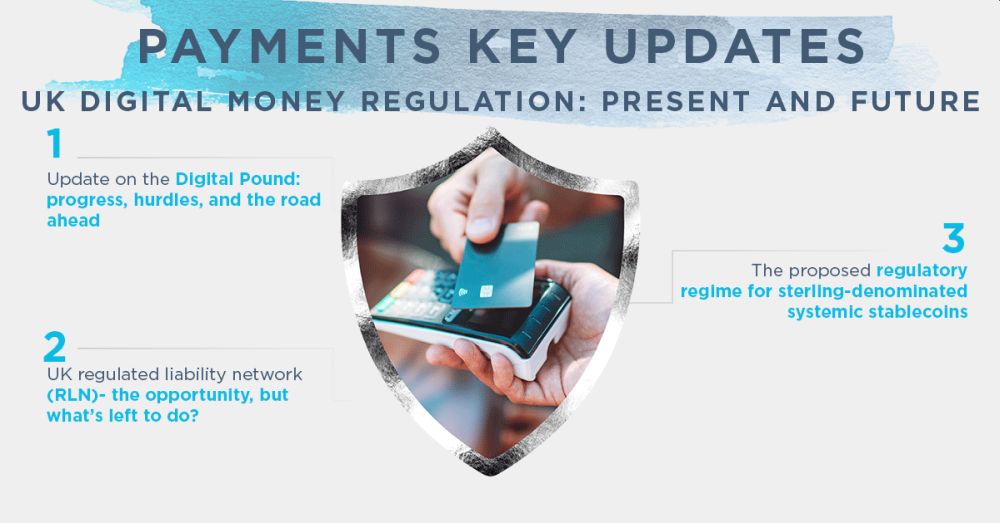
The digital pound: Progress, hurdles, and the road ahead
The Bank of England (BoE) and HM Treasury are actively
considering a digital pound to sit alongside cash and bank
deposits, aiming to boost the UK’s digital economy. This
forward-looking initiative is now in its design phase, with a final
decision on rollout anticipated after 2026, subject to new
legislation. In the article below, we delve into the latest updates
and strategic direction for the BoE’s digital currency plans.
We also spotlight the key challenges and opportunities this
development could present for businesses and financial
institutions.
UK regulated liability network (RLN)- the opportunity, but
what’s left to do?
The Regulated Liability Network (RLN) initiative is an ongoing
industry collaboration experimenting with programmable money for
wholesale payments and settlement. It proposes an infrastructure
for managing a variety of regulated digital money on an
interoperable network. The infrastructure aims to facilitate
programmable payments and tokenised commercial bank deposits to
improve security, reduce fraud, and increase efficiency in several
financial activities including property transactions.
Read more on the RLN project and the risks and
opportunities that it presents here.
Proposed regulatory regime for sterling-denominated systemic
stablecoins
On 10 November 2025, the Bank of England (BoE) published a
consultation paper setting out its proposed regulatory framework
for systemic stablecoins. Stablecoins are digital assets designed
to maintain a stable value and can be used for both retail payments
and wholesale settlement. Key proposals include requirements for
the composition of backing assets held by systemic stablecoin
issuers. Issuers will be permitted to hold up to 60% of their
backing assets in short-term UK government debt, with the remaining
40% held as deposits at the BoE.
Read more on the proposed regime and commercial
implications for relevant firms here.
The content of this article is intended to provide a general
guide to the subject matter. Specialist advice should be sought
about your specific circumstances.