

Flu has hit the UK earlier than in previous years but it is too soon to know if the mutated strain is more severe than usual
It is being called super flu, mutant flu and even a “flu-demic”.
But the current influenza surge is not as scary as it may seem. In fact, so far, a bout of this year’s flu seems little different from those in previous winters, experts have said.
Flu cases have certainly been soaring in recent weeks, leading to more pressures in A&E and calls for people to wear face masks if they have symptoms. Liberal Democrats have called for free flu jabs for staff in schools.
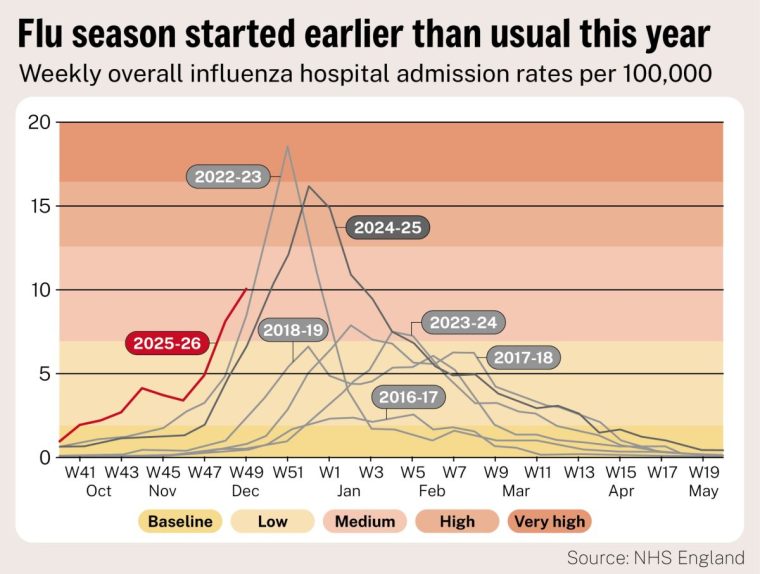
Health bodies have given some alarming-sound figures. The number of people in hospital with flu in England in the first week of December was more than 50 per cent higher than the same time last year, and 10 times higher than in 2023 to 2024.
That might sound shocking. But it just reflects that this year’s flu wave has arrived earlier than usual. Every winter there is a clearly defined spike of flu cases, which usually begins to rise any time from October to January.
Unfortunately that early arrival has meant that more people have been infected before they had time to get vaccinated against flu. The vaccine cannot remove all chance of catching the virus, but it does cut the likelihood of getting seriously ill from it.
So, the early flu surge has helped cause relatively high flu cases in hospital for the time of year, but it doesn’t necessarily mean this year’s flu is intrinsically more dangerous, said Professor Ed Hutchinson, a virologist at the University of Glasgow.
“So far there isn’t any evidence that this season’s [flu] is more dangerous than it normally would be if you get it. It’s just that there are more cases than normal for this time of year.”
While we talk about “the flu”, outbreaks are in fact caused by a mix of different flu viruses that can be grouped into different families. All these viruses are constantly mutating, which is why people need to get vaccinated every year.
The dominant strain this year has changed more than happens in an average year. It has seven mutations in one of its key proteins, called haemagglutinin. There are usually about three or four mutations between one winter and the next, said Dr Hutchinson.
That could help explain why this virus has started spreading earlier, as people’s immunity to flu from previous exposures are giving less protection.
This year’s new strain or “subclade” of flu initially led to concerns that the vaccine would be less effective than usual, because the strains included in the vaccine were selected before the mutations arose, in the southern hemisphere’s winter (the UK’s summer).
Fortunately, this year’s flu vaccine seems to be working about as well as in previous years at reducing serious illness from the virus, according to figures from the UK Health Security Agency (UKHSA).
The vaccine is reducing hospital attendance in children by 70 to 75 per cent and in adults by 30 to 40 per cent, similar to in previous years. “These results provide reassuring evidence that this season’s flu vaccines offer important protection to children and adults, despite concerns about the new subclade,” said Dr Jamie Lopez Bernal, the consultant epidemiologist for immunisation at UKHSA.
What of the talk that this year’s virus is a “nasty” strain? While it is tempting to come to that conclusion if we know a few people who have had a bad dose of flu, we cannot know the number who had a mild case.
Mild flu cases more common than severe ones
It is actually more common to have a mild case of flu – which might be mistaken for a cold or even go unnoticed – than to become severely ill with it or to be hospitalised.
The question of severity can only be answered by public health doctors calculating the number of severe cases compared with the total number of infections.
So far, there are no such figures for the UK. But in a good sign, there are no signs of greater severity from this flu strain from countries in East Asia that were last month in the tail end of their own flu surge, according to the European Centre for Disease Prevention and Control. They “have not experienced unusually high disease severity”, the centre reported.
That picture could change as the UK flu season progresses. But at the moment, it is unknown if the total impact from flu this winter will be worse, better or similar to previous years. Messaging that glosses over this uncertainty risks exaggerating the threat.
“There is danger to saying this is different, this is the worst year ever,” said Dr Simon Williams at Swansea University. “We do know from public health science this kind of fear messaging doesn’t always work. You can have counterproductive effects where people don’t buy into the message, and they just assume that authorities are fear mongering.”
And if a really dangerous flu strain arises that has potential to cause another global pandemic, they might disbelieve it, he said. “Long term, it’s not good to constantly have these periods of crisis, where this is ‘the worst winter ever’. In time, people will be a bit sceptical.”