
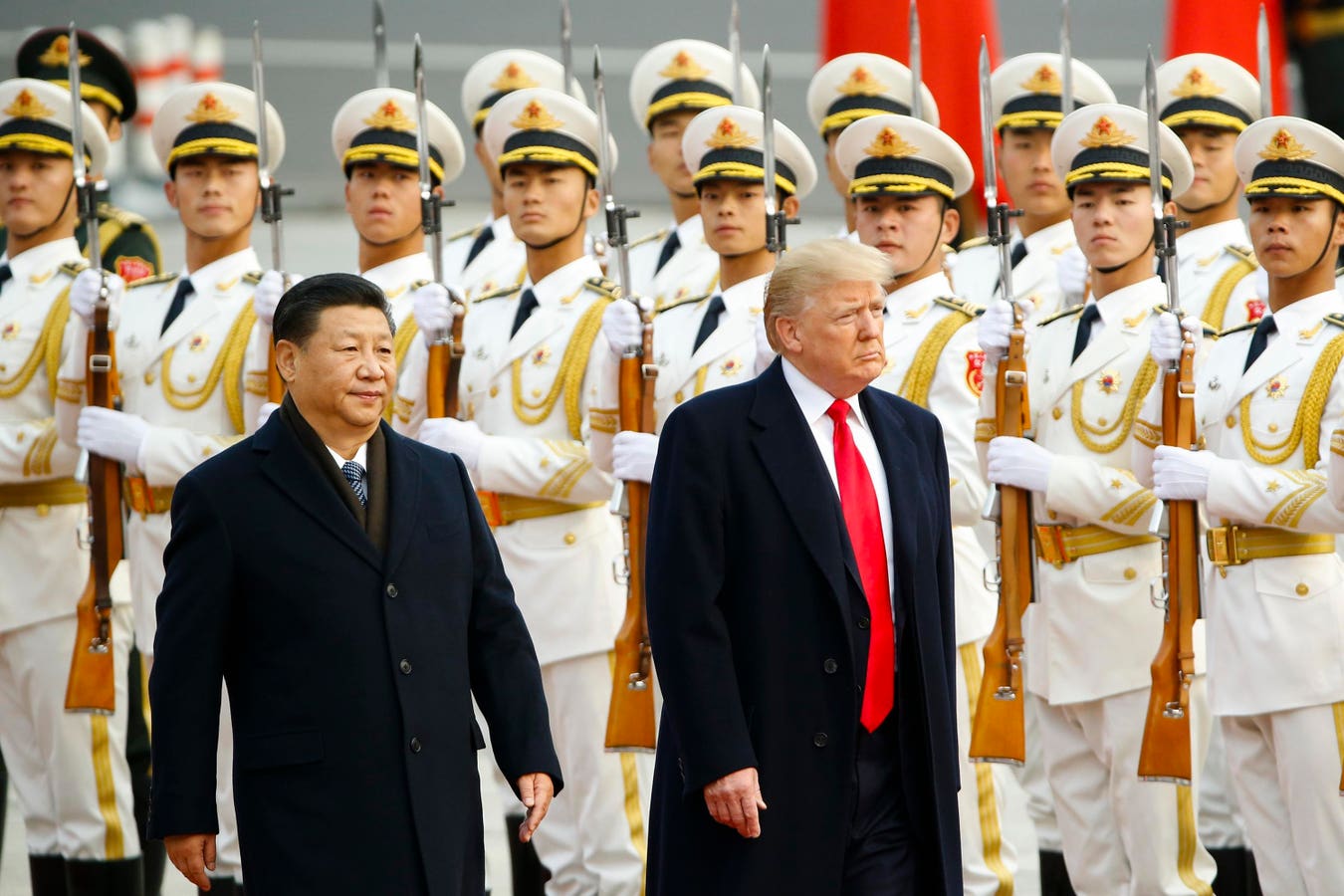
U.S. President Donald Trump visits China in November, 2017
Getty Images
Superintelligence, when AI outperforms humans across all cognitive tasks, could eventuate within the next five years, warns Time Magazine. Artificial Intelligence (AI) is driving the electric revolution because one half of AI costs are electric power. New growth in U.S. power demand will compound at 20% through 2030, according to Wood Mackenzie.
Where does U.S. power come from? The largest slice of U.S. power currently comes from gas-fired power plants. But new power growth in the past couple of years has predominantly come from renewables, solar and wind. What does the future hold for fossil sources like gas and coal, and what are the policy goals of the Trump administration?
Retail Electricity prices will rise by 50%, if inflation is included, in the next ten years, according to DNV. Although other energy costs, like gasoline and natural gas, are expected to rise more slowly, electricity cost is a lightning rod because it’s front and center in running a household. A 50% uptick in electricity cost over the next ten years is a sobering prospect.
Observers say power costs in Georgia rose 6.1% in the year ending August 2025, and led Democrats to flip two seats in the Georgia public service commission. This tells us that utility costs are becoming an issue for voters.
The China Connection.
It seems impossible, but could China really help save the U.S. in the upcoming electricity price war?
First, China is manufacturing and exporting massive quantities of hardware for renewables. China has a stranglehold on selling clean tech. 80% of the world’s solar panels, and 60% of the planet’s wind turbines, are produced in China. The country also supplies 70% of the world’s EVs and 75% of batteries.
But the clincher is that the cost of electric devices from China is falling—and by a lot. New data from Ember indicate large price reductions for grid batteries in 2024 (by 40%) and again in 2025. Sale prices for grid batteries are based on recent auctions in Italy, Saudi Arabia and India (but not China or the U.S.), and on expert interviews These show costs of $75/KWh for battery equipment delivered and $50/KWh to install and connect to the grid, totaling $125/KWh. The prices apply to 4-hour grid batteries or longer durations, as of October 2025.
However, the real cost that has to be considered is the Levelized Cost of Storage (LCOS), which Ember calculates as $65/MWh. This includes lifetime costs of financing, operations, efficiency and degraded materials. Auctions have also pushed down the LCOS.
Ember also estimates the cost to shift half of the daytime solar power to storage for nighttime use, and finds this would add $33/MWh (half of $65/MWh) to the cost of solar production. Since average price of solar production, globally, was $43/MWh in 2024, switching half of the cheap daytime power to more dispatchable nighttime use would imply a total price of $76/MWh.
This means global sales of grid batteries from China lead to cheap daytime electricity that is also dispatchable anytime day or night. “This is a game-changer for countries with fast-growing demand and strong solar resources,” said Kostantsa Rangelova, Global Electricity Analyst at Ember. Solar farms and batteries can provide reliable clean electricity to empower much of the world’s future.
China Grid Batteries To U.S. Are Inhibited By Tariff Trade War.
The tariff trade war with China has boosted the U.S. cost of grid batteries from China. The tariffs are high on graphite and active anode materials. This is driving up costs of electricity from utilities. To illustrate, in May 2025 the average tariff was 124%—enough to push the cost of a four-hour battery above 2023 levels. Existing tariffs are delaying battery projects and causing a lot of uncertainty in the U.S. market.
The battery market uncertainty has deepened as President Trump has reduced support for renewables that include solar and wind, onshore and offshore. The federal pushbacks have been summarized by Bloomberg.
The U.S. faces a choice that will determine future electricity costs. Wood Mackenzie have published a graph that has powerful insights for future electricity costs. Europe has followed one pathway where the cost of electricity has risen roughly in proportion to the percent of solar and wind generation. An average for EU27 is $240/MWh for 30% solar and wind. The U.S. is paying $140/MWh for 17% solar and wind. The big winner is China at $100/MWh for 18% solar and wind. Wood Mackenzie suggest that China’s electricity costs will remain flat (steady) as the country heads towards 50% solar and wind by 2035.
But what will happen in the U.S.? If the fed returns to supporting solar and wind, settles the trade war with China, and boosts import of cheap Chinese renewable hardware and grid batteries, the country may keep their electricity costs steady at a lower rate. But if current policy continues to handicap renewables, and try to replace them by more expensive gas-fired turbines and nuclear plants, electricity prices will escalate in the U.S.
Grid Batteries Are Surging Globally.
Grid battery storage (BESS) is an avenue to make solar and wind energy dispatchable, for example by storing extra daytime power in batteries for nighttime use. Ember has reported on the global picture: Grid battery costs since 2014 have fallen by 20% per year on average. And yearly installations rose by 80% per year (almost doubling each year). Grid batteries, as a catalyst for wind and solar reliability, are booming.
Global grid battery costs are falling and battery storage is accelerating in the last 10 years.
Ember
Strong growth has occurred in the U.S., despite the recent anti-renewables stance by the administration. In the 12 months through April 2025, some 178 large battery storage sites (greater than 1 MW) have been switched on in the U.S., a nearly 40% increase over the total of all previous batteries. Most of these would have been in the completion process before the Trump administration’s second term.
The state of Texas is number 1 in wind energy in the U.S. and number two in solar energy after California. But here’s the kicker: 94% of new power capacity added to the Texas grid since 2020 came from renewables and batteries. It’s hard to understand why U.S. policy would choose to slow down this success.
U.S. policy would benefit by following Texas, whose renewables thrust was planned and implemented by Governor Rick Perry in the years 2000 – 2015. During this period, wind power expanded from 1 GW to 10 GW. Such a U.S. policy would require support for solar and wind deliverables, because they are cheaper and faster to install than gas-fired turbines, and much cheaper than advanced nuclear which won’t be available commercially until after 2030.
And the U.S. should settle the trade war with China, and agree to buy many solar panels and grid batteries and wind turbines, at basement prices. In effect, China would be helping to stabilize electricity prices in the U.S., and in the age of deals this would be a very big one, as predicated by Georgia election results.