

World Rugby has moved a step closer to lowering the legal height of a tackle in professional rugby by announcing that community game trials will be extended to next summer’s Under-20 World Championship.
England, Ireland, Scotland and Wales have been among 11 nations running a two-year trial in which the upper limit for a legal tackle was lowered from the shoulder to the sternum in all community and age-grade rugby. In England that was from National One and below.
World Rugby reports that this has led to a 10 per cent reduction in upright tackles, which run a high risk of head-on-head collisions. There have been some individual reports of a drop in concussions and of faster-paced rugby with more offloads.
A proposal will be put to the World Rugby council next year that the lower tackle height be written into full law for community rugby from next July.
Meanwhile, the sternum tackle height law will be employed in elite rugby for the first time at the Under-20 World Championship in Georgia.
The law will not be enforced for pick-and-go carries close to the breakdown or when a player dives for the line. In those scenarios, the shoulder line will still apply. Double tackles will be permitted, provided that the first defender makes contact below the sternum.
World Rugby is anxious to wait until the conclusion of the trial before drawing any conclusions about rolling out a lower tackle height into professional and Test rugby.
However, it has been the direction of travel since the original community trial, and to roll out the law in this staggered fashion is sensible. Players who were 16 when the law trial was introduced are now stepping up into adult rugby, having spent the past two seasons learning to tackle below the sternum. For players who are now 15 and entering Gallagher Prem academies, it is all they have really known.
World Rugby uses the Under-20 World Championship to trial laws and initiatives because it allows the best young players in the game to prepare with new laws in mind, when they will not be switching between competitions. That has been a problem in the past, particularly with one early tackle height study that was conducted in Championship Cup matches but not league fixtures.
Not all under-20 trials make it to full law. One successful initiative was that a referee would play on from lineouts that are not straight, provided that they are uncontested. At next year’s tournament, ball carriers who lead dangerously with their head into contact will be liable to sanctions.
“There will be thorough analysis and we will take it back through the decision-making processes and consider it,” Mark Harrington, World Rugby’s chief player welfare and rugby services operator, said.
“One of the challenges for elite professional rugby is that the guys and girls are playing in a vast number of competitions. The acid test, and the reason why we are doing it, is that we have seen some good progress in the community game. At the same time, for different reasons and with different levers, there have been some improvements in the elite game.

Potential law changes could have massive implications on how the game is refereed at all levels
GARY CARR/INPHO/SHUTTERSTOCK
“What we don’t know is whether you marry up a daily training environment with the blunt instrument of a lower tackle height, does it give you even better results? This will be the first time we can look at that. There will be thorough investigation afterwards and, if the will of those stakeholder groups is that we pursue it further in the elite game, we will absolutely do so.”
If the lower tackle height does come into force in the professional game, the next question will be how it is refereed. Players will be watching closely. Freddie Steward, the England full back, voiced concerns that players are already being penalised too harshly for accidents.
“I think it’s easy to sit on the sofa and be like, ‘Oh, that was disgusting,’” he said. “But when you’re in the game, it’s so difficult, the intensity and the speed of it, to get things right all the time. The way the game is now, those tiny margins are there for everyone to see.
“The laws now are really strict and really tight and there literally is no margin for error. When you’re doing what we do, it’s really difficult to be on the right side of the law all the time. But that’s the way the game is and I suppose you have to adapt to that.
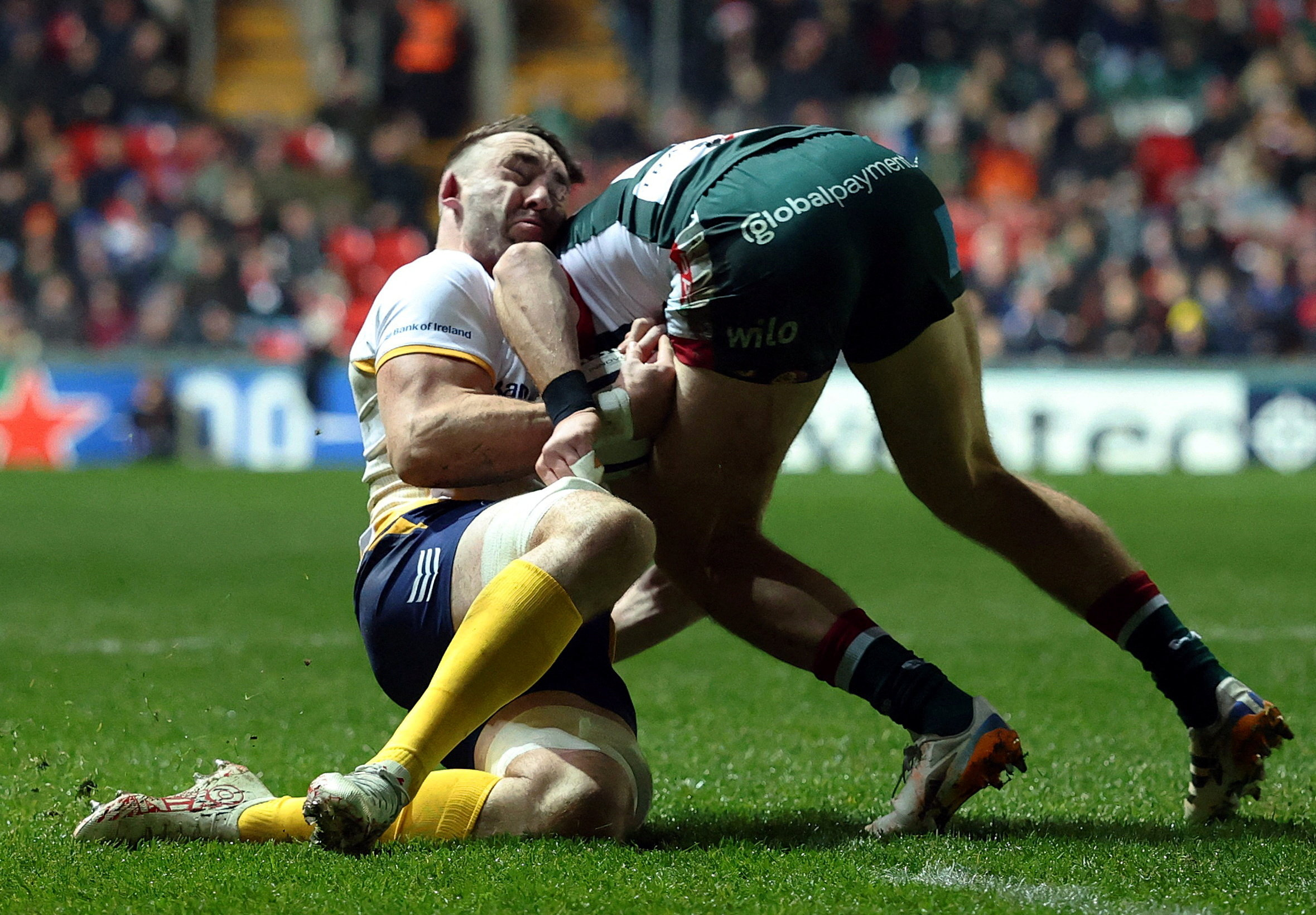
Conan, left, took a big collision from Steward on Friday, but the England man went unpunished
ANDREW BOYERS/REUTERS
“I think the game is too strict at the minute and I probably put myself on the line by saying that, but there’s so many things that potentially are penalised that really it’s just a rugby incident and the game would probably benefit from those loosening up a bit.
“Of course you penalise the obvious stuff, but there are certain aspects that you just need to understand. This is rugby and people watch it because it’s big blokes whacking each other and running into each other. That’s what makes the game so special. So I just hope that going forward the laws don’t take that out of it.”
Steward feels there is a bit more common sense coming into officiating. He was not penalised for a collision with Jack Conan early in Leicester Tigers’ Champions Cup defeat by Leinster last Friday.
“I think he slipped into it,” Steward said. “If I was penalised there, I would have felt a bit hard done by. But I’m glad the right decision was made.
“Two years ago we were at a point where every single thing was being penalised. Now it’s slightly better in that they’re taking these things into account and taking each thing separately. So we’re getting there.”