
Is it because they seek to provoke, or has art always reflected the mood, anxieties and obsessions of the society that produces it?
Gilbert & George are well known for using shock as a tool.
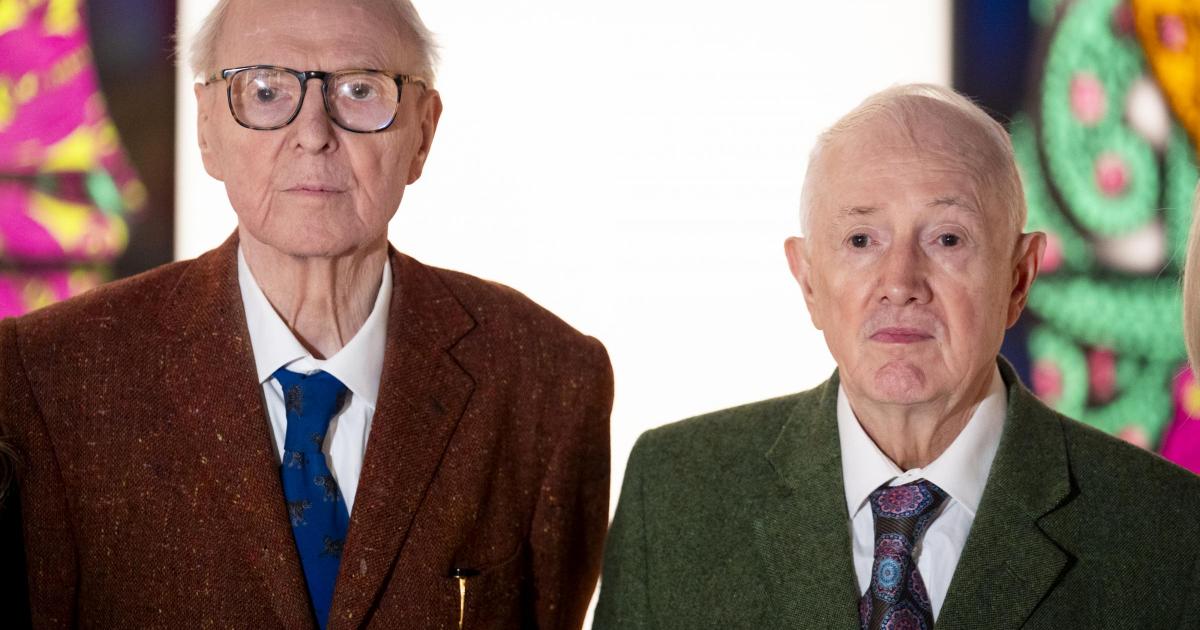
Artists Gilbert & George standing in front of Bagrave (2020) on display during a photocall for the Gilbert & George (Image: PA)
Although they do not always rely on modern materials or digital methods, they deliberately employ provocative imagery including the use of their own bodily fluids to confront social taboos.
According to the artists, they aim to normalise discussions around human biology, sexuality and the aspects of life that polite society tends to hide.
Their work challenges the conventions of the art world itself, asking audiences why certain subjects are considered unacceptable while others are celebrated.
A similar desire to provoke was seen in the work of Russian performance artist Marina Abramović, who has often used her own body as a medium.
In one of her early performances, Imponderabilia (1977), Abramović and Ulay stood naked in a doorway, forcing museum visitors to squeeze between them to enter the gallery.
Participation was optional but the emotional impact was unavoidable.
I would personally rather experience art that makes me uncomfortable than art that washes over me unnoticed.
Art should provoke something: reflection, discomfort, curiosity, or even anger.
That reaction is part of the work.
When I was younger, another memory of mine was seeing a plain blue painting when I was younger.
It was Yves Klein’s Blue Monochrome (1961).
At the time I barely glanced at it, not understanding its significance.
Klein had developed a unique pigment known as International Klein Blue (IKB), a synthetic ultramarine bound with a special resin that allowed the colour to retain its intensity and powder-like texture.
Klein believed this colour embodied the immaterial and the infinite; the painting was not “just blue,” but an immersion in pure pigment, an attempt to evoke a spiritual experience with a single colour.
What looked simple was, in reality, a highly technical and philosophical experiment.
More recently, a music artist—Zulu, in his performance 25-hour Run and spent over 25 hours running on a treadmill while a huge sawmill blade rotated dangerously close behind him.
On the surface, it seemed absurd.
Artists Gilbert & George standing in front of Fates (2005) on display (Image: PA)
But the piece explored endurance, anxiety and the modern pressure to keep moving even when risk looms over us.
The performance blurred the line between art, athleticism and survival.
Was the artist demonstrating personal resilience, critiquing society’s obsession with productivity, or simply testing the limits of his own body? The ambiguity is exactly what made it art.
The question of danger in art is not new.
In 1971, Chris Burden staged one of the most infamous performance artworks of the 20th century.
In a gallery space, he instructed a marksman to shoot him in the left arm with a .22-calibre rifle.
The event was recorded, but its intention was not spectacle alone.
At the time, the Vietnam War dominated global consciousness.
Graphic images of violence had become daily media consumption.
Burden’s Shoot confronted this desensitisation head-on, forcing audiences to witness real bodily harm within the “safe” confines of an art gallery raising uncomfortable questions about violence as entertainment.
Yet Burden’s work also sparked ethical debates.
Was this a radical artistic statement, or an irresponsible act of self-harm? Could an artist claim that intentionally being shot was meaningful, or was it simply reckless masochism masquerading as art? Critics disagreed, and to this day, Shoot sits uneasily at the boundary between profound artistic commentary and extreme personal risk.
Beyond individual examples, controversial art raises broader ethical questions about responsibility both the artists and the audiences.
When artists use their own bodies or place others in unsettling situations, they test the limits of consent, safety and moral accountability.
Some argue that pushing these boundaries is essential: art has always exposed uncomfortable truths, challenged power structures and forced society to confront what it prefers to ignore.
Others counter that provocation alone does not justify harm, and that shock can become an empty gesture if it endangers people or exploits trauma without offering genuine insight.
There is also the issue of audience complicity.
When viewers watch an artist endure pain, humiliation or danger, are they participating in a meaningful critique of society or simply consuming suffering as spectacle?
This tension sits at the heart of controversial art, reminding us that creative freedom and ethical responsibility are never entirely separate.