
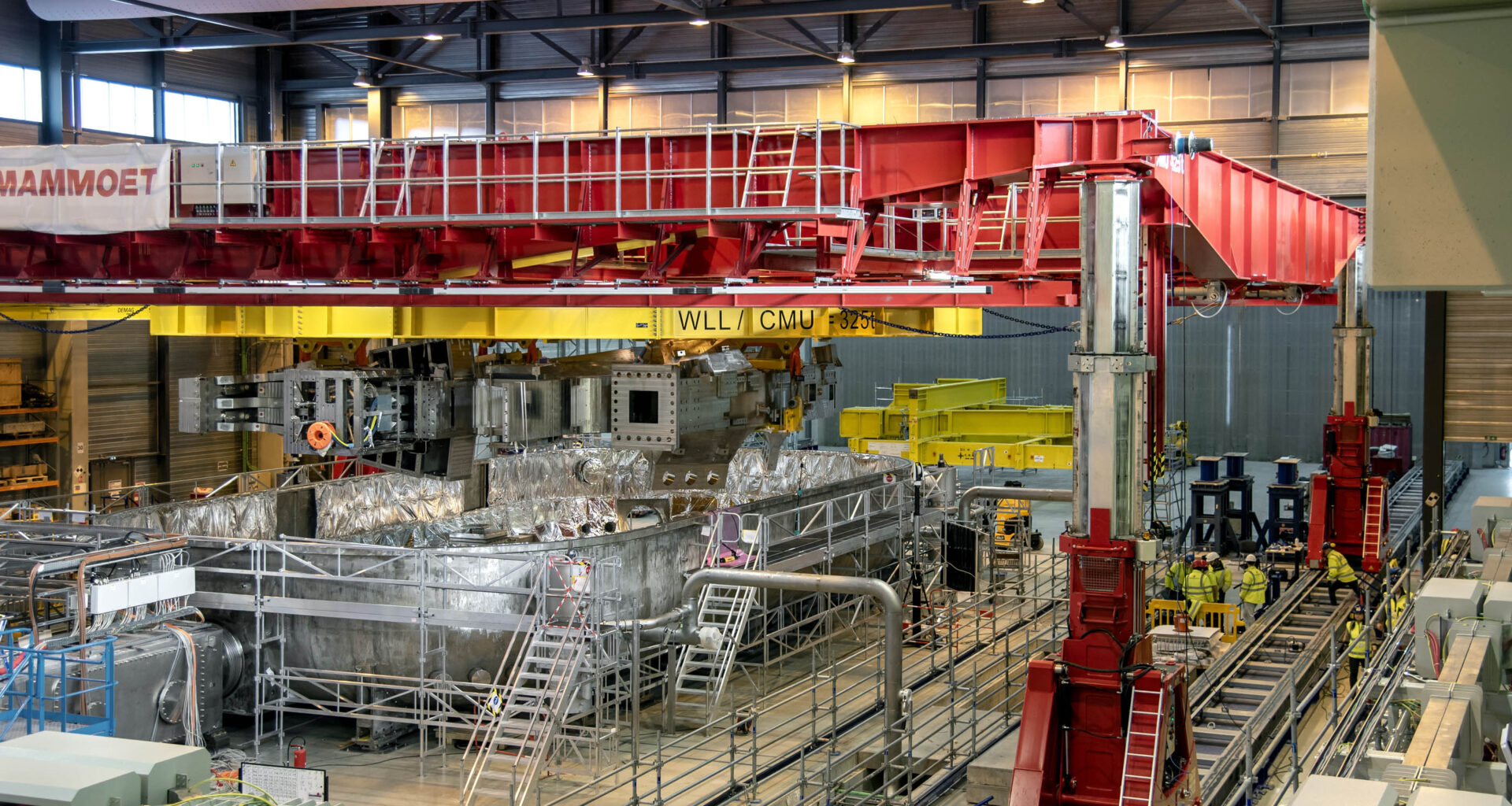
Toroidal field coils have already experienced extreme cold. Once finalized, in Japan or in Europe, most of them were tested at 80 K (minus 194 degrees Celsius) before being shipped to ITER. Testing at 80 K is a relatively simple operation that provides precious information on the thermal and mechanical constraints that a coil will be exposed to during its lifetime. Testing at 4 K, which is the operating temperature of the ITER superconducting magnetic system, is a completely different operation that requires a massive infrastructure: a large insulated cryostat, powerful cooling and power systems connected to the coil by a real ITER feeder, and all the required command and control instrumentation.
“At 4 K, the winding inside the coil becomes superconducting, which allows us to circulate a strong electrical current and thus generate an intense magnetic field,” explains David Grillot, ITER manager for the integrated commissioning program. While parameters inside the magnet cold test facility do not completely reproduce the conditions the coil will face during the machine’s operational phase, they come close enough to enable, in David’s words, “a partial but real-scale commissioning of the tokamak’s magnetic system.