
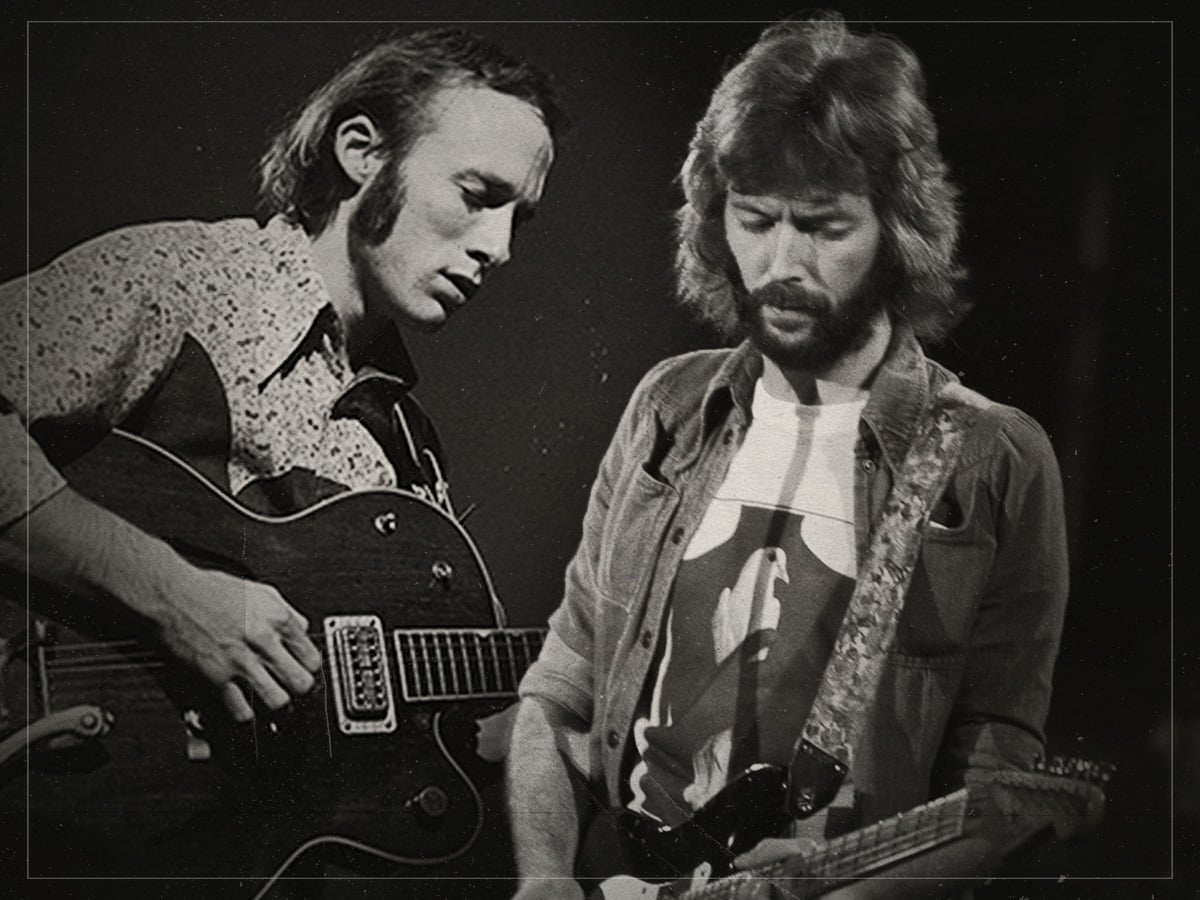
(Credits: Far Out / AVRO’s TopPop / Beeld en Geluid Wiki / Netherlands Institute for Sound and V…
Tue 16 December 2025 16:30, UK
By the early 1970s, Eric Clapton had finally found himself amid a musical milieu he’d been chasing for years.
He was always a reluctant creature of the counterculture. Stood as one of the leading forces of Bohemian lysergia, wielding his trippy Gibson guitar designed by The Fool, his novel use of fuzz pedals, and far-out improvised jams cutting a diffident psychedelic mark amid London’s swinging peak.
Yet, it was the roots revival Clapton felt truly at home. Having jumped ship from The Yardbirds due to their pop trajectory, a spell in John Mayall & the Bluesbreakers would give a clue to his earnest love of music’s foundational DNA over the kaleidoscopic excesses splashed across the charts.
After Cream’s demise, Blind Faith and Derek and the Dominos would set the stage for Clapton’s deeper hurtle towards rock’s rustic beginnings, establishing a sonic template that would largely anchor the next 50-odd years of solo material.
Over in America’s West Coast, Stephen Stills was charting a similar course. While his and Neil Young’s former Buffalo Springfield dwelled in a subtle realm of sunshine-psych, Stills too blossomed into a Californian heavyweight amid rock’s rootsiness, soaking up the fascination with the States’ musical sentiments. Teaming up with The Byrds’ David Crosby and The Hollies’ Graham Nash, the celebrated harmony trio captured the Woodstock zenith that hung in the air with their alchemic brew of folk rock and stirring paeans to peace.
It turned out that from across the Atlantic, Clapton was paying close attention. For his eponymous 1972 debut album, Clapton had invited Stills to add a solo and some basslines to his ‘Let It Rain’ single, possibly a likewise jam after laying down guitar parts for Stills’ ‘Go Back Home’ two years earlier, but just as likely due to his sheer fandom of that album’s mammoth single.
According to lauded session musician George Terry, who had spent time in the studio with both, the collaborator stated, “I clearly recall Eric telling me that Stephen would go to heaven for writing that song.”
The lead single from 1970’s Stephen Stills, ‘Love the One You’re With’ stands as the former Buffalo Springfielder’s defining hit. A joyous zest of steel drums and boasting an impressive vocal support from comrades Crosby and Nash plus extra singing heft from Rita Coolidge, her sister Priscilla Jones, and The Lovin’ Spoonfuls’ John Sebastian, the warm singalong was inspired by a chance remark from keyboardist Billy Preston, stressing, “If you can’t be with the one you love, love the one you’re with.”
While the rest of the record pursues a gentler course of folk rock contemplation, ‘Love the One You’re With’ certainly leaps out of the speakers with an extra buoyant surge, clearly, all involved having heaps of fun. Not only would his Preston nod peak at the top 20 in the States, but if Clapton’s predictions prove correct, all it’ll take is one blast of ‘Love the One You’re With’ to convince Saint Peter to fast-track admission into those pearly gates.
Related Topics