
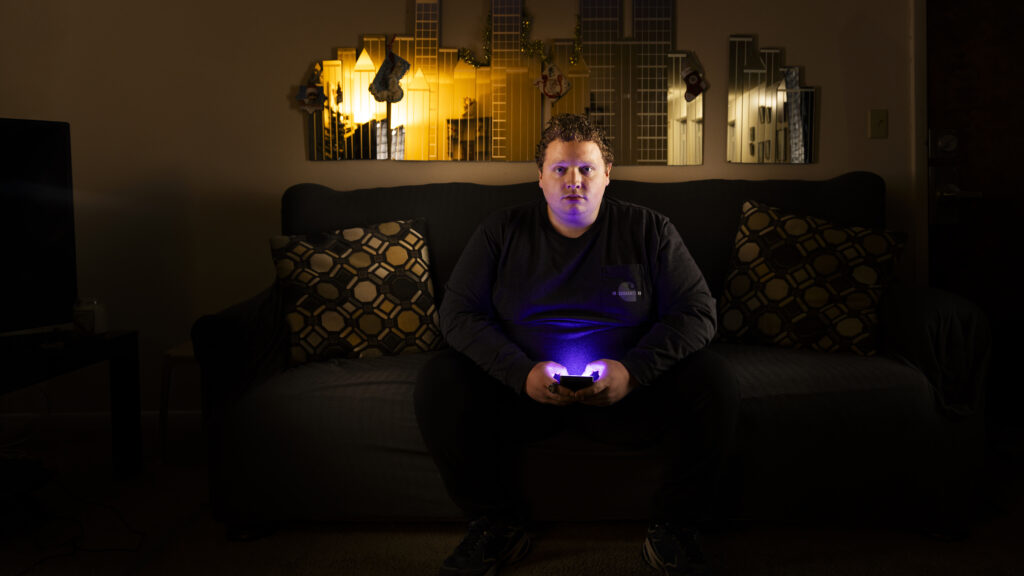
In his teens and early 20s, Tyler Adolfo showed an ability to communicate effectively. A local newspaper in Massachusetts published a front-page story about his success in a speech contest. He won his college’s talent contest with a rap performance. And in October 2021, he helped craft a campaign on behalf of his fraternity to increase awareness of sexual assault in Greek life, before speaking with a New York Times reporter about the issue.
Over the next six months, Adolfo’s words kept attracting attention — except this time because they were bizarre.
Like others with bipolar disorder, Adolfo had soared into a manic episode, the kind that came with such a confidence boost and such racing thoughts that he lost connection with reality.
On Twitter, as the social media site was called then, he made 1,155 posts in a matter of weeks, many of them gibberish like this: “leafy the non team hopper like overrated rage quit like the superior godly abandoned only begotten princess buttcheeks.” In a TikTok video, he said his fraternity brothers would “go to prison for the rest of your lives for the smears you said to me,” a reference to allegations he now says stemmed from “grandiose delusions.”
“Those still sit with me today, the things I was saying,” Adolfo said in reflecting on the episode, almost four years later.
Such reflections are common among people with bipolar disorder. While manic episodes generally end in six months or less — some are far shorter — and people can become stable with medication, some with the condition now face a modern-day hurdle in trying to rebuild their lives: the fallout from the delusional, sometimes hurtful things they said online.

STAT Plus: Why first-generation mental health apps cannot ignore next-gen AI chatbots
It’s an issue that has become even more salient with the explosion of social media. The relationship between mania and social media has become a regular topic in a Reddit group about bipolar disorder.
Online posts can not only reveal a person’s illness but also lead to feelings of intense shame, making recovery harder, psychiatrists and people with the disorder say. There are no easy solutions because, when manic, people often aren’t receptive to others’ expressions of concern. And sometimes the comments hurt or alienate the very people who would otherwise provide such support.
“In the old days, if somebody was manic, they stayed at home — which has its own negatives — but then it stayed in the family,” said Po Wang, a Stanford University psychiatrist who specializes in treatment of bipolar disorders. “If you have manic behaviors on social media, there is a lot of cleaning up to do.”
An estimated 2.8% of U.S. adults had bipolar disorder in the past year. Globally, the incidence of the disorder among adolescents and young adults — the groups likeliest to use social media — has also recently increased significantly, though some psychiatrists think that is due at least in part to greater awareness of the disorder and overdiagnosis.
People with the condition who use social media often become more active online if manic because of their increased cognitive speed and overabundance of thoughts, Wang said.
Their posts can include offensive declarations that they might not normally share — or even actually believe, Wang said.
A person has thousands of thoughts daily, “and we are not judged by the chatter because it’s filtered,” Wang said. During mania, “all this unfiltered stuff comes out that is not representative of the person.”
A 2022 study in the journal Bipolar Disorders found that two-thirds of people with the condition regretted their social media activity, more than double the control group.
“When people are in a manic phase, they do not necessarily have insights into the consequences of what they are doing,” said Søren Dinesen Østergaard, a professor of translational psychiatry at Aarhus University in Denmark and senior author of the study. Once the manic episode has resolved, they could “look at their digital tracks and see that they have done something that they now regret. That could potentially push them in the other direction towards a depression.”
Jon, a 49-year-old father of three, who spoke on condition his full name not be disclosed, used to write about poker on Twitter and kept a blog on the game; he developed such a following that venues for tournaments paid him to attend and report on them.
That changed about five years ago, when he started sharing cryptic posts about his efforts to bust human trafficking rings and tagged the hackers groups Anonymous and Legion. It was after sending those posts, in 2021, that he was first diagnosed with bipolar disorder.
“I just generally made an ass of myself,” said Jon, who even before diagnosis had experienced manic episodes about every seven years since he was a young man.
During his manic episode, he also attacked his family on social media, leading to their estrangement for a time.
After being hospitalized and starting medication, Jon stabilized. But when he tried to log into his Twitter account again, he discovered he had been banned from the platform. Without the audience he had long cultivated, venues no longer had reason to pay him to promote tournaments.
“It was devastating because it had taken me years to build,” said Jon, who had used the earnings to supplement other income. “It was a loss of income as well as a loss of, I guess, reputation.”
There is often little understanding among people witnessing such a spiral, Wang said. Their rejection of those who are spiraling — or even perceived rejection by those who are experiencing the mania — contributes to greater isolation and unemployment among people with bipolar disorder than the general population, studies show.


Sign up for Daily Recap
All the health and medical news you need today, in one email
“When people are manic, [others] don’t go, ‘Oh, that guy needs help.’ They go, ‘Wow, what the heck is going on with that guy?’” Wang said.
Growing up, Adolfo was bullied, struggled with mental health, and got into fights. Raised in a single-parent household with little money, he didn’t have the internet at home like many of his peers. Still, he managed to excel and was admitted to the University of Massachusetts at Amherst, where he joined Kappa Sigma and developed the closest friends he had ever had, he said.
He also started drinking constantly, to the point where he would attend class while drunk.
 After his mania manifested on social media, Adolfo said he wished someone had stepped in to help him get the help he needed.Anthony Tieuli for STAT
A switch in his brain eventually flipped, and he became manic. He posted conspiracy theories about the illuminati online and announced that he would hold a press conference on campus to discuss what he said was sexual abuse in his fraternity.
In January 2022, Adolfo’s sense of paranoia led to confrontations with others, including his mother. He attacked a friend, stabbing him with a pocketknife.
Facing assault charges, he was later examined by a forensic psychologist, who determined that he acted out of paranoia and concluded that he should not be held criminally responsible. The charges were eventually dismissed.
His fraternity also kicked him out — not because of the assault but because of a post he had sent attacking its leadership, said Adolfo, who had managed the frat’s social media.
He wonders how things might have turned out for him if not for social media. While manic, he was convinced that everyone was interested in what he had to say; afterwards, he fixated on the belief that they were all gossiping about him.
“It could have been an opportunity … for someone to step in and realize something was wrong and facilitate me getting the serious help that I needed,” Adolfo said. “That is not really what happened.”
After the episode, he became deeply depressed, gained more than 170 pounds, and feared “being around anybody.” While many of his fraternity brothers visited him when he was hospitalized for mania in October 2021 — and then confronted him online as his social media posts became more aggressive — after the episode, no one reached out.
Jody Adewale, a clinical psychologist in Los Angeles, tells patients embarrassed by their social media posts to “beat yourself up once and then move on.”
“It’s less about going back and fixing it and more about, ‘what did I learn from it?’” Adewale said. “Sometimes, if you go back online and try to do the apology and try to fix what was said, it can suck you back into this rabbit hole.”
Adolfo eventually found the right medications, started exercising, and enrolled in another university. He has been sober for nearly four years.
On YouTube, he discusses bipolar disorder and tries to reduce stigma around it.
Asked whether he worries about what could happen if he again becomes manic, Adolfo said he hopes that, if he’s tempted to post on social media again, he could “look at it and say, last time things didn’t turn out well.”
Last year, Adolfo sent a letter to his fraternity’s national office in which he took responsibility for the social media posts he sent about members of the group, while also explaining the role mental illness played.
“I understand that mental health challenges are not an excuse for my [behavior], but I hope it provides some context,” he wrote. “If it wasn’t for the mitigating factor of being in a severe mental health crisis, I would have never made the comments I made because they were completely antithetical to who I am.”
In January, a fraternity leader responded.
“It is a special privilege to inform you that you have been reinstated to membership in the Fraternity,” the letter stated.
“It felt like I was no longer being punished,” Adolfo said.
He also no longer fears the world.