
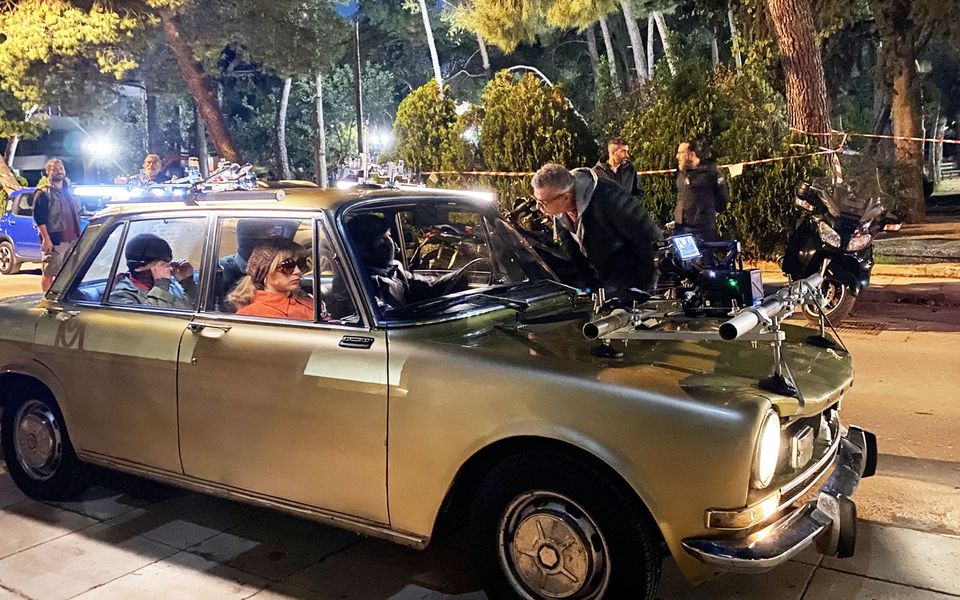
Snapshot from the filming of a reenactment for the upcoming Skai documentary on the November 17 terror group, depicting the assassination of CIA station chief Richard Welch, the organization’s first victim, outside his Athens home in December 1975.
Greece’s Hellenic Film and Audiovisual Center (EKKOMED) has withdrawn its approval for state cash-rebate funding for an upcoming Skai TV documentary after it emerged that the film includes an interview with a convicted member of the now-dismantled terrorist group November 17. The move has prompted accusations of censorship from the broadcaster.
In a decision published this week on the government’s transparency portal Diavgeia, EKKOMED said it had revoked its earlier approval, granted on December 8, for the documentary “November 17: Rise and Fall,” presented by journalist Alexis Papachelas, citing an incomplete assessment of key facts.
“The issuance of the initial approval was based on an incomplete evaluation of a substantive factual element – namely the participation of a person convicted of terrorism and unrepentant for his actions,” EKKOMED said, referring to jailed November 17 hitman Dimitris Koufontinas.
The organization said it needed to reassess the project after considering additional information that had not been fully evaluated at the time of the original decision, “whose institutional and social weight became clear at a later stage,” as well as a letter from two victims’ advocacy groups, which it said played a key role in the reversal.
Skai media group founder and managing director Ioannis Alafouzos on Tuesday criticized the move as arbitrary interference in a journalistic and historical work, accusing EKKOMED of attempting to impose “preventive censorship.”
In a letter to EKKOMED chief executive Leonidas Christopoulos, Alafouzos said the documentary followed international practice by recording testimonies from all key figures, including former public order minister Michalis Chrysochoidis and others involved in dismantling the group, as well as Koufontinas himself. He noted that EKKOMED had been informed of the interview’s inclusion as early as June 2.
Alafouzos alleged that the decision reflected outside pressure that violated journalistic ethics and said Skai would not legitimize practices “reminiscent of darker periods in our history.”
Speaking to Kathimerini, Christopoulos said the move did not constitute a final rejection but rather a reassessment of the funding application. “It is not an easy case, and I understand Mr Alafouzos’ reaction,” he said. “The project was initially approved, but following the letter from victims’ associations, the correct course was to revoke the decision and re-evaluate.”
“There is no issue of censorship,” he added. “But the question is whether a documentary that includes the views of the chief executioner of November 17 should be financed by the state.”
Christopoulos said the reassessment would proceed promptly, as the application remains valid.