
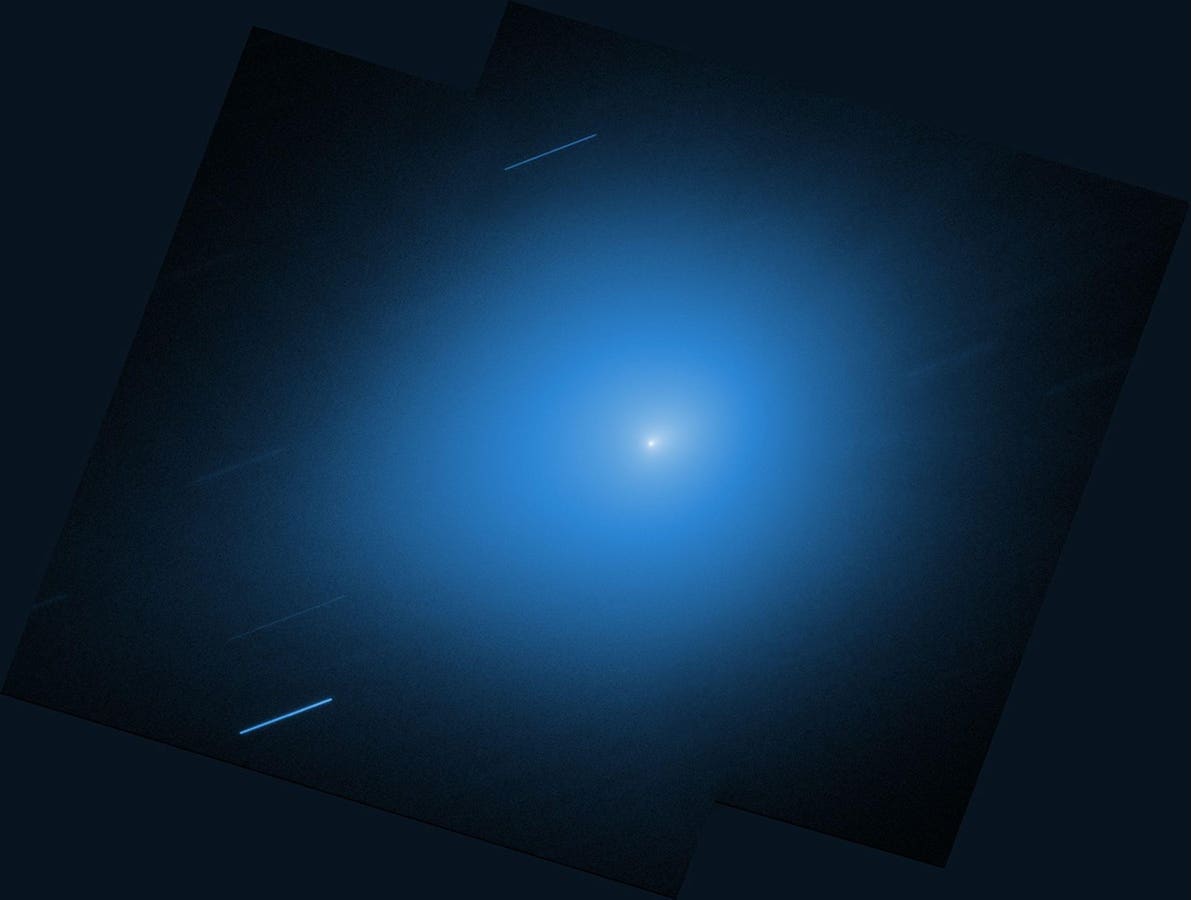
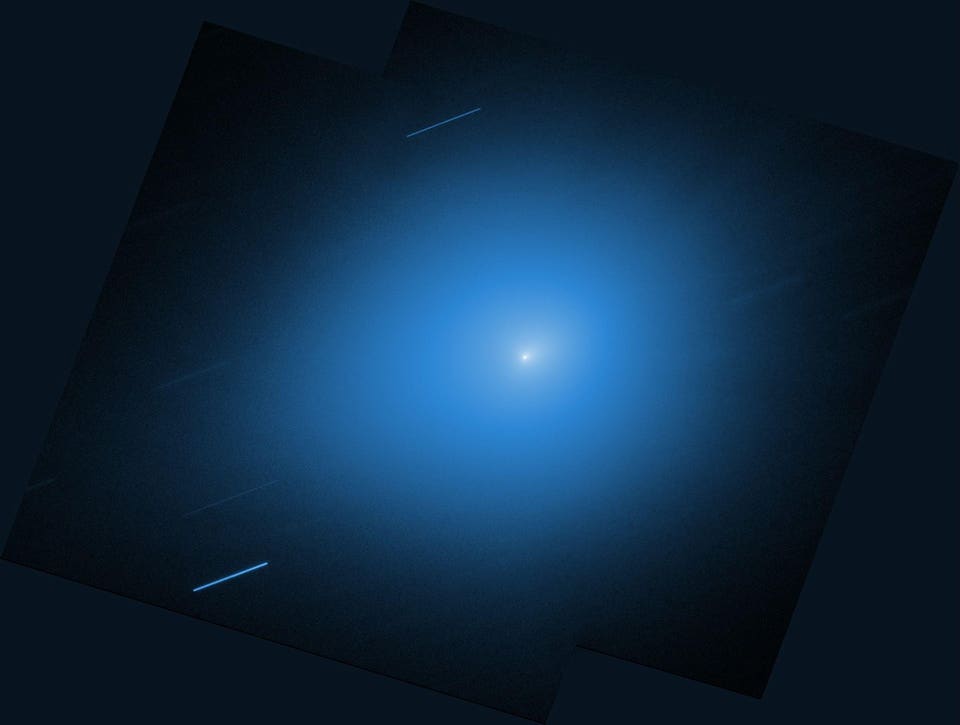
The NASA/ESA Hubble Space Telescope reobserved interstellar comet 3I/ATLAS on 30 November with its Wide Field Camera 3 instrument. At the time, the comet was about 286 million kilometers from Earth. Hubble tracked the comet as it moved across the sky. As a result, background stars appear as streaks of light. Hubble previously observed 3I/ATLAS in July, shortly after its discovery, and a number of observatories have since studied the comet as well. Observations are expected to continue for several more months as 3I/ATLAS heads out of the solar system.
NASA, ESA, STScI, D. Jewitt (UCLA). Image Processing: J. DePasquale (STScI)
3I/ATLAS, a comet from deep space that’s currently barrelling through the solar system — which some have speculated may be an alien spacecraft — will make its closest approach to Earth on Friday, Dec. 19.
Discovered on July 1, 2025, by the Asteroid Terrestrial-impact Last Alert System (ATLAS) telescope in Río Hurtado, Chile, 3I/ATLAS is the third of its kind ever observed after 1I/Oumuamua in 2017 and 2I/Borisov in 2019.
When To See Interstellar Comet 3I/ATLAS
3I/ATLAS got closest to the sun — about 126 million miles (203 million kilometers) — on Oct. 29, and on Dec. 19, it will get closest to Earth at about 168 million miles (270 million kilometers). That’s not very close — the distance between Earth and the sun is 93 million miles (150 million kilometers) — but it’s the best view we’ll get.
“After billions of years of galactic solitude and just moments in the warmth of our sun, interstellar comet 3I/ATLAS makes its closest approach to Earth on Friday,” said Dr. Gary Blackwood, PhD, a retired NASA Jet Propulsion Laboratory astronomer hosting a live comet 3I/ATLAS viewing event, in an email. “On a hyperbolic orbit originating from the center of the Milky Way, this rare visitor will depart our solar system never to be seen again.”
Is Interstellar Comet 3I/ATLAS An Alien Spacecraft?
Despite speculation by Harvard astrophysicist Dr. Avi Loeb that 3I/ATLAS may be an alien spacecraft, the comet behaves much like the comets of our own solar system. New data from NASA’s Psyche mission and ESA’s Mars Trace Gas Orbiter confirm the comet is accelerating — a slight push caused by jets of vaporized gas escaping the surface, called “outgassing.”
“We measured the non-gravitational acceleration using long-baseline astrometry,” said Marshall Eubanks, lead author of a new paper published in Research Notes of the AAS, to Spaceweather.com. “The results are pretty typical of ordinary comets, and certainly not record-breaking.” The team estimates that 3I/ATLAS weighs about 48.5 tons (44 million metric tons) and has a radius of 850-1,200 ft (260-370 meters).
The conclusion? 3I/ATLAS fits the comet profile, putting to rest any speculation that it might be artificial.
Where To See Interstellar Comet 3I/ATLAS
There are a few ways to get a glimpse of 3I/ATLAS when it’s at its closest — so at its biggest and brightest — on or close to Dec. 19. The Virtual Telescope project will host a live feed on YouTube at 04:00 UTC on Dec. 19 (11:00 p.m. EST on Dec. 18).
There are also some live public events timed to the comet’s closest approach to Earth. The RESET Hotel in Twentynine Palms, California — close to Joshua Tree National Park — is hosting a special skywatching event on December 19-2. During a guided night-sky experience led by Blackwood, guests will be able to view comet 3I/ATLAS in Celestron Origin and Celestron StarSense Explorer telescopes.
“Comet 3I/ATLAS has become both a scientific and cultural phenomenon, and this week the eyes and telescopes of the world will be watching to learn everything we can,” said Blackwood. “This interstellar visitor means many things to different people, and as an astronomer, it reminds me that we live in a galaxy that is abundant with other worlds and mysteries that may one day reveal that we are not alone in the cosmos.”
Wishing you clear skies and wide eyes.