
Upon the death of Dame Jilly Cooper there was regrettably no mention in her obituary in The Times of On Rugby, a wry publication from 1984 co-written with her husband Leo. Rather more prosaic than her bonkbusters, there was no account of Rupert Campbell-Black representing Rutshire in the County Championship, or vying with a Russian prince qualifying on residency and a South African with a British passport for the England No10 jersey.
The Coopers devoted one entry to student rugby. “Most of the universities other than Oxford and Cambridge have rugby clubs,” they wrote. “However, the standards of play suggest that the modern student probably prefers bed to boot and bird to ball.” Such wry disparagement of standards may not be wholly true any more.
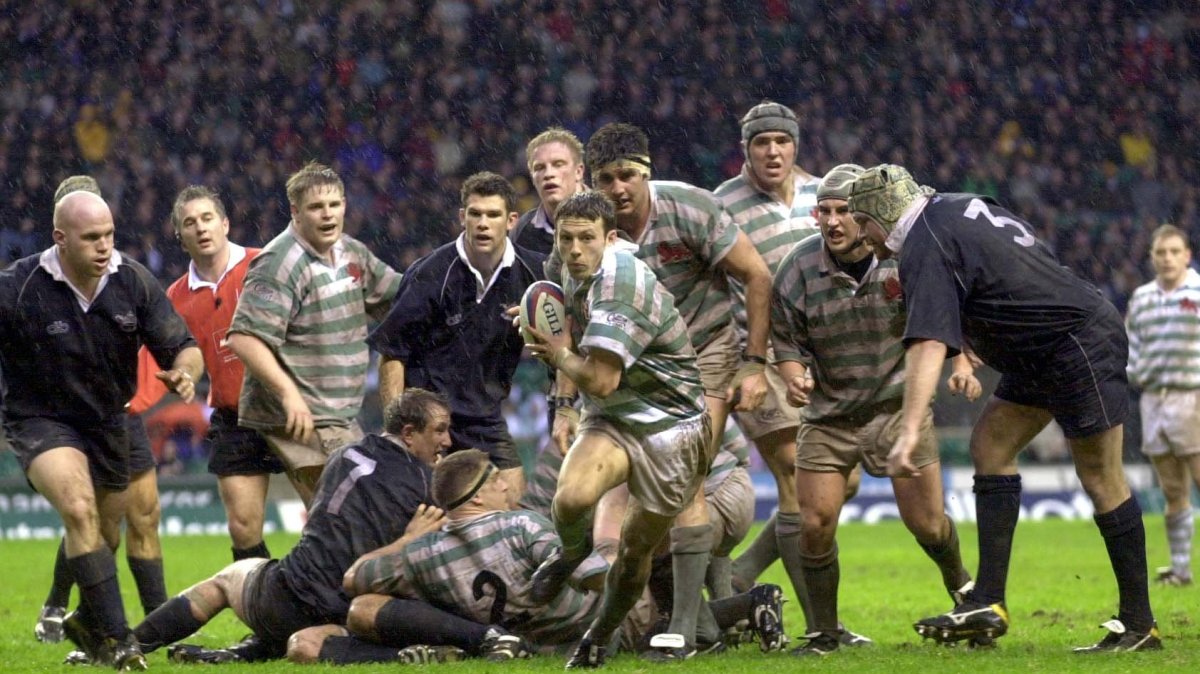
Here we are in December, the traditional home of the Varsity Match, an event of significance in 1984 but one that no longer looms. I recall lying ill on the settee, watching the 2008 fixture from Twickenham. It was already past its heyday and, moved from the home of rugby last year, has been relegated forevermore. Without looking it up, when are this season’s men’s and women’s Varsity Matches? Congratulations if you said February 28 at StoneX Stadium.
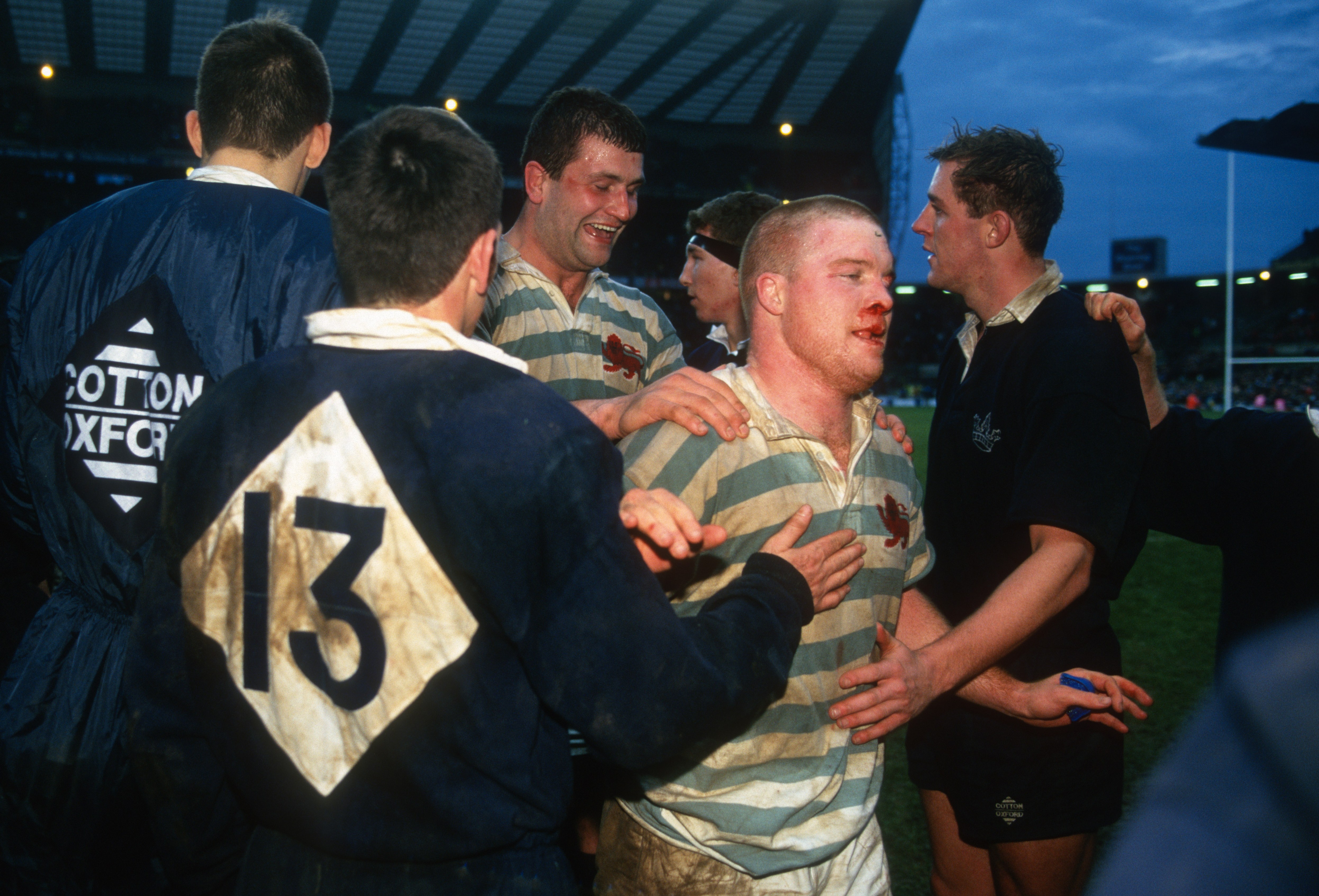
A bloodied Cambridge captain Tom Murphy leaves the field after the 1997 Varsity Match
MARK LEECH/OFFSIDE VIA GETTY IMAGES
The professional transformation of 30 years ago dunked universities into uncertainty. In Mud, Blood and Money: English Rugby Union Goes Professional, Ian Malin committed a chapter to this effect, as rugby left the world where Mark Bailey could write a thesis on “the importance of the rabbit to the medieval economy” and play for England.
In the crazed era of 1995 to 2000, when administrators went partially bonkers with cross-border ideas, university rugby sought continental exploration. Which Irish team became European champions first? Not Ulster, but University College Cork (UCC), and on the same day, a few hours earlier: January 30, 1999, when UCC paraded on the field at half-time at Lansdowne Road, before Ulster defeated Colomiers to win the Heineken Cup.
In 1997, The Times sponsored the Student European Rugby Championship, pulling together 16 teams in four pools. Len Harty (UCC), Bob Reeves (Bristol) and Ted Wood (Durham) were the owls behind the idea. “We are heading back towards a belle époque for university rugby,” Harty said.
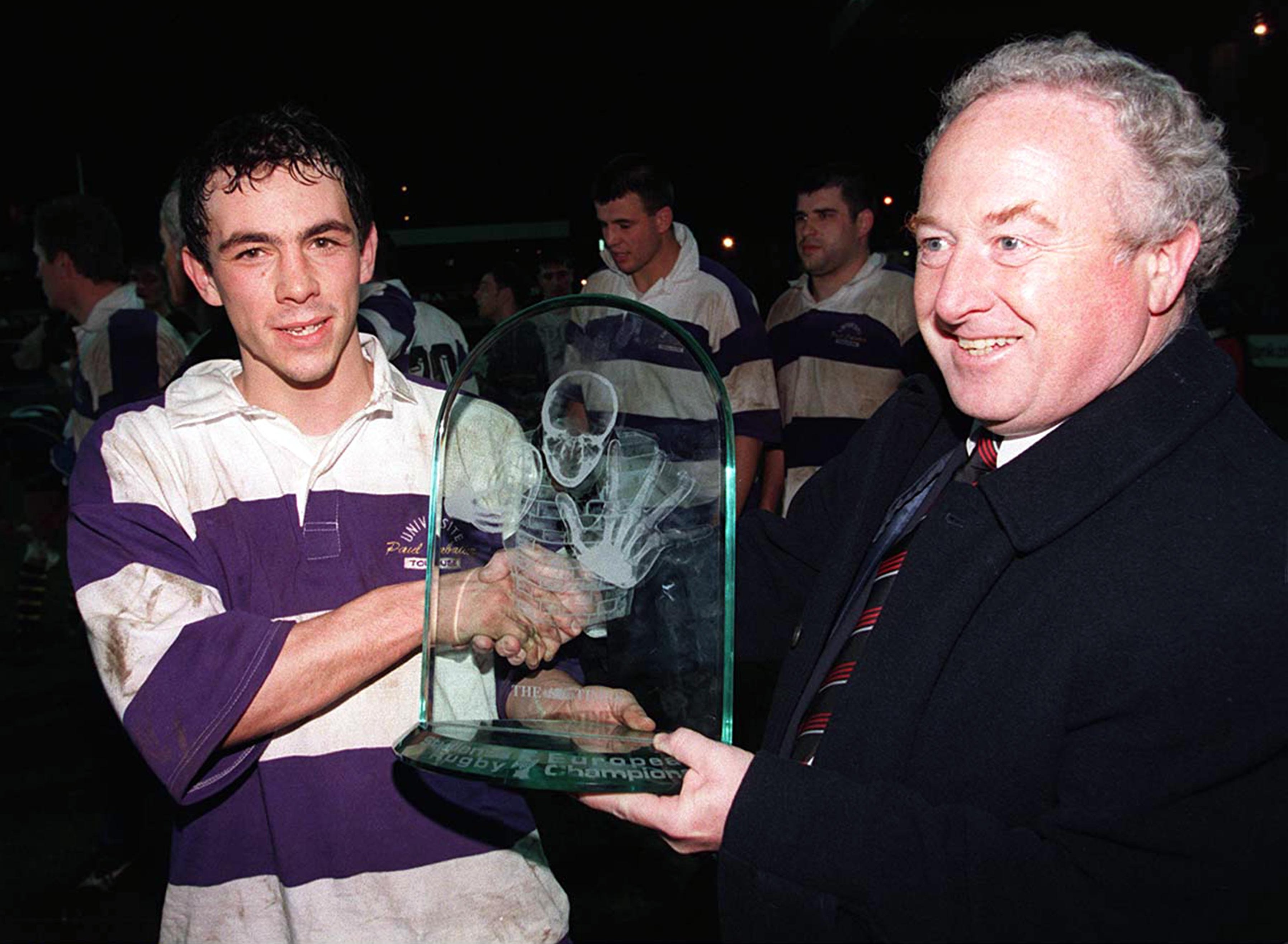
Julien Tilloles of Toulouse receives The Times’ sponsored trophy from Harty in 1998
HUW EVANS AGENCY
Uwic, now Cardiff Metropolitan University, blew away Queen’s University Belfast 107-10, and stuffed Exeter and Edinburgh to book a semi-final against Swansea. Delayed until the next February because of a waterlogged pitch, Uwic won the Welsh derby and faced Paul Sabatier University (PSU) for the championship. Mirroring the first Heineken Cup final, this time it was Cardiff versus Toulouse in the Welsh capital.
There were suggestions that the final would be a curtain-raiser to the Five Nations game at Wembley, to no avail. Uwic had Gareth Cooper and Nathan Budgett, future internationals, but the star was Xavier Garbajosa in a 52-37 win for PSU. Garbajosa actually played for France in the Wembley game, 19 days after the student final, scoring two tries in France’s 51-0 victory over Wales.
Renamed The Times Trophy for 1998-99, the competition returned with Rome and Barcelona taking part. In the quarter-finals, Brunel beat University College Dublin (UCD) 18-16 despite a conversion, two penalties and a drop-goal for the Irish fly half, one Brian O’Driscoll.
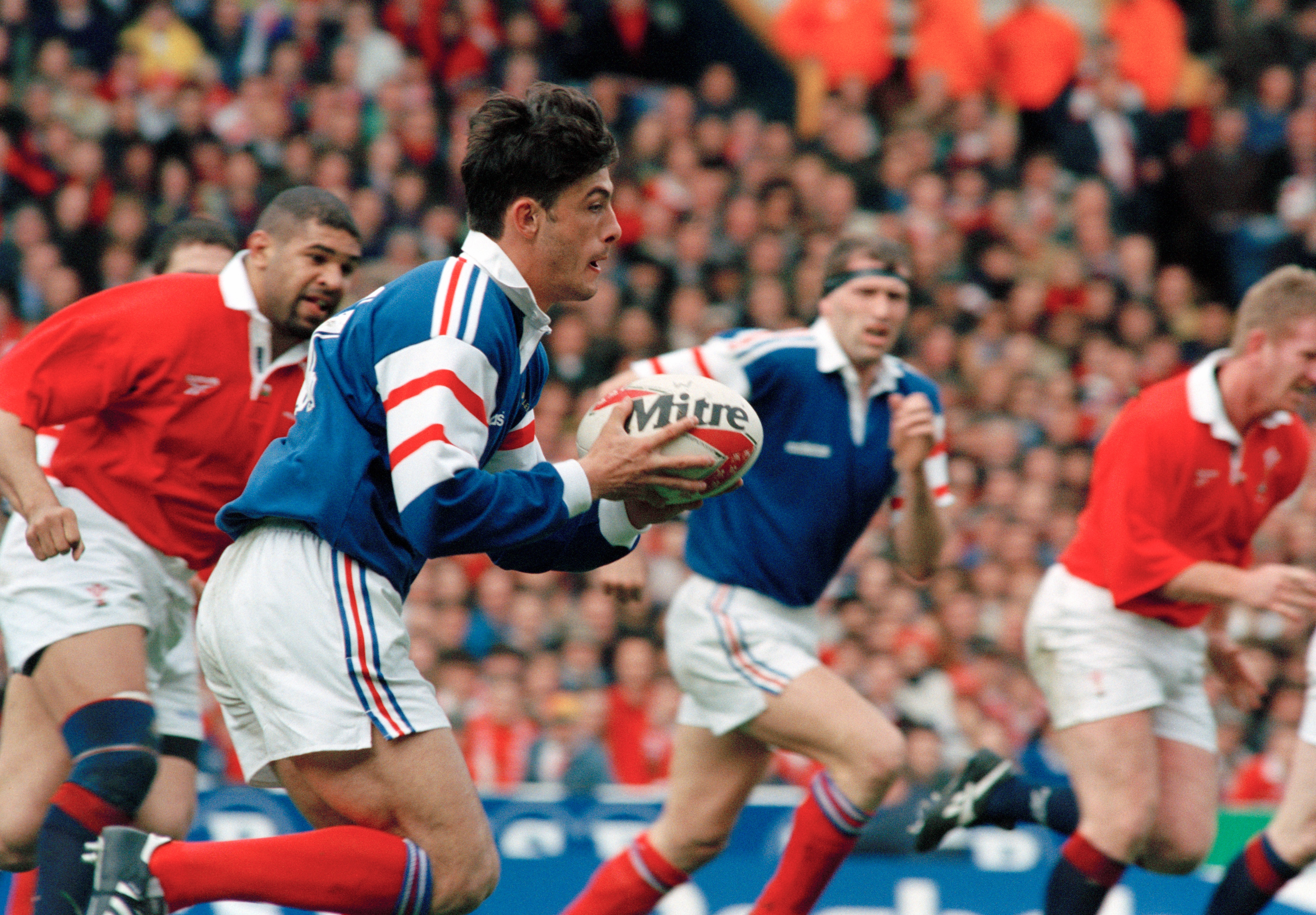
Garbajosa starred for France against Wales at Wembley, having impressed in the Student European Rugby Championship
MIKE BRETT/POPPERFOTO VIA GETTY IMAGES
Brunel had future internationals in Reuben Bijl (Netherlands), Matt Cairns (England), Donnie Macfadyen (Scotland) and Tom Shanklin (Wales), but that quality was not enough to reach the final as they lost 15-0 to Grenoble, who fielded Benjamin Boyet, a future five-cap fly half. This, however, was UCC’s year and a side featuring Peter Stringer, Jerry Flannery, Mike Ross and Mick O’Driscoll won the morning final 14-10 at Donnybrook.
UCC made the final again in 2000, while Bayonne-Pau progressed thanks to 19 points from the boot of Daniel Larrechea, the future Sale Sharks fly half, against Uwic. The mayor of Bayonne welcomed the players to the town hall before the final, which had Ed Morrison as referee and Michael Aylwin on site to cover the match for The Times. The home side won 19-6. A lack of sponsorship then restricted the scope of the fourth and — so it appears — final edition of the championship.
Sir Humphrey Appleby said in Yes, Prime Minister that Britain should protect the universities — “both of them”. The fictional cabinet secretary would be disgusted at the state of student rugby in 2025: as the Varsity Matches recede, the other seats integrate further into the elite.
The Inter-Varsity Athletics Board admitted rugby union in 1921-22, the same season that the Varsity Match moved from the wintry mist of The Queen’s Club to the greater accommodation of Twickenham. Bristol were champions that season, beating Leeds in the final at Welford Road, and among their number was Vince Griffiths, a fly half who played for Wales and the British Lions in 1924.

Charlie Marr scores Oxford’s third try as they won Varsity blues for a successive year in 2012
TIMES PHOTOGRAPHER MARC ASPLAND
That was the forebear to the continually improving Bucs Super Rugby, whose men’s competition has ten teams, including three in Wales and an English spread. The game between Bath and Exeter in October drew a crowd of more than 8,000 to the Rec, and the home side’s team-sheet read like a Bath academy line-up, including Tyler Offiah and Enoch Opoku-Gyamfi, who made his Italy debut in the autumn. Last Friday Durham, in their 150th anniversary season, met Cardiff at Rosslyn Park for the Ted Wood Challenge Cup, in honour of the coach who helped devise that short-lived European contest.
Though there is no Varsity Match equivalent over the Channel, the French Universities side has pedigree. They beat the touring Springboks in 1996, and won the Students World Cup in 1992, 1996 and 2000 with a string of future internationals. At the first edition in 1988 (won by New Zealand), England — with a squad featuring Tony Underwood, Victor Ubogu and Phil de Glanville — lost 18-16 to the Soviet Union.
France have the upper hand in the thriving, annual Crunch Universitaire. England Students first combined — Oxbridge, polytechnics and all — to face the French in 1986, losing 19-14 to a squad featuring Franck Mesnel (the fly half studied architecture at École des Beaux-Arts in Paris before he joined Racing Club de France and founded Eden Park). The most recent clash was in May, when France won 42-31 at Terrasson-Lavilledieu. Will Ramply, now of Bristol Bears, represented England, while France fielded two Racingmen — Kléo Labarbe and Yanis Basse — who started against Exeter Chiefs at the weekend.
It was not Mesnel but another flamboyant back who made his mark on the Varsity Match. In 1995, Jérôme Riondet became the first Frenchman to win a Blue in the fixture. Raised in Grenoble and schooled at the Sorbonne in Paris, Riondet irked Oxford officials by not wearing the standard tie. “I am extravagant sometimes, not very straight like English people are,” he told The Times 30 years ago. “I played last year for Harlequins. They have the nicest jerseys of all, not too dark, you know?”
Riondet also characterised the difference between the two nations. “In England, you wait until the referee turns round, then you punch someone,” he said. “In France, we react too quickly and the referee sees us.”