
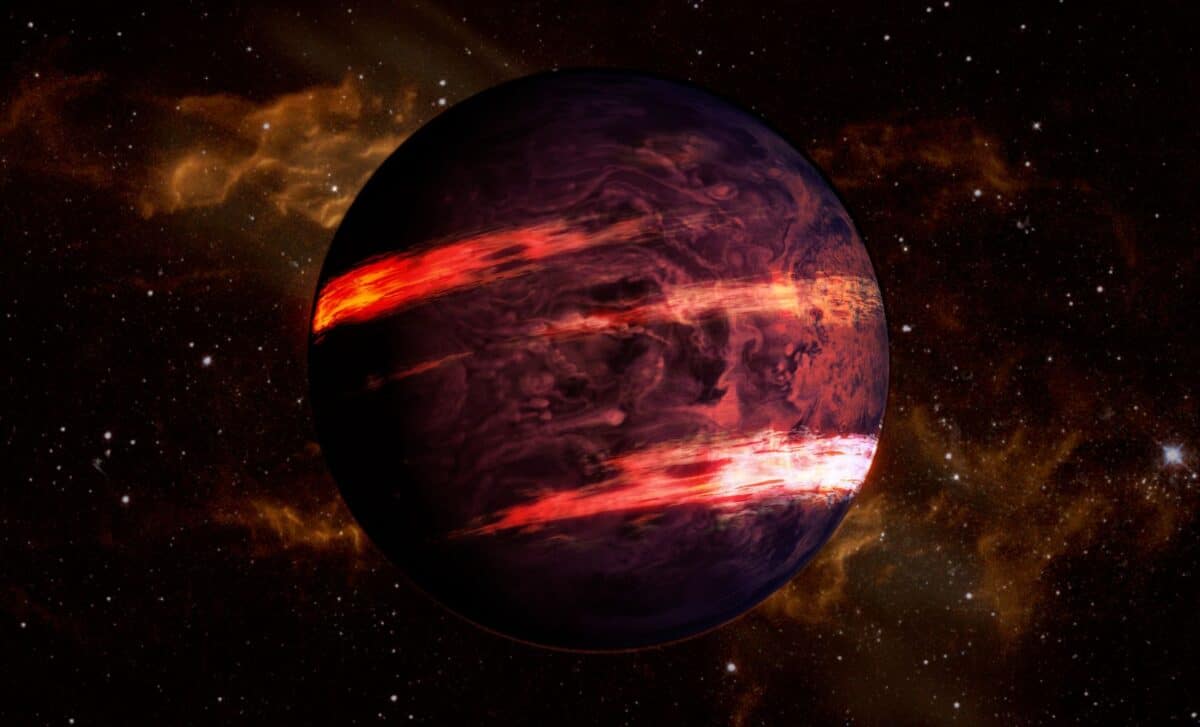
Astronomers from the University of Hawai‘i at Mānoa and other institutions have identified a new wide-orbit planet and a stellar companion around two young ultracool dwarfs located in the Taurus Molecular Cloud, a region only 430 light-years away. The companions, confirmed to be gravitationally bound, include a planetary-mass object and a faint stellar body that challenge existing classifications.
The findings come from the KOINTREAU survey, short for Keck Observations in the INfrared of Taurus and ρ Oph Exoplanets And Ultracool dwarfs, which uses adaptive optics imaging from telescopes such as Keck II and Gemini North. The results, published on December 4 on the arXiv preprint server, mark the first discoveries of the survey and contribute to the limited but growing catalog of young, directly imaged companions in star-forming regions.
A Planetary-mass Companion At 690 AU
The first object, named KOINTREAU-1b, was found orbiting the ultracool dwarf star XEST 17-036 at a distance of about 690 astronomical units. Its mass was estimated to be 10.6 times that of Jupiter, placing it in the planetary-mass range. According to the team, this makes KOINTREAU-1b only the fifth such planetary-mass companion discovered in the Taurus region.
The study, arXiv preprint server, revealed that KOINTREAU-1b’s spectral profile varies between observing epochs. This variation could suggest the presence of atmospheric clouds or possibly a disk encircling the object. As reported by the researchers:
“The slope of KOINTREAU-1b’s spectrum varies between epochs,” a sign that additional observations could help determine whether this is a structural feature or an effect of the viewing angle.
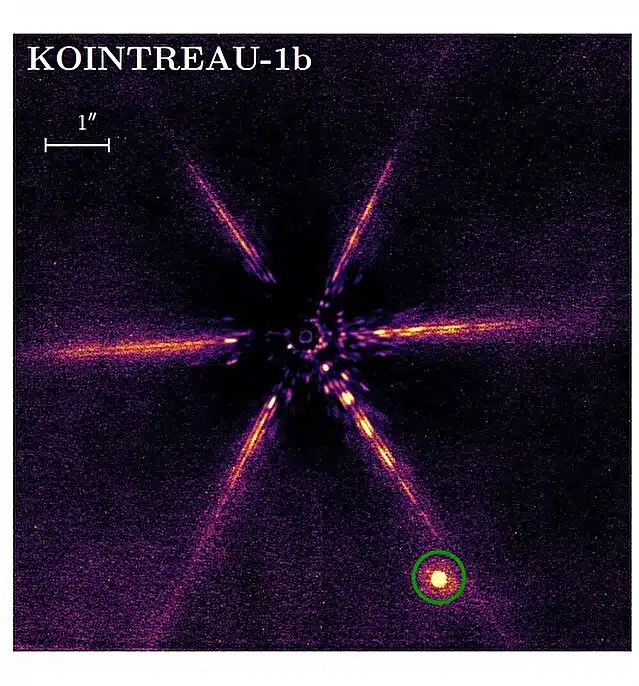 KOINTREAU-1b appears as the bright dot in the green circle (lower right), emerging after the host star’s glare is reduced. Credit: arXiv
A Faint Young Star With An Edge-on Disk
The second companion, designated KOINTREAU-2b, orbits the ultracool dwarf XEST 13-010 at a projected separation of 560 AU. Unlike KOINTREAU-1b, KOINTREAU-2b is a stellar object classified with a spectral type M4.5, but its faintness is unusual. As stated in the latest research, it is the faintest known M4.5 object in the Taurus region.
The team suggests that KOINTREAU-2b is a young star obscured by an edge-on disk, seen primarily in scattered light. This hypothesis is reinforced by the absence of hydrogen emission in its spectrum, an anomaly for stars of this type. As the researchers point out, this lack of emission makes the system stand out and warrants further investigation into the star’s orientation and accretion activity.
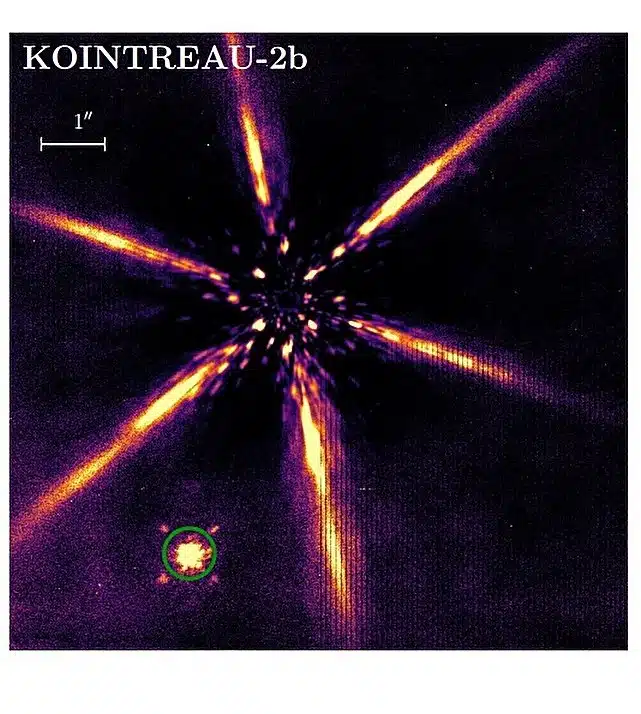 KOINTREAU-2b shows up as the bright speck in the green circle (lower left) after the star’s central glare is suppressed. Credit: arXiv
Early Returns From The KOINTREAU Survey
Both discoveries are part of the initial phase of the KOINTREAU survey, which targets young stars in the Taurus and ρ Ophiuchi regions. As the authors noted, the survey uses infrared pyramid wavefront sensing at Keck to push the limits of high-contrast imaging around faint and cool stars.
The identification of KOINTREAU-1b and KOINTREAU-2b provides valuable early data points for understanding substellar object formation at wide separations, which remains an open question in astrophysics. As stated in the published paper, the research team hopes that continuing the KOINTREAU campaign will lead to the discovery of more such objects.
“As the KOINTREAU survey continues, we hope to find more planetary-mass companions in both Taurus and Ophiuchus, providing valuable anchors for the earliest stages in the evolution of substellar objects and helping to expand the study of extremely young directly imaged companions.”