
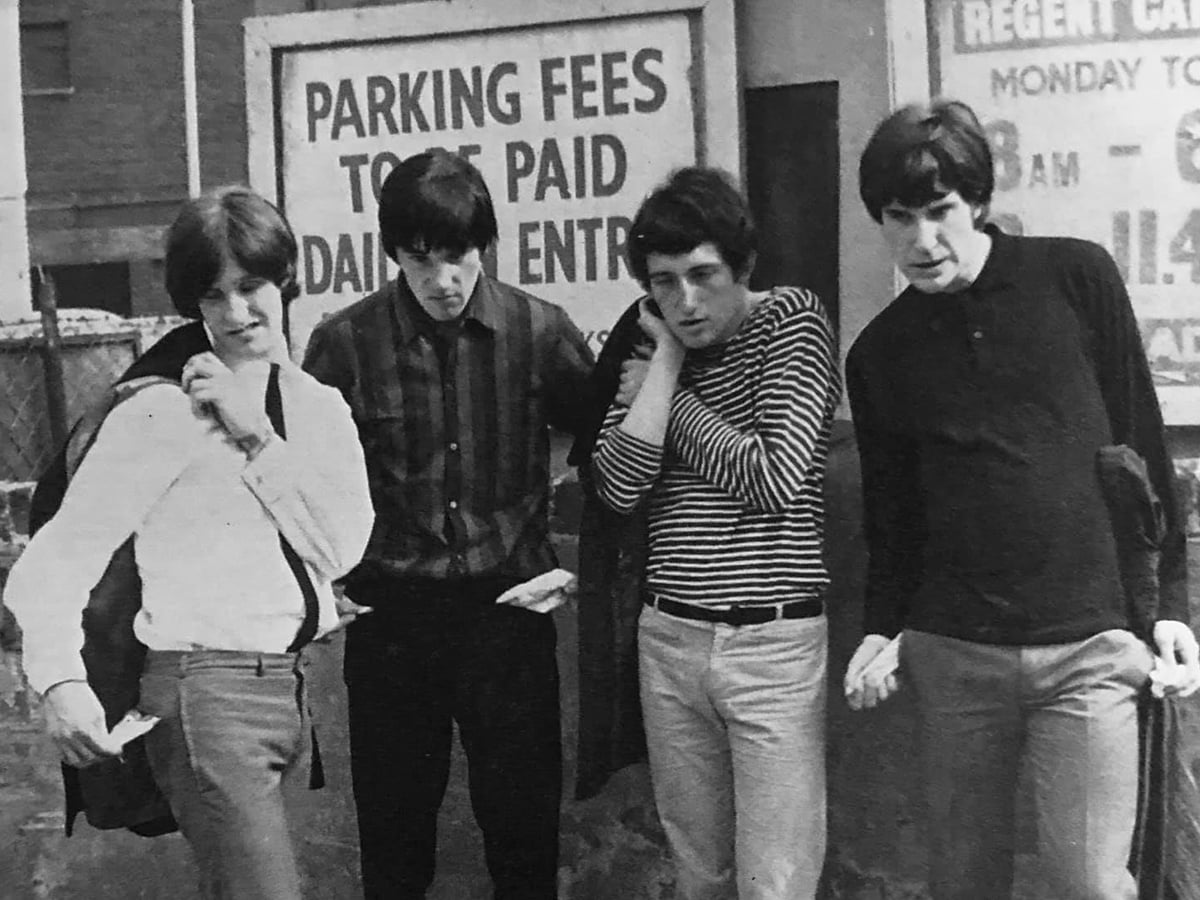
(Credits: Bradford TImeline)
Thu 18 December 2025 8:21, UK
It might seem like the British invasion bands just morph into one over time, but they’re very different entities. But what do The Rolling Stones, The Beatles, and The Kinks all have in common?
Apart from being three of the biggest bands of the 1960s, they were also all touched by the talents of an oft-overlooked session musician named Nicky Hopkins. Hopkins can be heard on such legendary tracks as ‘Gimme Shelter, by The Rolling Stones, ‘Revolution’ by The Beatles, John Lennon’s ‘Oh Yoko’, and the album, The Kinks Are the Village Green Preservation Society. And yet, the mention of Hopkins’ name is likely to be met with bewilderment.
Nicholas Christian Hopkins was born in Perivale, England, on 24 February 1944. He began playing the piano at the age of three and quickly caught the attention of a local piano tutor, who spotted his prodigious talent. By the time he was old enough to leave school, he’d already won a scholarship to the Royal Academy of Music. However, his musical ambitions were consistently undermined by Crohn’s disease, which had affected him and would continue to affect him his whole life.
However, in 1960, his studies were interrupted when, at just 16, he was asked to become the pianist with Screaming Lord Sutch’s Savages, a local R&B group. But just as the outfit was having its first taste of success, Hopkins’ health deteriorated, and he was forced to undergo a series of operations that nearly cost him his life and forced him to remain bedbound for 19 months. This close encounter with death convinced Hopkins to continue finding work as a session musician, and he soon became the most in-demand session pianist working in London in the 1960s.
In 1965, Hopkins would be invited by producer Shel Tamly to play with The Kinks. At that time, the group had already made an impression on the charts with tracks like ‘Dedicated Follower Of Fashion’, but it would be their three following studio albums that would cement their place in the annals of music history.
 Nicky Hopkins in session. (Credits: Far Out / The Session Man LTD)
Hopkins performed on four of The Kinks albums, including The Kink Kontroversy (1965), Face to Face (1966), Something Else by The Kinks (1967) and The Kinks Are the Village Green Preservation Society (1968). Hopkins became such a key part of The Kinks’ existence, that Rayh Davies even wrote a song inspired by him. ‘Session Man’ from Face to Face paints a portrait of Hopkins: the pianist who’s “not paid to think, just play”. The track opens with an extravagant flourish of a harpsichord played by Hopkins himself.
Ray Davies would later say of Hopkins: “His best work in his short spell with The Kinks was on the album Face to Face. I had written a song called ‘Session Man,’ inspired partly by Nicky. Shel Talmy asked Nicky to throw in ‘something classy’ at the beginning of the track. Nicky responded by playing a classical-style harpsichord part. When we recorded ‘Sunny Afternoon,’ Shel insisted that Nicky copy my plodding piano style. Other musicians would have been insulted, but Nicky seemed to get inside my style, and he played exactly as I would have. No ego. Perhaps that was his secret.”
It’s hard to tell whether ‘Session Man’ is a harmless portrait of Shelley or a subtle insult. At the time it was written, Davies and Hopkins were perfectly cordial with each other. But after the release of The Village Green Preservation Society, Hopkins incensed The Kinks frontman by maintaining that “about seventy per cent” of the keyboard work on the album was his. Davies, however, had already credited himself.
But after Hopkins’ death in 1995, Davies put any bad blood behind him and opened up about his admiration for the musician who, arguably, defined The Kinks’ sound. In an interview with The New York Times, Davies said: “Nicky, unlike lesser musicians, didn’t try to show off; he would only play when necessary. But he had the ability to turn an ordinary track into a gem – slotting in the right chord at the right time or dropping a set of triplets around the backbeat, just enough to make you want to dance. On a ballad, he could sense which notes to wrap around the song without being obtrusive. He managed to give ‘Days,’ for instance, a mysterious religious quality without being sentimental or pious.”
Hopkins would go on to work with a dizzying number of recording artists throughout the ’60s and ’70s before joining the church of Scientology in the 1980s. Hopkins credited the church for helping him kick his alcohol and drug addiction and, as a consequence, remained a vocal advocate of Scientology for the rest of his life. At this time, he began working as an orchestrator and composer for film, working on titles such as 1993’s The Fugitive. Although you might not know him by name, the legacy of the ’60s most important session musician lives on in the legendary recordings he worked on.
What other legendary songs did Nicky Hopkins work on?
Hopkins can easily be considered the most valuable session musician of the 1960s. Though some might pitch that towards Jimmy Page because of the sheer volume of songs he helped to bring to light during his own session days, Hopkins’ contributions are incredibly hefty and weighty in legacy.
Here are ten of the best.
‘Sympathy for the Devil’ – The Rolling Stones‘Gimme Shelter’ – The Rolling Stones‘Angie’ – The Rolling Stones‘She’s a Rainbow’ – The Rolling Stones‘You Can’t Always Get What You Want’ – The Rolling Stones‘Revolution’ – The Beatles‘Don’t Let Me Down’ – The Beatles‘Across the Universe’ – The Beatles‘Waterloo Sunset’ – The Kinks‘Sunny Afternoon’ – The Kinks
So, the next time you listen to ‘Sunny Afternoon’, or ‘Happy Xmas (War Is Over)’ remember the name, Nicky Hopkins.
Related Topics
The Far Out Beatles Newsletter
All the latest stories about The Beatles from the independent voice of culture.
Straight to your inbox.