
The strains of Rudolph the Red-Nosed Reindeer coming out of the radio or supermarket sound system make uncomfortable listening for Rebecca Daley.
For the past 14 years she has battled with a condition that turns her skin bright red, causes irritation and pain – and, on occasion, makes her nose swell to three times its size and almost ‘glow’ with redness, she says.
‘I hated it. The nose is in the centre of the face, you can’t hide it. Near Christmas time, people would shout: ‘Come guide my sleigh!’
Rebecca, 39, a creative arts support worker from Chorley in Lancashire, suffers from rosacea. Until recently, it caused her such embarrassment she avoided leaving the house.
Rebecca had no skin problems at all before the birth of her son, Elliot, in 2011. But it was traumatic – the baby was in a foot-first, breach position and stopped breathing for a few moments as doctors struggled to retrieve him from the birth canal.
Elliot, now 14, spent two-and-a-half weeks in intensive care after doctors tried for 22 minutes to resuscitate him. Rebecca believes the stress caused physical changes in her body. ‘It changed something in me,’ she says.
In the weeks that followed, she noticed a strange red rash consisting of pustules and cysts on her face.
‘I was so busy getting to know my son and recovering from the birth to pay too much attention to it, but it didn’t go away,’ she says, and ‘was itchy and burned’.
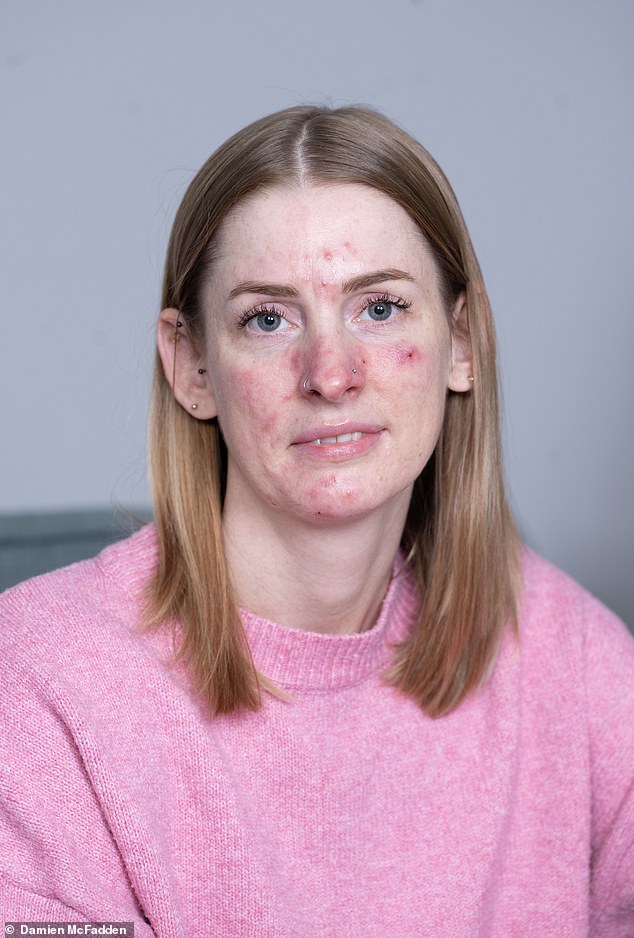
Rebecca Daley, 39, has struggled with rosacea since the birth of her first son in 2011
Imagining it would easily be remedied, she initially tried over-the-counter creams, acne treatments and spot gels. But nothing worked.
Finally, when her son turned one, Rebecca visited her GP, who told her it was rosacea.
She’d heard of the condition but was dismayed to be told it was ‘something lots of people got’ and ‘had to just put up with it’, she recalls.
About 2.9million adults in the UK suffer from rosacea, official estimates claim. It causes facial flushing that may look like persistently dilated blood vessels, ‘along with small bumps and pus-filled spots similar to acne’, says Dr Vani Agarwal, a consultant dermatologist and spokesperson for the British Skin Foundation.
It can also cause overgrowth of the oil-secreting glands on the nose (known as rhinophyma) – which in turn leads to the nose to swelling in size – as well as irritation of the surface of the eyes and eyelids, causing dryness, itching and redness, she explains.
‘In severe rhinophyma, the nose can become several times larger than its normal size – and, in rare cases of giant rhinophyma, it can also obstruct the nasal airways leading to breathing difficulties,’ adds Dr Agarwal.
Rosacea usually begins between the ages of 30 and 50 and is more common in women and people with fairer skin tones.
Its exact cause is unknown, but it’s thought to be a combination of genetic and environmental factors.
Rosacea can be trigged by several factors such as stress, alcohol, exercise, extreme temperatures, spicy foods and hot drinks.
‘When we’re under stress, our bodies release hormones, including cortisol, which increase inflammation and make blood vessels more reactive – both of which can lead to the flushing and sensitivity typical of rosacea,’ says Dr Derrick Phillips, a consultant dermatologist at OneWelbeck private clinic in London.
Pregnancy hormones can have a similar effect: changes in oestrogen and progesterone can alter blood flow, increase skin sensitivity and destabilise the skin’s barrier, making it more sensitive to triggers.
‘For someone with an underlying tendency to rosacea, the combination of emotional stress and hormonal changes around pregnancy or childbirth can bring symptoms to the surface or make them more pronounced,’ explains Dr Phillips.
Blushing easily (not simply when embarrassed, but also as a more sustained reaction and to certain foods, for instance) can signify a tendency to rosacea.
Blushing occurs when chemical messengers cause the muscles in the blood vessel walls to relax, leading to dilation and increased blood flow to the skin.
Treatment typically includes oral antibiotics which have anti-inflammatory properties, such as doxycycline, lymecycline and erythromycin – and, for more severe cases, isotretinoin (sold as Roaccutane) can also be effective at drying up the oil-secreting glands.
Rhinophyma is typically treated with resurfacing lasers (such as CO2 or Er:YAG), which help shrink dilated blood vessels and thin thickened skin, Dr Phillips adds.
Rebecca spent six years struggling with her condition but, despite trying creams as well as prescribed antibiotics, nothing helped. And the anxiety caused by her appearance made things worse.

Dr Derrick Phillips, a consultant dermatologist in London, explains how stress releases hormones which can increase inflammation and make blood vessels more reactive
‘I worked in a legal firm office and dreaded going in’ she says. ‘I’d apply make-up but it never covered it. In winter, I looked like Rudolph the Red-Nosed Reindeer, and people called me that, too. I dreaded going out and facing people. I avoided social gatherings and got really anxious.’
This stress most likely exacerbated her symptoms. One US study involving 544 rosacea patients, by the National Rosacea Society, found 62 per cent reported flare-ups due to stress at least once a month, while 11 per cent said it was a daily occurrence.
Finally, aged 33, Rebecca saw a different GP who referred her to a dermatologist. She was prescribed Roaccutane for her acne, but this left her lips and face very dry.
‘It was so uncomfortable and still didn’t really get rid of the redness,’ she recalls. ‘I tried it for weeks but nothing changed, I felt worse, so I stopped taking it.’
Rebecca tried cutting out other potential triggers – including spicy foods and alcohol – but couldn’t control her stress.
In despair, one day in 2019, she posted a picture of herself on Instagram, and was amazed when dozens of women called her brave in the comments, wanting to connect.
‘I decided then that there was no point hiding any more,’ she says. ‘I started a personal page and mentioned my rosacea, and was inundated with followers all saying the same thing – that they were being fobbed off.’
In time, Rebecca was approached by companies specialising in products for rosacea. ‘Some worked, some didn’t,’ she says.
She then the tried a serum called Kalme made with caper extract – ‘I’d use it whenever I felt a flare-up coming and it would instantly calm and soothe’, she says. ‘Finally, I found something that worked.’
Rebecca carried on using it, and bought her own supplies when the free samples ran out. She also used a physical sunblock containing zinc.
Not all rosacea treatments will suit everyone with the condition, however.
‘Treatment is tailored according to the type of rosacea,’ explains Dr Agarwal. ‘Topical agents such as azelaic acid and ivermectin 1 per cent cream, used alongside anti-inflammatory antibiotics such as doxycycline, can be very effective. The latter can target the papules and pustules caused by rosacea, but are not very helpful for the redness.’
Redness and facial flushing can be effectively treated again using lasers, adds Dr Phillips, to precisely target and reduce facial redness and visible blood vessels. Some, such as DermaV, are available in NHS dermatology and plastic surgery departments.
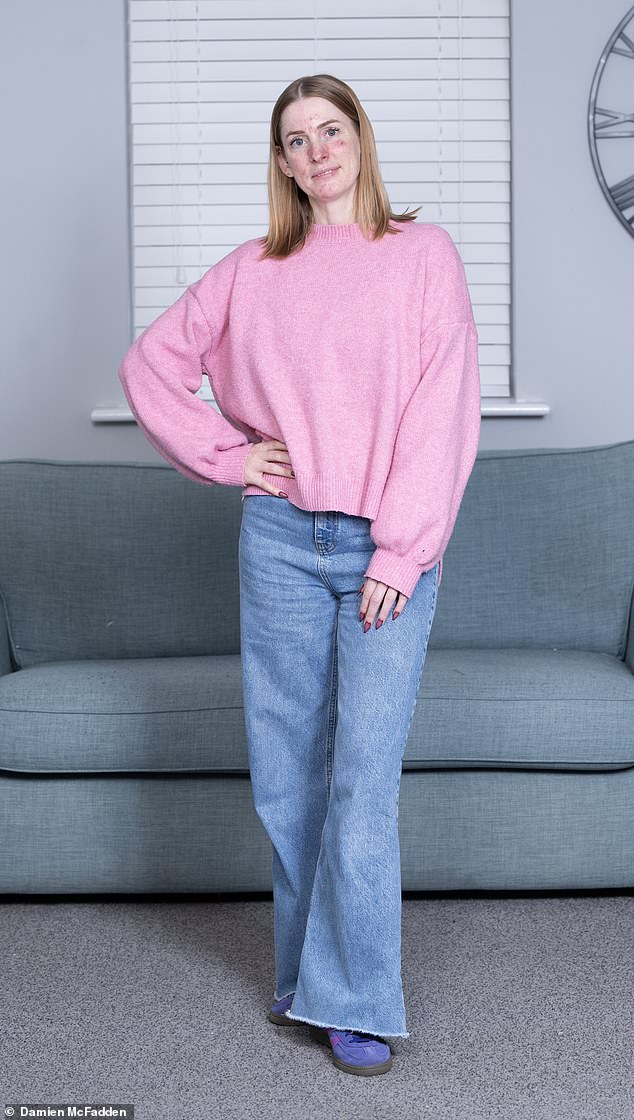
Rebecca has regained her self-confidence and now competes in body-building contests
Increasingly, some dermatologists are taking a more holistic approach. This involves not only caring for the skin targeted treatments, but the gut, too – specifically the gut microbiome (the community of microbes that live there that are increasingly linked with health conditions).
The theory is that an imbalance in the microbiome fuels inflammation that can damage the outermost layer of the skin which, in turn, makes the skin more sensitive to rosacea triggers such as sunlight.
One of the leading exponents of this is Dr Justine Hextall, a consultant dermatologist at the private Tarrant Street Clinic in Arundel.
Treatment may include a course of probiotics (supplements of ‘good’ bacteria) and a diet rich in prebiotic foods including leeks, broccoli, apples and bananas. These help feed the beneficial microbes, which in turn produce fatty acids to aid inflammation reduction and support a healthy skin barrier.
More surprisingly, perhaps, patients are also advised to wear sunscreen throughout the year, as research suggests up to 85 per cent of rosacea patients have sun sensitivity, says Dr Hextall.
Dr Agarwal emphasises its use, even in winter: ‘Applying a broad-spectrum SPF30 or SPF50 daily can help reduce the frequency of flare-ups and protect the skin.’
Now, Rebecca offers advice and help to other people with rosacea and says that, despite still getting flare-ups, her condition is mostly under control.
Her nose becomes red at times, but is a normal size again, and her self-confidence has returned – she’s even competing in body-building contests. ‘It is something I would never have dreamed of doing a few years ago,’ she says.
‘There is no cure for my condition. But now I am embracing it and learning to live with whatever my nose looks like – Rudolph or not.