
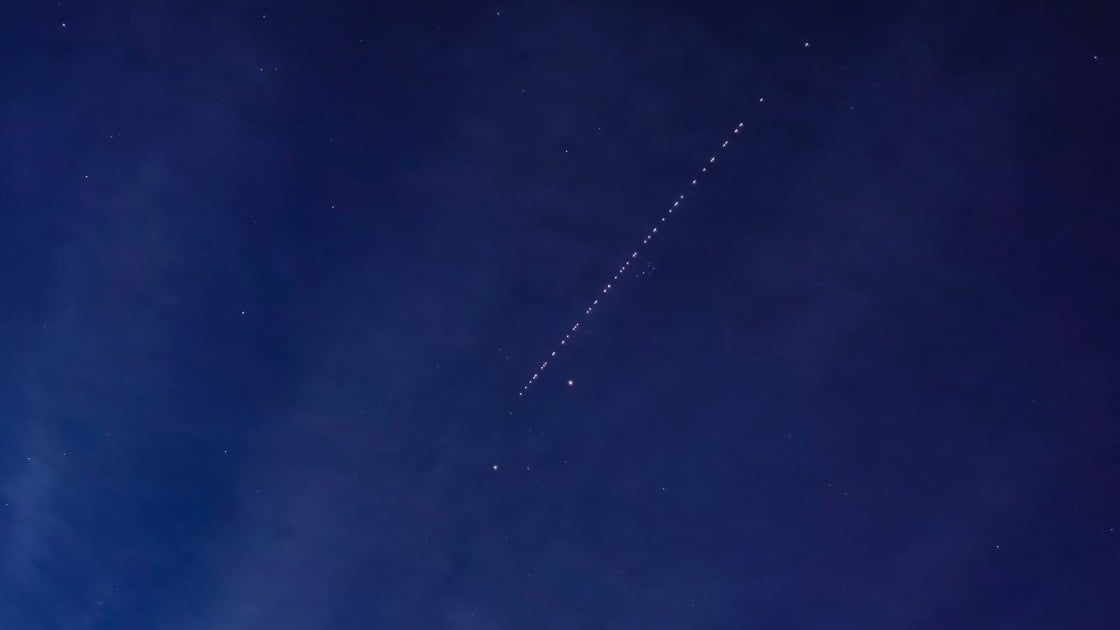
A Starlink satellite has suffered a malfunction that caused it to eject a small amount of debris into Earth’s orbit, according to SpaceX.
Launched on Nov. 23, the Starlink satellite, 35956, “experienced an anomaly” on Wednesday while orbiting the Earth at 418 kilometers, “resulting in loss of communications,” SpaceX tweeted.
It’s unclear exactly what happened, but “the anomaly led to venting of the propulsion tank, a rapid decay in semi-major axis by about 4 km, and the release of a small number of trackable low relative velocity objects,” SpaceX says.
The statement raises questions about whether the satellite experienced a minor explosion or was struck by something. It also suggests the satellite can no longer maneuver with its built-in propulsion, even if contact is re-established.
This Tweet is currently unavailable. It might be loading or has been removed.
The incident caused the satellite to drop by about 4 kilometers. Although it remains largely intact, SpaceX says the vehicle is “tumbling and will reenter the Earth’s atmosphere and fully demise within weeks.” It’ll also fall below the International Space Station, “posing no risk to the orbiting lab or its crew,” the company added.
A relatively small number of Starlink satellites have experienced malfunctions when they were being retired, including propellant leaks and power failures, which the company has reported to the US Federal Communications Commission. Last year, SpaceX also de-orbited 100 satellites after an issue was identified that could cause them to later fail.
In this case, it looks like SpaceX issued the public warning about satellite 35956 because it released fragments that could pose an orbital hazard. The company is now coordinating with NASA and the US Space Force to track the debris. In its tweet, SpaceX added, “As the world’s largest satellite constellation operator, we are deeply committed to space safety.” The Starlink network currently spans over 9,000 orbiting satellites.
Recommended by Our Editors
“We take these events seriously. Our engineers are rapidly working to root cause and mitigate the source of the anomaly and are already in the process of deploying software to our vehicles that increases protections against this type of event,” SpaceX said.
Starlink satellites also faced a potential collision risk with a Chinese-deployed satellite last week. In response, the company has been calling for greater data sharing between satellite operators.
Starlink satellites have been designed to fully disintegrate upon reentering the Earth’s atmosphere. Earlier this year, the company retired hundreds of older satellites by plunging them into the atmosphere. Still, there’s a chance some small, but usually harmless fragments can survive re-entry, the company has previously said.

Get Our Best Stories!
Your Daily Dose of Our Top Tech News

Sign up for our What’s New Now newsletter to receive the latest news, best new products, and expert advice from the editors of PCMag.
Sign up for our What’s New Now newsletter to receive the latest news, best new products, and expert advice from the editors of PCMag.
By clicking Sign Me Up, you confirm you are 16+ and agree to our Terms of Use and Privacy
Policy.
Thanks for signing up!
Your subscription has been confirmed. Keep an eye on your inbox!
About Our Expert

Michael Kan
Senior Reporter
Experience
I’ve been a journalist for over 15 years. I got my start as a schools and cities reporter in Kansas City and joined PCMag in 2017, where I cover satellite internet services, cybersecurity, PC hardware, and more. I’m currently based in San Francisco, but previously spent over five years in China, covering the country’s technology sector.
Since 2020, I’ve covered the launch and explosive growth of SpaceX’s Starlink satellite internet service, writing 600+ stories on availability and feature launches, but also the regulatory battles over the expansion of satellite constellations, fights with rival providers like AST SpaceMobile and Amazon, and the effort to expand into satellite-based mobile service. I’ve combed through FCC filings for the latest news and driven to remote corners of California to test Starlink’s cellular service.
I also cover cyber threats, from ransomware gangs to the emergence of AI-based malware. Earlier this year, the FTC forced Avast to pay consumers $16.5 million for secretly harvesting and selling their personal information to third-party clients, as revealed in my joint investigation with Motherboard.
I also cover the PC graphics card market. Pandemic-era shortages led me to camp out in front of a Best Buy to get an RTX 3000. I’m now following how President Trump’s tariffs will affect the industry. I’m always eager to learn more, so please jump in the comments with feedback and send me tips.