
Brooke Bailey had just started working at a Pennsylvania nail salon in March 2025 when she started experiencing an ‘aching, throbbing’ pain in her left hip.
At first, Bailey thought nothing of it. But when the pain worsened and radiated down her leg and into her ankle, she sought medical help.
Her doctor suspected she had tendinitis – inflammation of the tendons, the thick cords that attach muscle to bones.
While tendinitis, which affects hundreds of thousands of Americans every year, can come on suddenly after injury, most develop it from repetitive motions.
Doctors blamed the suspected condition on the 23-year-old being 5ft 9in tall and sitting in a salon chair all day.
‘The doctors had mentioned that it could be because of my job…’ Bailey said. ‘Some days were worse than others, and I tried to figure out what was triggering it, but at the time I didn’t know what it was.’
Doctors referred her to physical therapy, but the pain worsened and left her unable to do the exercises. It took multiple doctor appointments over seven more months before a physician ordered an MRI scan.
Finally, in October 2025, the MRI revealed Bailey had two tumors: one in her femur and one in her groin. Soon after, she was diagnosed with stage four Ewing sarcoma, a rare cancer that grows in bone cells and the soft tissues surrounding the bones.

Brooke Bailey (pictured), a 23-year-old nail technician from Pennsylvania, suffered hip pain for months, which doctors insisted was due to her height and sitting at her job
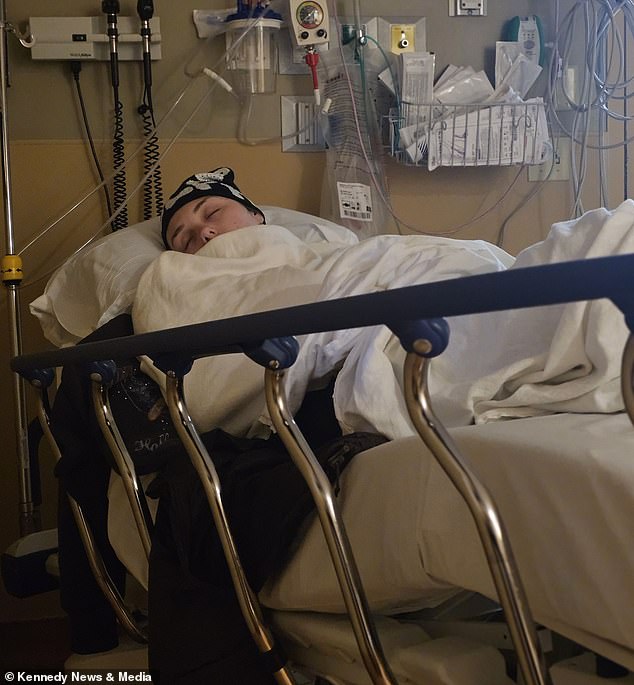
Bailey is pictured above during cancer treatments. Doctors will determine in January whether she needs surgery alongside her current chemotherapy plan
Your browser does not support iframes.
‘I never thought in my mind that it was cancer, so it was scary, but I kind of felt relieved, too, because I was like, “I’m not crazy. There is something wrong and I knew it the whole time,”‘ Bailey said.
‘I was like, “What’s next? I’m ready to start the healing process because I want my life back.”‘
Ewing sarcoma affects just 200 to 250 Americans every year, the vast majority of whom are children and young adults. It’s unclear exactly how many annual deaths there are because the cancer is so rare, but experts estimate there are several dozen.
The overall five-year survival rate is 81 percent, according to the American Cancer Society. If it spreads to other organs, that rate drops to 41 percent.
Stage four cancer means the disease has spread from its primary site – Bailey’s cancer likely spread from her femur to her groin area.
Symptoms include bone pain, fractures, swelling or tenderness near the affected areas. Some patients may also feel a lump in their arm, leg, chest or pelvis, according to the Mayo Clinic.
Bailey is now undergoing six rounds of chemotherapy and will be assessed in January to determine if she needs surgery.
Her mother, Marissa Koons, has set up a GoFundMe page to help raise money for egg retrieval, as chemotherapy can destroy eggs and lead to infertility. The fundraiser also covers travel and accommodations for the procedure.
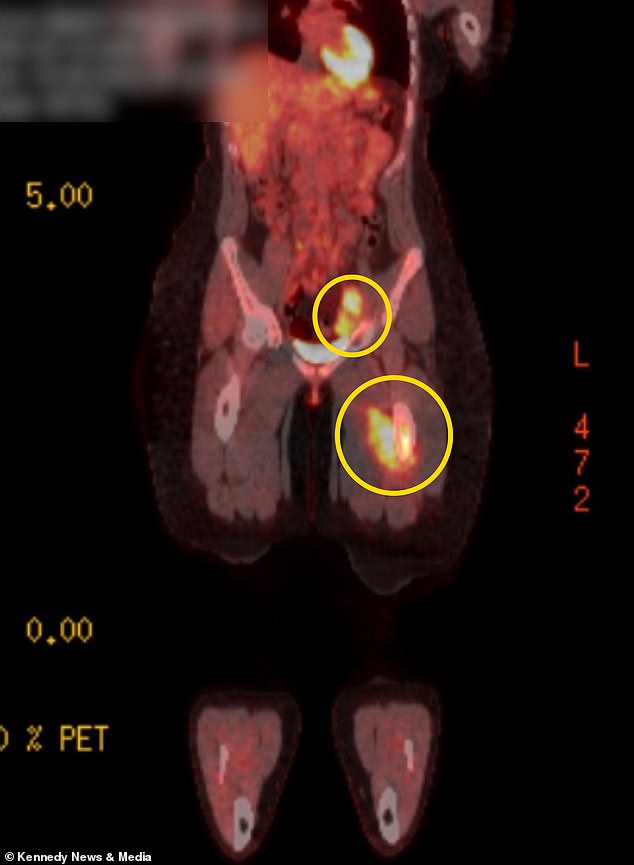
The circled sections in the above scan show tumors in Bailey’s femur and groin

Bailey’s mother (pictured left with Bailey) set up a GoFundMe to help with her daughter’s egg retrieval. They wanted to do the procedure so she can possibly have children in the future
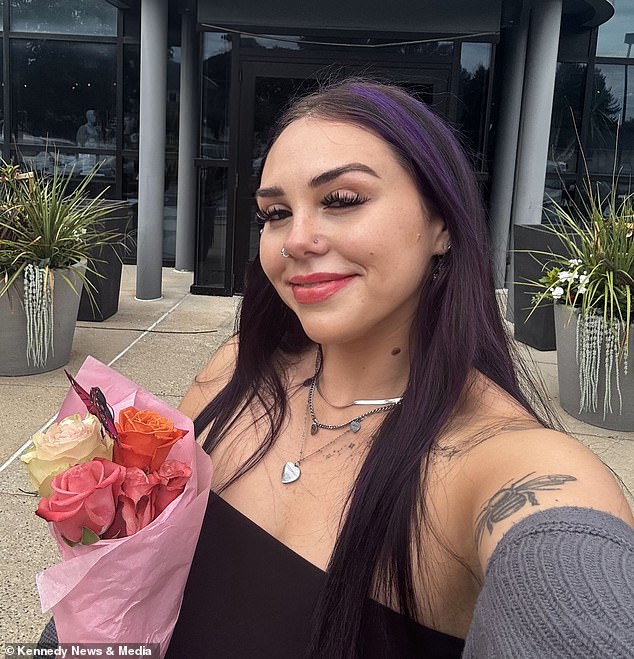
Bailey (pictured) is undergoing treatment and is encouraging other young people to seek a second opinion if they feel something is wrong
‘We used that money for the egg retrieval because the insurance didn’t cover that at all,’ Koons said. ‘[The fundraiser] exceeded the goal, and we’re at over $7,000 now, which has helped us to pay for the egg retrieval without me going into my credit card debt.
‘I had to stay at a hotel for this round of chemo, the travel, prescriptions. It really did help, but most of it went to the egg retrieval because that really did need to be taken care of.’
In the meantime, Bailey is encouraging other young people to look for a second opinion if they are repeatedly dismissed by their doctors.
‘I’ve learned that you really are your biggest advocate for yourself, and if you don’t like what somebody says, go see somebody else,’ she said. ‘I wish that’s what I had done. You are your [own] person, and you need to take care of yourself…
‘You really need to be kind of forceful when it comes to [advocating for yourself with doctors], which is sad. But if you know that there’s something wrong with you, then you know. I knew that there was something wrong with me. I didn’t know that it was cancer, but I knew deep down inside that there was something wrong.
‘I think the biggest takeaway from this is to listen to your body.’