
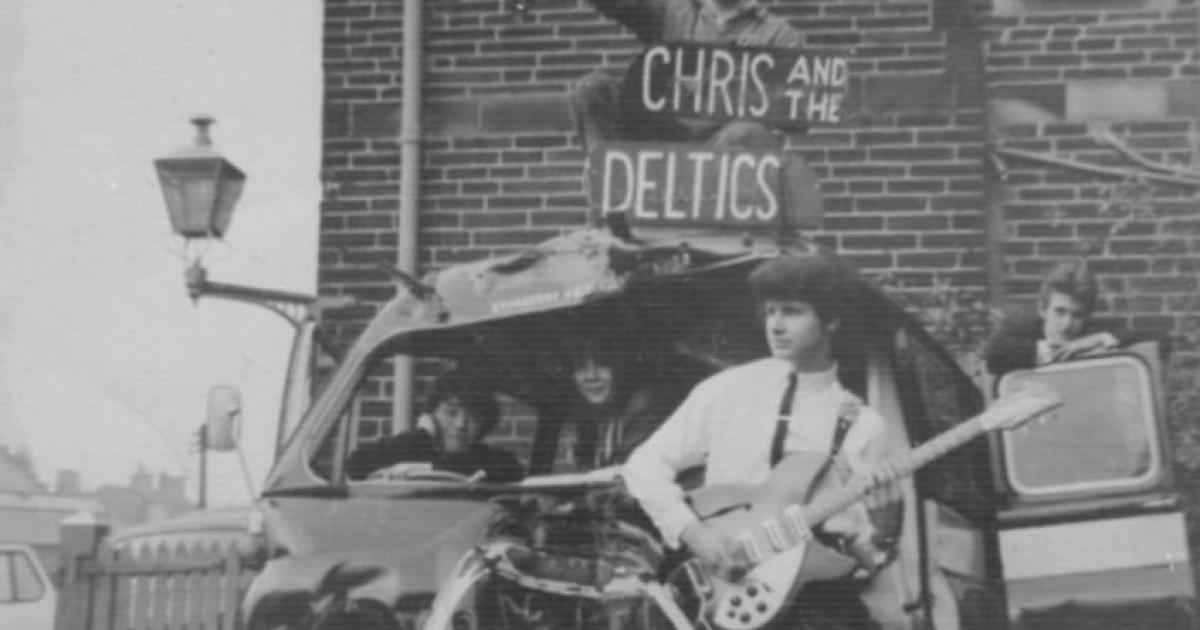
Chris and the Deltics started out in 1962 as a skiffle, country and western group called Jessie and the James Boys, with Dennis Raynor, Ron Short and Roy Atkinson.
Their music was outdated, so something had to change. Within a few weeks the group was completely reorganised, with Dennis Raynor, rhythm guitar, Roy Atkinson, bass guitar, Robert Ayres, lead guitar, Dave Potts, drums, and Ron Short their manager. The group invested in Futurama’s guitars from Moore’s on North Parade and the drummer bought a second-hand set of drums once used by the Temperance Seven.
A new name was supplied by Ron Short. He was a railway signalman and chose Deltics as this was a large diesel locomotive of the time – and he liked the name. Dennis Raynor had always wanted to be called Chris, and as he was the lead singer the group’s name was chosen.
With Ron’s management skills, they were soon playing throughout West and South Yorkshire and in many pubs and clubs locally, including the Prince Arthur on Sticker Lane, the Black Bull in Denholme, the White Horse in Wibsey and the salubrious King’s Head in Westgate, as well as many in Leeds, such as the popular Star and Garter in Kirkstall.
In 1963 they played at the famous Birkenshaw Agricultural Fair, although this was quite a shock for a group with limited amplification.
Early in 1964 Dave Potts left, and his place was taken by the experienced drummer John White. At around the same time lead guitarist Robert Ayers left. John Raywood, originally from Goole, joined in his place.
In 1964 there was a setback that could have had serious consequences. At Stump Cross near Northowram their van hit a lamp standard by the junction of the Bradford, Halifax and Leeds roads. The lamp was demolished and the vehicle was a write-off. Luckily there were no serious injuries, other than to Roy Atkinson, who was thrown through the windscreen (this was pre-seatbelt days), causing a perforated ear drum and a week in hospital. All the instruments were thrown out of the van when the back door was flung open, and although the guitars were in cases they were all damaged in some way. The local council made them pay £120 for a new lamp standard and £20 for repairs. The rigours of the pop world.
The group’s popularity continued well into 1965. Drummer John White moved on, replaced by Paul Robinson, and John Raywood also left. Alan Bennett, a good keyboard player, and female vocalist Mary ‘Misty’ Maddison were recruited, to give the group some depth.
In 1966 they had an average of 10 bookings a month, most of them at top venues, including Haddon Hall in Leeds, the Adelphi Hotel in Harrogate, the Silver Blades ice rink in Bradford, the White Swan in Pontefract and the American airbase at Menwith Hill.
Over this period the name of the group changed to Four U Four. However, in September 1966 the diesel had run out, and the group was no more.
The van accident costs £140 in1964 – in today’s costs about £2,025. It was all part of the days of having a group and still carrying on, regardless of setbacks.
* Derek and collaborator, musician Reuben Davison, profile singers, bands and musicians from Bradford’s 1950s and 60s music scene in their website: wwwwhenbradfordrocked.co.uk