
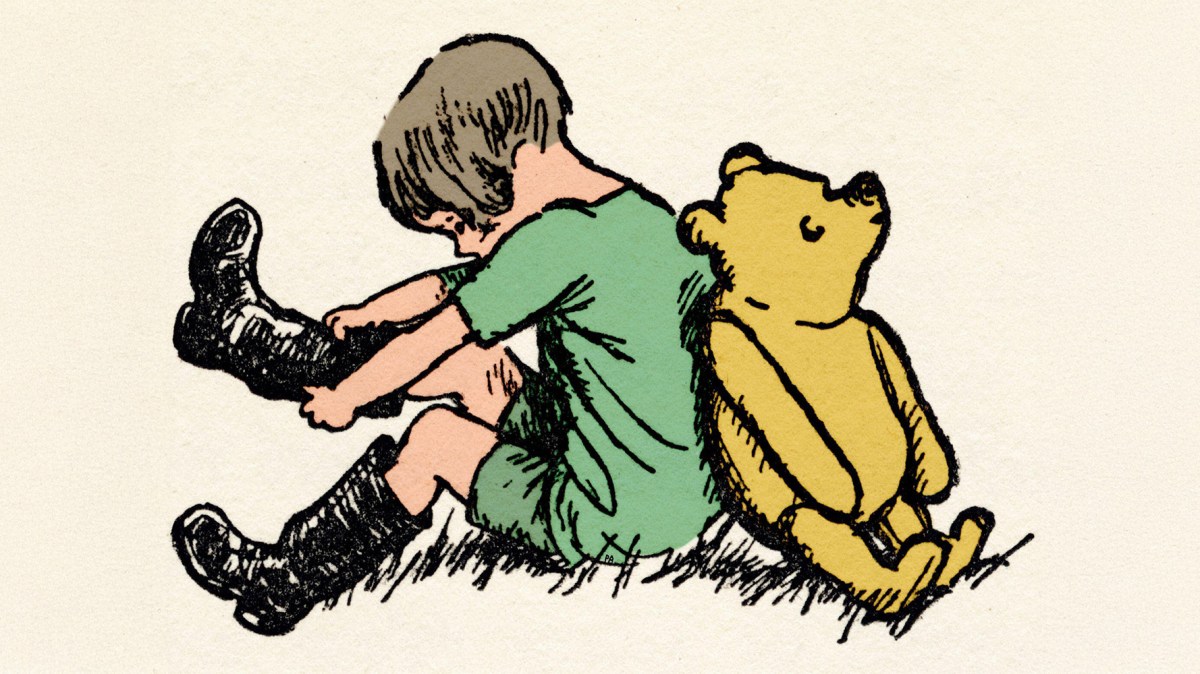
One hundred years after the first appearance of Winnie-the-Pooh in December 1925, the “bear of very little brain” remains as popular as ever, a quiet rebuke to our age of optimisation. Alan Alexander Milne’s dreamy adventures in Hundred Acre Wood do not hurry. They ponder honey, the weather, the moral weight of a small decision and, of course, the unpredictability of winged insects. “You never can tell with bees.”
Most of all, they celebrate childlike imagination. Here, we publish the original Pooh story, The Wrong Sort of Bees. AA Milne — a playwright, Punch humourist and survivor of the Somme — was commissioned to write it for London’s Evening News on Christmas Eve in 1925. It was a huge success, thanks in part to the accompanying illustrations. Of course, Milne’s son, Christopher Robin, and his teddy, Edward Bear, had already appeared in When We Were Very Young (1924), the duo’s first collection of whimsical poetry for children.
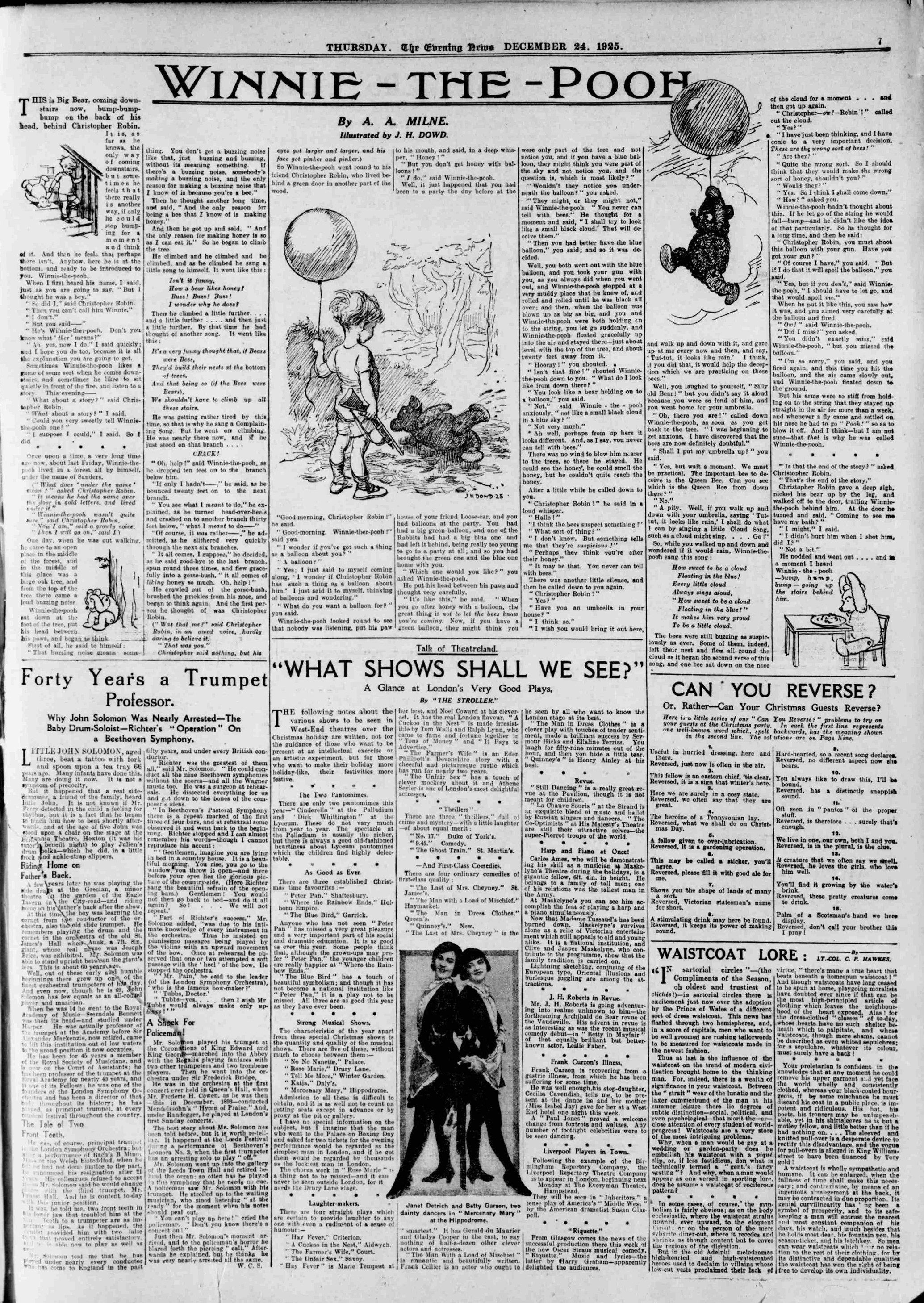
EVENING NEWS/ASSOCIATED NEWSPAPERS
James Campbell, author of The Men Who Created Winnie-the-Pooh, believes the key to the Pooh books was Milne’s “unexpected deep love for his only child. Like many late fathers — he was about forty when Christopher Robin was born — he had a somewhat cynical outlook towards children’s stories and books. But perhaps because his own childhood was rather cold and undemonstrative, he was overwhelmed by this deep love — and one shared with his wife — for their only child.”
The Wrong Sort of Bees laid the groundwork for Winnie-the-Pooh and its sequel The House at Pooh Corner (1928), which remain high watermarks of interwar children’s literature. But even now, parents and children adore these stories, and I think it’s to do with these different layers of reality that are right there in that very first story, with its curious combination of the childlike and the worldly-wise.
TRUSTEES OF THE POOH PROPERTIES/TRUSTEES OF THE SHEPARD TRUST/HARPERCOLLINS
Reading the story about Eeyore losing his tail to my five-year-old recently, I was struck by a passage where Milne observes a certain kind of English spring day. “Little soft clouds played happily in a blue sky”, he writes, pausing to note “the new green lace” on the beeches and a copse of “old and dowdy” firs. He has the clouds “skipping” in front of the sun and then sliding out the way “so that the next might have his turn”. Here is a landscape suffused with the same kind of benevolent paternal affection as Milne confers on Pooh, Piglet and friends. Milne and the longtime Pooh illustrator EH Shepard cut through to a simpler vision of life and a return to innocence after the horrors of The Great War, Campbell says. “[They] managed to conjure up a fantasy of an Edwardian pre-World War Two idyll … and this appealed strongly to the postwar generation as a never-ending summer of cloudless skies and an escape from life’s realities.”
Like all great stories, Milne’s are driven by the characters — and I don’t think there’s a better one in all children’s literature than the depressed Eeyore. My five-year old is bowled over by the latecomer, Tigger, though Alan Bennett’s reading of the stories has made our whole family feel tenderly towards poor anxious Piglet.
Then there’s high-minded Owl who can apparently spell his own name (“WOL”) but falls to pieces over “delicate” words like “MEASLES and BUTTEREDTOAST”.
Measles and buttered toast! There’s a whole childhood hinterland right there. Milne captures all at once the experience of being a child but also of looking at a child and remembering what it was to be a child yourself. That’s what makes it all so poignant.
The Wrong Sort of Bees by AA Milne
TRUSTEES OF THE POOH PROPERTIES/TRUSTEES OF THE SHEPARD TRUST/HARPERCOLLINS
Once upon a time, a very long time ago now, about last Friday, Winnie-the-pooh lived in a forest all by himself, under the name of Sanders.
One day, when he was out walking, he came to an open place in the middle of the forest, and in the middle of this place was a large oak tree, and from the top of the tree there came a loud buzzing noise.
First of all, he said to himself: ‘That buzzing noise means something. You don’t get a buzzing noise like that, just buzzing and buzzing, without its meaning something. If there’s a buzzing noise, somebody’s making a buzzing noise, and the only reason for making a buzzing noise that I know of is because you’re a bee.’
Then he thought another long time, and said, ‘And the only reason for being a bee that I know of is making honey.’
And then he got up and said, ‘And the only reason for making honey is so as I can eat it.’ So he began to climb the tree.
He climbed and he climbed and he climbed, and as he climbed he sang a little song to himself. It went like this:
Isn’t it funny
How a bear likes honey?
Buzz! Buzz! Buzz!
I wonder why he does?

TRUSTEES OF THE POOH PROPERTIES/TRUSTEES OF THE SHEPARD TRUST/HARPERCOLLINS
Then he climbed a little further … and a little further … and then just a little further. By that time he had thought of another song. It went like this:
It’s a very funny thought that, if Bears were Bees,
They’d build their nests at the bottom of trees.
And that being so (if the Bees were Bears),
We shouldn’t have to climb up all these stairs.
He was nearly there now, and if he just stood on that branch …
CRACK!
‘Oh, help!’ said Winnie-the-pooh, as he dropped ten feet on to the branch below him.
‘If only I hadn’t –’ he said, as he bounced twenty feet on to the next branch.
‘You see, what I meant to do,’ he explained, as he turned head-over-heels and crashed on to another branch thirty feet below, ‘what I meant to do –’
‘It all comes, I suppose,’ he decided, as he said good-bye to the last branch, spun round three times, and flew gracefully into a gorse-bush, ‘it all comes of liking honey so much. Oh, help!’
He crawled out of the gorse-bush, brushed the prickles from his nose, and began to think again. And the first person he thought of was Christopher Robin.
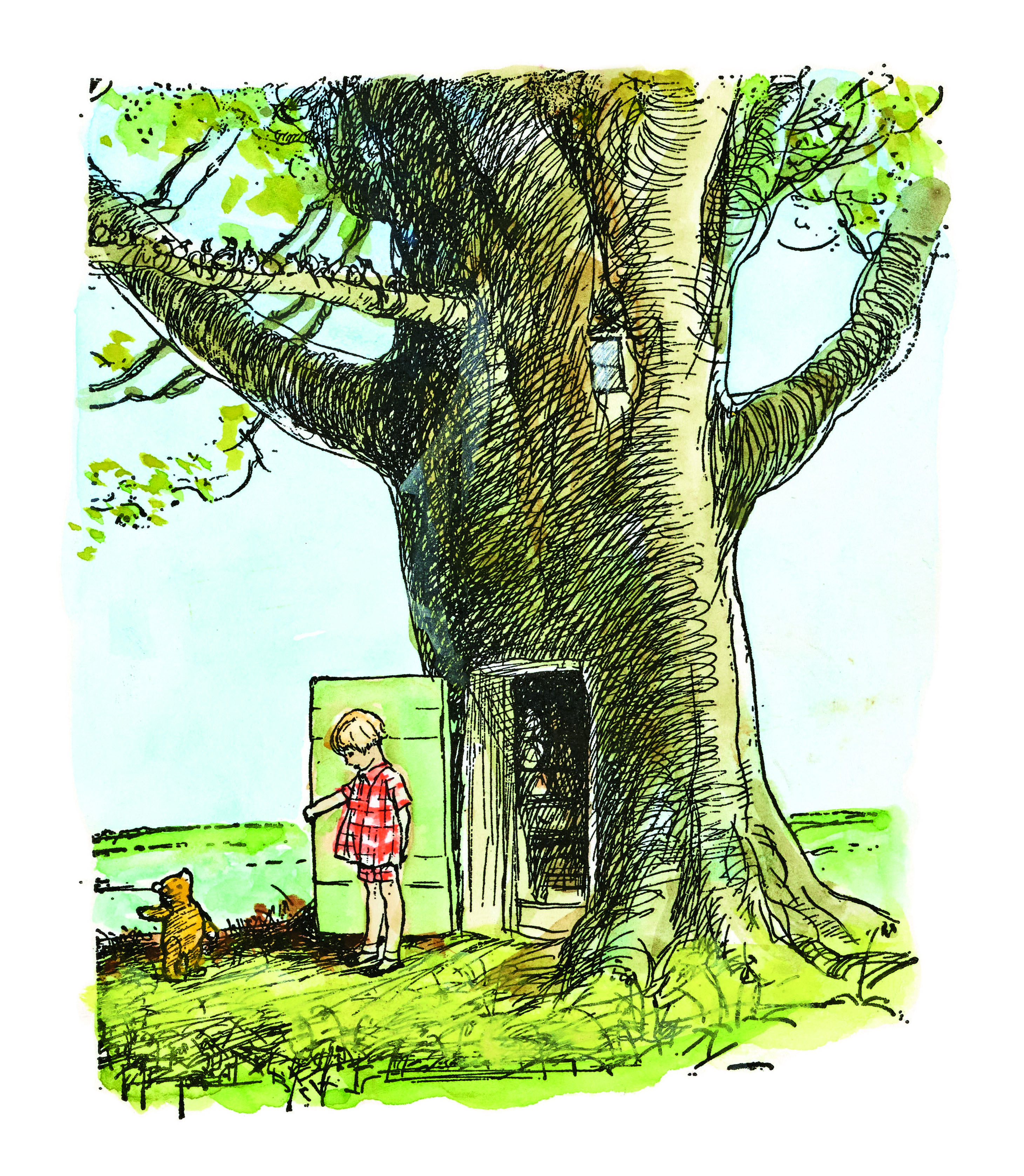
So Winnie-the-pooh went round to his friend Christopher Robin, who lived behind a green door in another part of the wood.
‘Good-morning, Christopher Robin!’ he said.
‘Good-morning, Winnie-the-pooh,’ said you.
‘I wonder if you’ve got such a thing as a balloon about you?’
‘What do you want a balloon for?’ you said.
TRUSTEES OF THE POOH PROPERTIES/TRUSTEES OF THE SHEPARD TRUST/HARPERCOLLINS
Winnie-the-pooh looked round to see that nobody was listening, put his paw to his mouth, and said in a deep whisper: ‘Honey!’
‘But you don’t get honey with balloons!’
‘I do,’ said Winnie-the-pooh.
Well, it just happened that you had been to a party the day before at the house of your friend Loose-ear, and you had balloons at the party. You had had a big green balloon, and one of the Rabbits had had a big blue one and had left it behind, being really too young to go to a party at all; and so you had brought the green one and the blue one home with you.
‘Which one would you like?’ you asked Winnie-the-pooh.
He put his head between his paws and thought very carefully.
‘It’s like this,’ he said. ‘When you go after honey with a balloon, the great thing is not to let the bees know you’re coming. Now, if you have a green balloon, they might think you were only part of the tree
and not notice you, and if you have a blue balloon, they might think you were only part of the sky, and not notice you, and the question is, which is most likely?’
‘Wouldn’t they notice you underneath the balloon?’ you asked.
‘They might or they might not,’ said Winnie-the-pooh. ‘You never can tell with bees.’
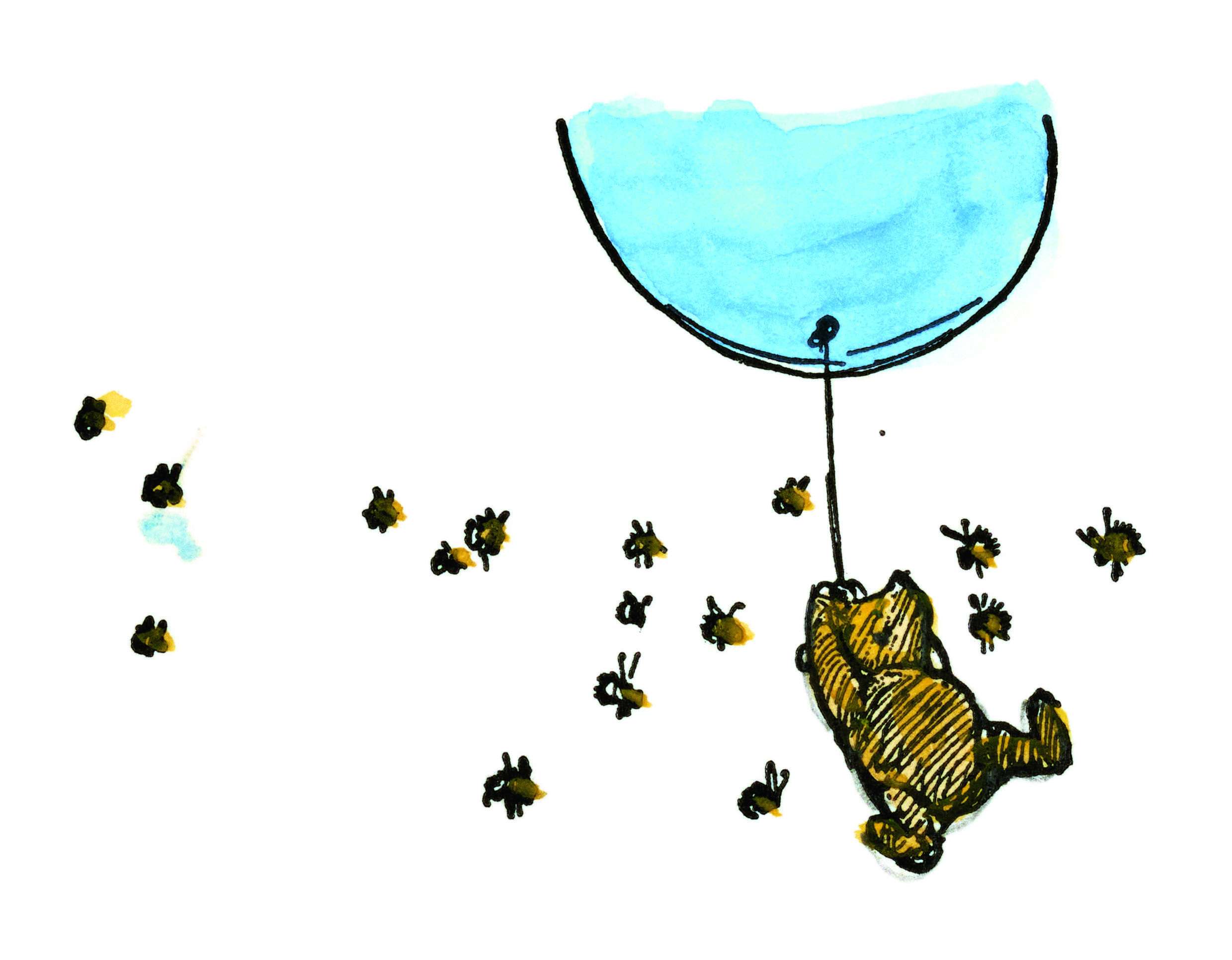
Well, you both went out with the blue balloon, and you took your gun with you, as you always did when you went out, and Winnie-the-pooh stopped at a very muddy place that he knew of, and rolled and rolled until he was black all over; and then, when the balloon was blown up as big as big, and you and Winnie-the-pooh were both holding on to the string, you let go suddenly, and Winnie-the-pooh floated gracefully up into the air, and stayed there — just about level with the top of the tree, and about twenty feet away from it.
TRUSTEES OF THE POOH PROPERTIES/TRUSTEES OF THE SHEPARD TRUST/HARPERCOLLINS
‘What do I look like from down there?’
‘You look like a bear holding on to a balloon,’ you said.
‘Not,’ said Winnie-the-pooh anxiously, ‘not like a small black cloud in a blue sky?’
‘Not very much.’
After a little while he called down to you.
‘I think the bees suspect something!’
‘What sort of thing?’
‘I don’t know. But something tells me that they’re suspicious!’
‘Perhaps they think that you’re after their honey?’
‘It may be that. You never can tell with bees.’
‘Have you an umbrella in your house?’
‘I think so.’
‘I wish you would bring it out here, and walk up and down with it, and gaze up at me every now and then, and say “Tut-tut, it looks like rain.” I think, if you did that, it would help the deception which we are practising on these bees.’
So, while you walked up and down and wondered if it would rain, Winnie-the-pooh sang this song:
How sweet to be a cloud
Floating in the blue!
Every little cloud
Always sings aloud.
“How sweet to be a cloud
Floating in the blue!”
It makes him very proud
To be a little cloud.
The bees were still buzzing as suspiciously as ever. Some of them, indeed, left their nest and flew all round the cloud as it began the second verse of this song, and one bee sat down on the nose of the cloud for a moment, and then got up again.
‘Christopher — ow! — Robin,’ called out the cloud.
‘Yes?’
‘I have just been thinking, and I have come to a very important decision. These are the wrong sort of bees.’
‘Are they?’
‘Quite the wrong sort. So I should think they would make the wrong sort of honey, shouldn’t you?’
‘Would they?’
‘Yes. So I think I shall come down.’
‘How?’ asked you.
Winnie-the-pooh hadn’t thought about this. If he let go of the string, he would fall — bump — and he didn’t like the idea of that particularly. So he thought for a long time, and then he said:
‘Christopher Robin, you must shoot this balloon with your gun. Have you got your gun?’
‘Of course I have,’ you said. ‘But if I do that it will spoil the balloon,’ you said.
‘Yes, but if you don’t,’ said Winnie-the-pooh, ‘I should have to let go, and that would spoil me.’
When he put it like this, you saw how it was, and you aimed very carefully at the balloon and fired.
‘Ow!’ said Winnie-the-pooh.
‘Did I miss?’ you asked.
‘You didn’t exactly miss,’ said Winnie-the-pooh, ‘but you missed the balloon.’
‘I’m so sorry,’ you said, and you fired again, and this time you hit the balloon, and the air came slowly out, and Winnie-the-pooh floated down to the ground.