

It has been 42 days and counting since Kamran Ahmed began his hunger strike at HMP Pentonville.
On remand for the past 13 months, he is due to appear in court next June in connection with a break-in at an Israeli-linked weapons factory in Gloucestershire in August 2024.
But as his health deteriorates at the north London prison — he has already been admitted to hospital twice — there is no guarantee that Ahmed, 28, will make it to trial.
“Every day I’m scared that potentially I might die,” he said in a telephone interview on Friday night from his cell, where he spends 21 hours a day. “I’ve been getting chest pains regularly … There have been times where I felt like I’m getting tasered — my body’s vibrating or shaking. I’ll basically lose control of my feelings.
“I’ve been scared since the seventh day when my blood sugars dropped. The nurse said, ‘I’m scared you’re not going to wake up [when you go to sleep]. Please eat something.’”
“But I’m looking at the bigger picture of perhaps we can relieve oppression abroad and relieve the situations for my co-defendants,” added Ahmed, a mechanic from east London. “Yes, I’m scared of passing away. Yes, this may have life-long implications. But I look at the risk versus reward. I see it as worthwhile.”
Ahmed spoke via HMP Pentonville’s prisoner telephony service, a system whereby inmates use a fixed landline phone in their cells to call approved numbers. He is able to speak with his friends and family through the service, which inmates are required to buy credits for. Calls may be monitored or recorded in line with prison rules and security. In-cell phones were introduced in 2016 in an attempt to cut reoffending rates.
Ahmed is one of six Palestine Action activists on hunger strike as they await trial on charges of criminal damage, aggravated burglary and violent disorder at a factory for Elbit Systems, an Israeli arms manufacturer, and in relation to an alleged break-in at RAF Brize Norton, in June. They deny the allegations.

Pro-Palestinian activists are alleged to have damaged an aircraft at RAF Brize Norton in June
BBC

Two of the group — Qesser Zuhrah and Amy Gardiner-Gibson — have not eaten for 50 days. Both have been admitted to hospital. Zuhrah is said to have a resting heart rate of 127 beats per minute (for adults a normal resting heart rate ranges from 60 to 100 beats per minute).

Clockwise from top left: Qesser Zuhrah, Amy Gardiner-Gibson, Teuta Hoxha, Heba Muraisi, Ahmed and Lewie Chiaramello
Ahmed, meanwhile, has dropped from 75kg to 60kg in weight. His last meal was on November 8. Any time food is brought to his cell he rejects it, telling prison staff to log his refusal. He only drinks water with salt, which is needed to maintain essential electrolytes, prevent dehydration and stabilise blood pressure.
Ahmed said he was now “literally a shell of myself” and had started to experience hot flushes in his head. “My head just feels suddenly hot and it feels like I’m going to drop,” he said.
His speech had also started to become slurred, “it sounds like I’m a little bit punch drunk,” he added.
Medics and lawyers speaking on behalf of the activists said last week that they were now “at a critical stage” and would probably die if David Lammy, the justice secretary, did not intervene. In the 1981 hunger strike co-ordinated by republican prisoners in Northern Ireland, in which 10 people died, one of the inmates, Martin Hurson, passed away after 46 days.

Kamran Ahmed, left, with his older brother, Redwan
COURTESY OF THE FAMILY
The government has refused to negotiate with the strikers’ legal team but denies allegations that the six were being mistreated and has restricted access to basic healthcare, as claimed by supporters.
Ahmed said: “I am concerned [about my health] but it shouldn’t be on me to be concerned. It should be on the government to be concerned with how they are letting this go on for this long without addressing it, without at least coming to the table and negotiating.”
Lord Timpson, the prison minister, said the government “will not meet with them” because it would be “entirely unconstitutional and inappropriate” as the “justice system … is based on the separation of powers”.
He said: “While very concerning, hunger strikes are not a new issue for our prisons. Over the last five years, we’ve averaged over 200 a year and we have longstanding procedures in place to ensure prisoner safety.
“Prison healthcare teams provide NHS care and continuously monitor the situation. HMPPS are clear that claims that hospital care is being refused are entirely misleading — they will always be taken when needed and a number of these prisoners have already been treated in hospital.
“These prisoners are charged with serious offences, including aggravated burglary and criminal damage. Remand decisions are for independent judges, and lawyers can make representations to the court on behalf of their clients.”
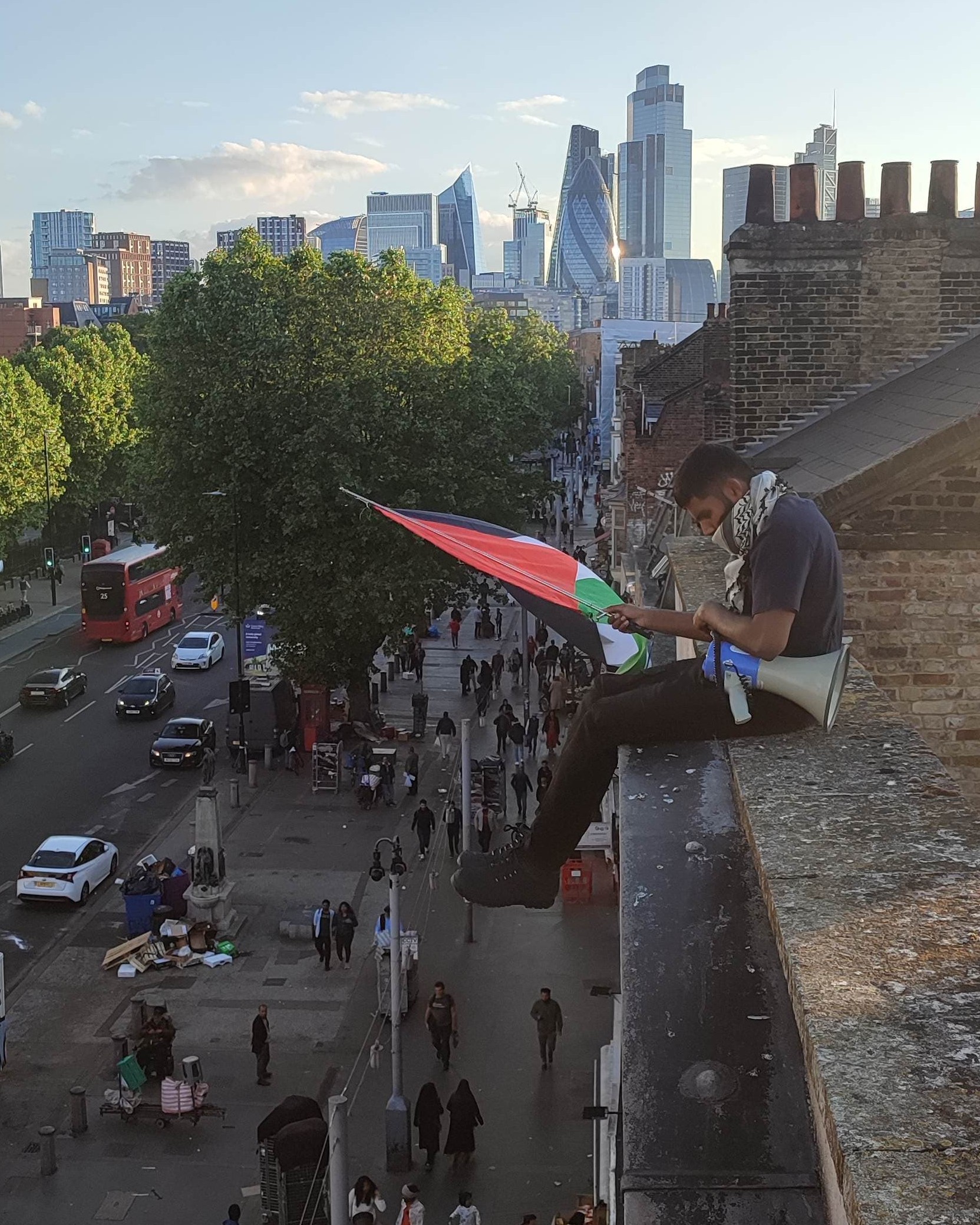
Ahmed with a Palestinian flag and megaphone in London
COURTESY OF THE FAMILY
One of the strikers’ primary demands is immediate bail. By the time the prisoners go to court in June, they will have spent at least a year behind bars without trial. The pre-trial custody time limit is six months, but judges have the power to extend remand on a case-by-case basis.
They are also demanding that the government reverse its ban on Palestine Action as a proscribed terrorist organisation, shut down all weapons factories in the UK linked to Elbit Systems, and improve communications with the protesters’ legal team so they can better prepare for trial.
Francesca Nadin, a representative for the hunger strikers, said the prisoners were “very firm” in their conviction to continue until their demands are met. But she suggested that the group would compromise if given the chance to meet the justice secretary.
Ahmed began refusing food after learning that some of the other activists on remand had started a hunger strike. The protesters are not in communication with one another and are being held in various prisons across England.

Shahmina Alam, Ahmed’s sister, has pleaded for the hunger strikers to receive appropriate medical attention
TOBY SHEPHEARD FOR THE SUNDAY TIMES
Ahmed’s older brother, Redwan, 30, said he believed his sibling was prepared to die for his cause.
“I know my brother well enough,” he said. “Without achieving what he needs to achieve, I don’t think he would do something half-hearted and that is the reality — and it’s sad to think about. I speak to my wife every day about how my brother might pass away.
“He means so much to me. He’s my best friend.”
Ahmed has access to television and books, but cannot use the internet. He spends roughly three hours a day outside his cell, two of which are spent working in the prison’s textiles workshop. “They’re still letting me go to this activity,” he said. But during one recent session “there was a point where my heart was raising, I honestly thought I would pass away within the next 10 minutes, 20 minutes”.

Redwan Ahmed says his younger brother is his best friend
COURTESY OF THE FAMILY
To further pass the time, Ahmed said he had also read The Life of Birds by David Attenborough, Billy Connolly’s biography and Four Kings, a boxing non-fiction book about a series of famous fights in the 1980s that revived the sport.
As a practising Muslim, he is reading the Quran and praying. “That’s really getting me through it,” he said. “Honestly, I don’t think I’d have the mental fortitude without Islam in my life.”
Ahmed said his faith had put him on the radar of a number of inmates at HMP Thameside — where he was held before being moved to Pentonville — who were awaiting trial in relation to far-right crimes.
One prisoner he met was a 19-year-old on remand for allegedly creating explosives and obtaining gun schematics with the aim of killing Muslims, he said. Ahmed said the two did not initially speak, but eventually revealed to one another why they were inside.

Supporters of the hunger strikers protest outside Pentonville prison
GUY SMALLMAN/GETTY IMAGES
“He had this ideology that he hates Muslim people in general,” he said. “I was just speaking with him, we were clearing the differences and stuff.”
He added: “I remember there was a point where his clothes got robbed or something when he put them in the washing machine. I gave him a spare set of trousers … After that I remember him saying, ‘You’re not like other Muslims’. And I was telling him, ‘I think you’ve got a misconception of Muslims.’”
Despite his isolation, Ahmed has been able to follow developments in the outside world — including last week’s massacre on Bondi beach, Sydney, in which two gunmen killed 15 people attending a Chanukkah celebration. The men are alleged to have been inspired by Isis.
Ahmed described the attack as a “tragedy”, adding: “My heart goes out to the people that passed away.” But he rejected the allegation that the pro-Palestinian cause and efforts to raise awareness of the humanitarian crisis in Gaza were linked to the mass shooting.

The prisoners say the hunger strikes have raised awareness
GUY SMALLMAN/GETTY IMAGES

GUY SMALLMAN/GETTY IMAGES
“I don’t think anyone in their right mind agrees with what Isis is doing and what they have done. So to even link it [the attack] to a humanitarian issue is ridiculous when these people probably had their own interest to serve,” he said.
“The fact that the government is restricting our protest, even criminalising phrases that are linked to the Palestinian protest, I find it absolutely absurd.”
Asked about the emotional toll his strike was having on his family and friends, Ahmed acknowledged the pain he was causing but said he remained committed, insisting that the hunger strikes had raised awareness of the prisoners’ cause and injected a “breath of fresh air” into the pro-Palestine movement.
“I understand it’s going to be difficult for everyone to watch me go through the situation. When I think about my friends and family … it’s difficult to push those thoughts aside,” he said. “But I think it’s necessary to achieve what the world should really look like.”