
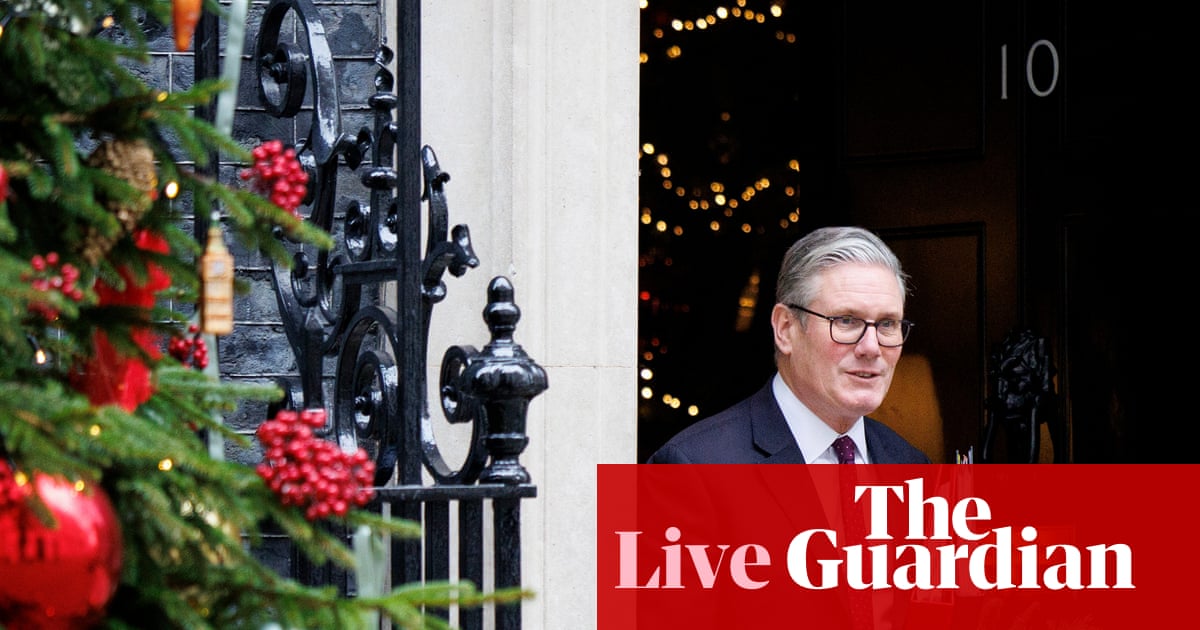
Of course Starmer will be PM next Christmas, Labour party chair insists
Anna Turley said that Keir Starmer will “absolutely” be the prime minister next Christmas, when asked by Trevor Phillips, amid continued speculation that Labour figures are manoeuvring to replace him.
Turley told Sky News:
Of course. Absolutely. As I said, people will really start to see and feel the change in their pockets.
Keirs got a very clear vision for making sure that people can really deal with the cost of living, that public services will get back on their feet.
And he’s building a Britain that is one that is tolerant, that is open, that is confident in itself, and that is really about renewal and investment in young people, as opposed to the division and the decline of the opposition.
I’ve sat around that cabinet table and there’s a team there that are ruthlessly focused on delivering on a day to day basis, whether it’s the NHS, whether it’s education, whether it’s defence, whether it’s housing.
This is a team behind that is determined to deliver on the promises that we made last year and to support a prime minister that’s got a clear vision for a renewal of this country.
Starmer, who is deeply unpopular with the public despite his landslide victory last summer, is approaching a perilous moment at next year’s May elections when Labour is expected to face a disastrous set of results across the country.
Key events
Show key events only
Please turn on JavaScript to use this feature
Tories will ‘smash’ upcoming local elections and don’t need to do a pact with Reform, deputy chair says
The Tory deputy chair, Matt Vickers, was also interviewed by Sky News’ Trevor Phillips this morning. Phillips asked him if the Conservatives have had talks with Reform about a possible electoral pact.
“No. We’re going to go out there and smash these next elections,” Vickers, who is also the shadow policing minister, confidently responded.
The Stockton West MP said that the Conservative party leader, Kemi Badenoch, has been doing the “homework” and listening to what voters have had to say since the general election last year.
Vickers said:
There’s actually a big dividing ground out there. The big division between us and the other parties is that we’re the party on the side of working people.
We’re not going to go around nationalising everything that moves. We’re not going to tax them to death.
We’re not going to give away benefits, limitless levels of benefits. We’re not going to remove that two-child cap like reform, like Labour. We’re here for working people who are doing the right thing.
While overall Tory poll ratings remain stubbornly low, Badenoch has been praised by some of her MPs, along with some commentators, for her recent Commons performances.
Shadow policing minister Matt Vickers appearing on Sunday Morning With Trevor Phillips. Photograph: Sunday Morning with Trevor Phillips/Sky News/PAShare
Updated at 05.39 EST
In an interview with The Observer newspaper this weekend, the health secretary, Wes Streeting, insisted Starmer has his “absolute support”.
He was forced to deny in November that he planned to unseat the prime minister, after a briefing war at the heart of government. Streeting at the time condemned “self-defeating” attacks on him coming from Downing Street and said they were indicative of a toxic culture inside No 10.
In his Observer interview, he also shrugged off suggestions of a joint leadership ticket with Angela Rayner, the former housing secretary and deputy prime minister, and told the newspaper:
The closer I see that job and the pressure on Keir and the demands of that job, the more I wonder why anyone would want it.
ShareOf course Starmer will be PM next Christmas, Labour party chair insists
Anna Turley said that Keir Starmer will “absolutely” be the prime minister next Christmas, when asked by Trevor Phillips, amid continued speculation that Labour figures are manoeuvring to replace him.
Turley told Sky News:
Of course. Absolutely. As I said, people will really start to see and feel the change in their pockets.
Keirs got a very clear vision for making sure that people can really deal with the cost of living, that public services will get back on their feet.
And he’s building a Britain that is one that is tolerant, that is open, that is confident in itself, and that is really about renewal and investment in young people, as opposed to the division and the decline of the opposition.
I’ve sat around that cabinet table and there’s a team there that are ruthlessly focused on delivering on a day to day basis, whether it’s the NHS, whether it’s education, whether it’s defence, whether it’s housing.
This is a team behind that is determined to deliver on the promises that we made last year and to support a prime minister that’s got a clear vision for a renewal of this country.
Starmer, who is deeply unpopular with the public despite his landslide victory last summer, is approaching a perilous moment at next year’s May elections when Labour is expected to face a disastrous set of results across the country.
Sixty-three council areas could opt to postpone elections until 2027 after some were already delayed until May 2026 as two-tier authorities are being combined into single unitary councils.
The Electoral Commission has raised concerns about the prospect of more delays to council elections in England, saying capacity constraints are not a legitimate reason to postpone long-planned polls.
Polls in several council areas were cancelled this year, in East Sussex, West Sussex, Essex and Thurrock, Hampshire and the Isle of Wight, Norfolk, Suffolk and Surrey.
Anna Turley told Sky News that the government is undertaking the biggest change in local government in 50 years.
“This is a huge programme of local government reform, and it’s right that we do it sensibly and calmly, and that takes time to deliver,” the Labour party chair said, confirming there is no “change to a plan” for a general election, which must be held by 15 August 2029.
The Labour party chair, Anna Turley. Photograph: Thomas Krych/Zuma/ShutterstockShare
Updated at 05.05 EST
Trevor Phillips points to Labour’s dire poll numbers (Reform is consistently the top party and Labour seems to be shedding votes to the Green party to its left, which is gaining momentum under its leader Zack Polanski).
Turley said people are “rightly” impatient for change but insisted it takes time for the government to deliver this.
She points to the employment rights bill, which finally become law at the end of last week, 18 months on from Labour’s landslide election victory.
The bill, which applies to England, Scotland and Wales, will give workers access to sick pay and paternity leave from the first day they start their job and includes extra safeguards for pregnant women and new mothers.
As my colleague Jessica Elgot notes in this story, the struggle to pass the law, which faced significant opposition from the Conservatives and business groups, meant the government made a number of concessions to secure its passage.
Trade unions agreed earlier this month to remove day-one rights to unfair dismissal from the package of reforms, in return for the lifting of the compensation cap, to get the bill through parliament in time to start implementing new rights from April.
Turley said Labour has delivered five million extra NHS appointments in its first year in government but admitted that public services have been on “their knees” so tangible change will take time to filter down to the members of the public.
“Next year, [people] will really start to see and feel more money in their pockets, better public services when they’re looking for an appointment with the doctor, the streets and the neighbourhoods looking better and better. And that change takes time,” Turley said.
Updated at 04.48 EST
We have some comments given by the Labour party chair Anna Turley to Sky News’ Trevor Phillips this morning. He asked her if Keir Starmer is incapable of taking “tough decisions until it’s too late”, something the prime minister said to Boris Johnson in 2020.
Turley defended the government’s record, saying it has “stabilised” the economy after “inheriting an absolute wreck” from the previous Conservative administration.
Turley also pointed to giving wider access to free school meals in England.
The government announced expanded FSM eligibility from September 2026, allowing all children from households receiving universal credit benefits to receive free lunches. Currently those with a net earned household income of below £7,400 a year are eligible.
But the expansion of free school meals will initially benefit far fewer children in England than claimed, according to analysis from the Institute for Fiscal Studies.
Updated at 04.34 EST
In this analysis piece, the Guardian’s health policy editor, Denis Campbell, looks at the history of these strikes and considers how likely it is for a settlement to be reached after the 14th walkout by resident doctors in a long-running pay dispute. Here is an extract:
Streeting says the British Medical Association is being unreasonable; the BMA, the doctors union, blames him for not rewarding medics properly for their vital work.
After eight strikes under the Tories and now three under Labour, the prospects of a settlement look as distant as at any point in the last 33 months. “At this rate, this is going to drag on and on and on all next year unless something changes. It’s never-ending,” said one NHS official.
His comments reflect the beleaguered mood in a service that yet again has had to cancel tens of thousands of appointments and operations, ask senior doctors to cover more junior colleagues’ shifts and plead with the public to come to A&E over the next five days only if absolutely necessary.
Resident doctors on their picket line at Guys & St Thomas’ hospital in Westminster on 17 December 2025. Photograph: Guy Smallman/Getty ImagesShareNHS ‘coping’ during resident doctors’ strike but faces difficult recovery over Christmas, Streeting says
Good morning and welcome to our live coverage of UK politics. The health secretary, Wes Streeting, has said he is worried about how the NHS will recover in the days after the resident doctors’ strike, which began at 7am on Wednesday.
Resident doctors (the new name for junior doctors) will return to work at 7am on Monday, having gone on strike after members of the British Medical Association (BMA) rejected a fresh offer from the government.
The BMA asked for a long-term plan to increase pay and properly compensate for years of below-inflation rises, and wanted new training places to be created.
The latest offer from the government would have increased the number of training places to enable early career doctors to start training in their chosen medical speciality, but not increased their pay for the current financial year.
Wes Streeting speaking to the media at Wellington House, London, on the first day of the strike. Photograph: Lucy North/PA Media
Streeting said the NHS, which is under intense strain due to the usual winter pressures, “is coping” during the strike, but admitted he was concerned about the coming days.
“The period that worries me more is the post-strike period when we have to try and recover the service. That now falls at a time of year which is the NHS’s busiest,” the health secretary told the Observer.
On Friday, Streeting said he wanted to end the dispute and that “we will get around the table with them again in the new year”, but insisted he has a responsibility to all NHS staff.
“I don’t think that doctors are selfish and don’t care about nurses and other healthcare professionals, but the BMA’s position can be quite hardline and uncompromising,” he added. We will have more on this story, and other political developments in the UK, shortly.