
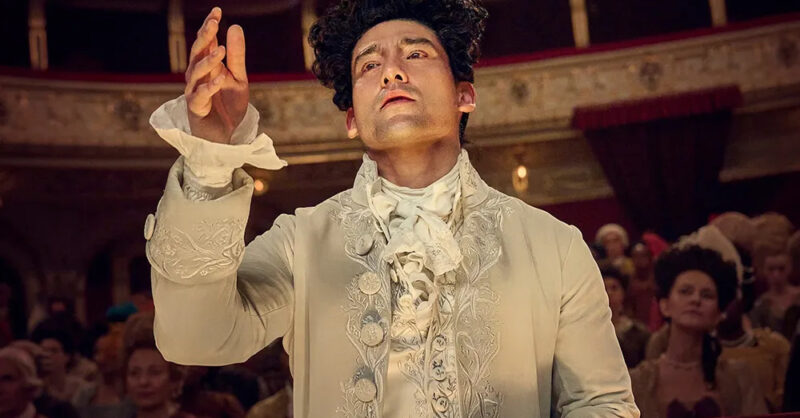
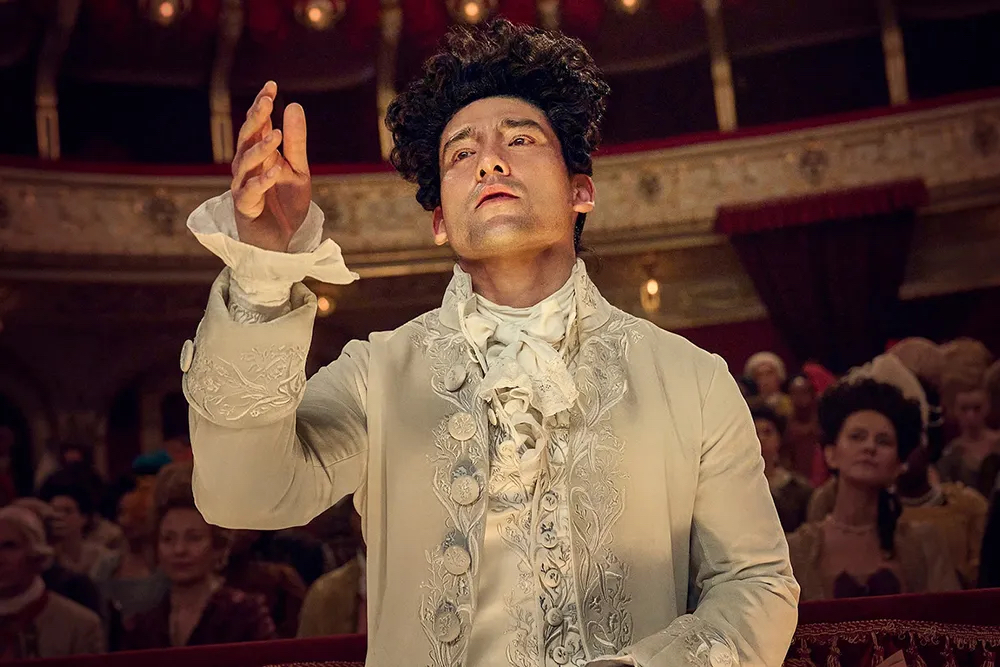
Photo by Simon Emmett/Sky
Somewhere between 2011’s Footloose and 2024’s Mean Girls, I stopped enquiring as to the point of remakes. There’s nothing that makes you feel old and irrelevant quite like your generation’s cult classics being regurgitated for a new, younger audience, and Hollywood is going to keep doing it regardless. All the same, adapting Peter Shaffer’s 1979 play Amadeus for the second time, when the first screen version was Milos Forman’s 1984 masterpiece, seems to be asking for trouble.
There were, however, three reasons to be optimistic: Joe Barton, the writer behind the perennially underappreciated Giri/Haji; Will Sharpe, star of the perennially underappreciated Giri/Haji, The White Lotus and Too Much; and Paul Bettany, who has held a special place in my heart since 2001’s A Knight’s Tale (there I go feeling old again).
Sky’s five-part television adaptation of Amadeus seems to answer its critics early doors, with a gentle nudge and a wink. Emperor Joseph (a rather unprincely Rory Kinnear) asks his court composer, Salieri, to “put on a remake” of his French opera Tarare in Italian. Salieri protests – he wants to make new work – but the Habsburg Emperor shuts this down: “A return to past successes is what’s needed in delicate times.”
The framing – a story within a story – is the same as in Forman’s film, with some small differences. An aged Antonio Salieri (Bettany) attempts suicide and is confined to a psychiatric hospital. There he is visited not by a priest, as in the film, but by Mozart’s widow, Constanze (Gabrielle Creevy). (The artificially aged Bettany is passable, but Creevy quite dreadful.) Salieri tells her he wishes to make his confession, and then we enter the flashback in which the action unfolds.

Treat yourself or a friend this Christmas to a New Statesman subscription for just £2
It is 1781, ten years before Wolfgang Amadeus Mozart’s death, and the composer is newly arrived at the court in Vienna from Salzburg. The setting is decadent and gilded, rendered in meticulous detail; the wigs are piled a little lower, the bosoms slightly less heaving, than in the film. Sharpe’s Mozart is a prodigy but ill-mannered, excitable, a drunken, petulant reprobate, and Salieri his wily, predatory and less preternaturally talented rival. Despite the Emperor criticising his work for having “too many notes”, Mozart soon establishes a reputation as a musical genius. Salieri, realising that he has been blessed with neither the same gifts nor the same enrapturing character, declares God his enemy and sets out to ruin the young upstart.
The big beats are broadly familiar, but spread over five 50-minute episodes, the whole thing is given more time to breathe and luxuriate. Barton has begun again with his script, so while there are nods to the 1984 version, it feels entirely fresh, at times cuttingly comic. Constanze takes a more central role than in the film, giving the series a more modern feel. Bettany’s Salieri is in turns full of jealousy, rage, admiration and resignation, all playing out over his wolfish features, but he can’t match F Murray Abraham’s Oscar-winning turn. Sharpe’s Mozart, on the other hand, is a revelation. The high-pitched giggle of Tom Hulce’s portrayal is gone, and so too is a little of the buffoonery. There is still a naive excitability, to Sharpe’s imagining, but Barton also explores Mozart as a tortured artist: tormented by letters from his overbearing father, mourning the death of his infant son, wrestling with his own genius.
Forman’s original inevitably casts a long shadow over it, but Barton’s Amadeus is nonetheless sumptuous, highly enjoyable television: a success for delicate times, indeed.
[See also: Christmas telly has lost its magic]
Content from our partners