
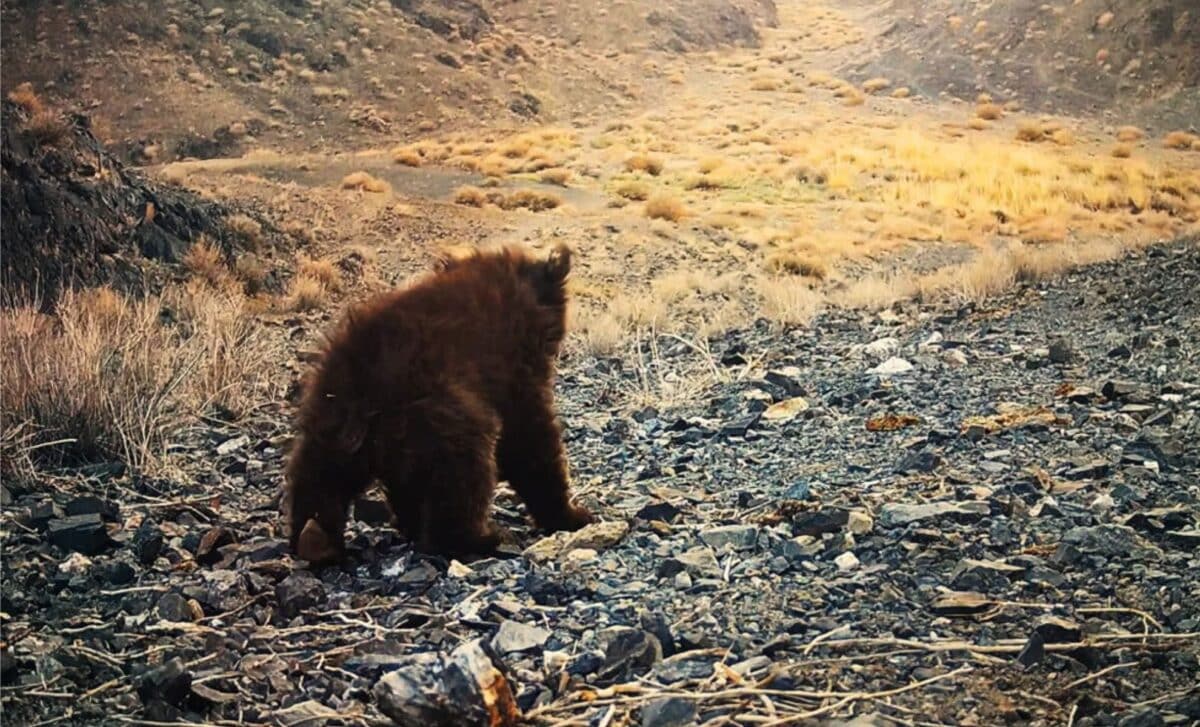
In the southern reaches of Mongolia’s Gobi Desert, a striking image has emerged from the sand and heat: one of the world’s rarest animals, the Gobi bear, caught on camera alongside her cub.
Footage recorded by automated camera traps for the documentary series The Wild Ones has revealed a female Ursus arctos gobiensis — a highly endangered subspecies of brown bear — traveling with a young cub. This marks one of the most significant wildlife sightings in recent years. With an estimated population of fewer than 40 individuals, the Gobi bear is one of the least observed large mammals on Earth.
The scene was captured inside the Great Gobi Strictly Protected Area, a remote nature reserve where few scientists, let alone tourists, ever venture. It is a region where temperatures can plunge to – 40°C in winter and soar past 40°C in summer — and where water sources may be separated by more than 100 miles.
Rare Bear Adapted to One of the Harshest Places on Earth
Known locally as Mazaalai, the Gobi bear is the only bear species on the planet adapted to life in a hot desert. Unlike its relatives in boreal forests or tundras, this bear survives in arid terrain by feeding primarily on wild rhubarb, desert grasses, and onions. Animal matter makes up just a fraction — estimated at around 1% — of its diet.
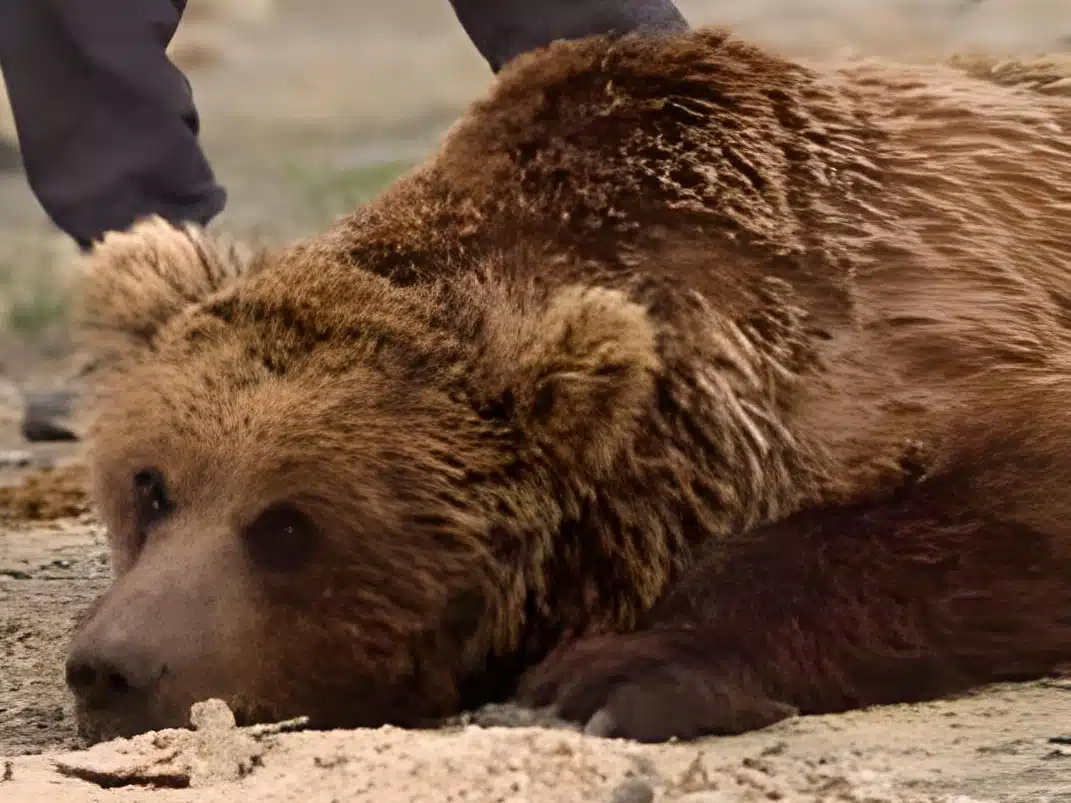 The Gobi bear (Ursus arctos gobiensis). Credit: Hunter J. Causey
It’s an evolutionary anomaly. The Gobi bear is physically smaller than other brown bears, with lighter fur and a more slender build. Its survival strategy hinges on conserving energy and making long treks across open desert to reach seasonal oases.
The estimated population has hovered below 40 for years, with no signs of stable growth. These bears are mostly restricted to three known oases in the Great Gobi “A” reserve, a protected area first designated in 1976 by the Mongolian government. The reserve was designed to preserve rare species in a part of the country that receives less than 100 mm of rain annually.
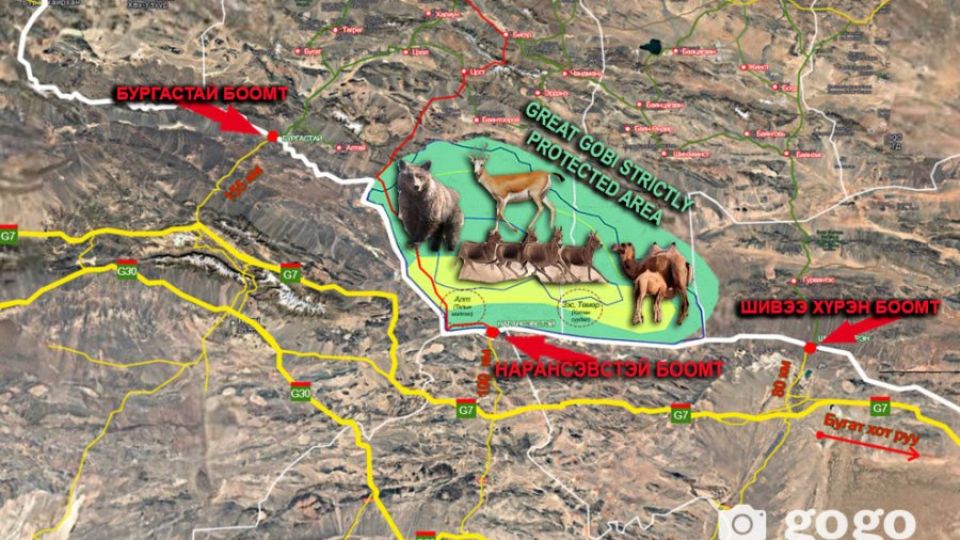 The red line drawn back from Naransevstein border point through the Thei Great Gobi Strictly Protected Area is the proposed road. Credit: GO GO MONGOLIA
Global attention has recently turned to the Gobi bear following multiple wildlife documentaries. In a past segment featured on BBC’s natural history program Asia, an adult was filmed walking over 160 kilometers across sand dunes to locate a water source — a trek that illustrates the extreme conditions under which these animals persist.
Camera Traps Reveal a Hopeful Signal
The bear-and-cub footage was captured by the crew of The Wild Ones, a nature series streaming on Apple TV+. Using more than 350 remotely operated camera traps, along with thermal sensors and satellite-guided drones, the team set out to document species thriving in extreme environments without direct human interference.
After weeks of fieldwork in the southern Gobi, the project produced rare footage showing not just an adult Gobi bear, but a cub walking closely behind. For researchers and conservationists, this signals that the population is still reproducing — an essential indicator that the bears are not only surviving, but may be capable of recovery.
The production team has confirmed that the footage will be submitted to UNESCO’s World Heritage Committee to strengthen appeals for increased conservation protections. The images may also help fill long-standing gaps in population data, which has mostly been based on camera trap surveys and limited genetic sampling.
Long-Term Survival Far from Guaranteed
Despite the breakthrough, serious challenges remain. The Gobi bear faces extreme ecological isolation, and the population is thought to be genetically limited due to long-term inbreeding. Access to water is becoming more unpredictable, as climate impacts accelerate across Central Asia. Many of the natural springs the bears rely on are drying up earlier each season.
The conservation strategy for the species has included limited supplemental feeding programs, habitat monitoring, and partnerships with international groups like the International Association for Bear Research and Management (IBA), but progress has been slow. The remoteness of the habitat and limited funding remain major barriers to expanding intervention.
A 2015 field assessment on Gobi bear conservation emphasized the risks posed by genetic bottlenecks, low birth rates, and poor reproductive tracking. So far, no known Gobi bear has been confirmed outside the protected zone in over two decades.