
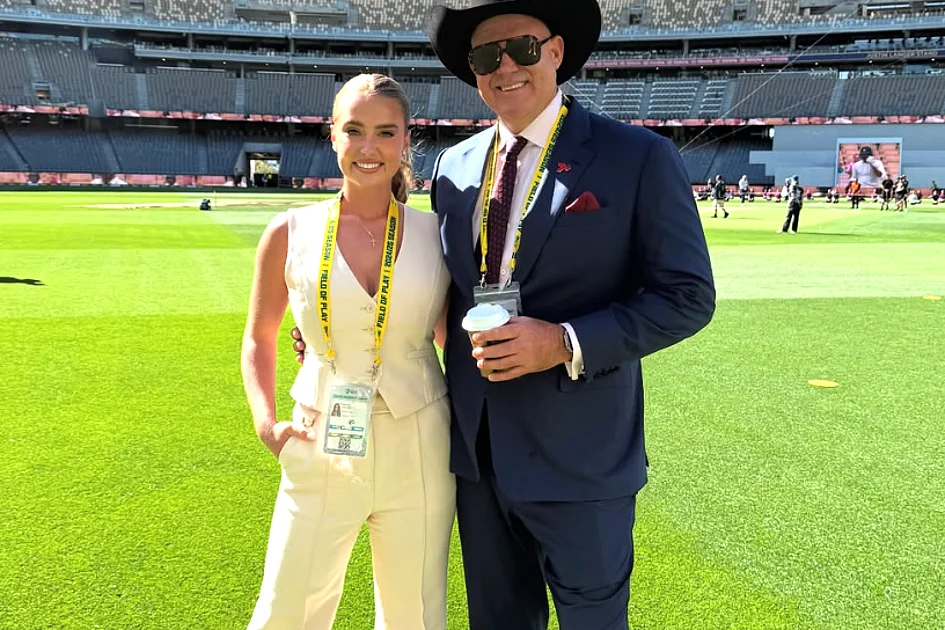
Sitting beside Grace Hayden in the media dining hall at Dubai International Stadium for this interview, what struck most was her focus. Between every sentence she so thoughtfully constructed, the Australian cricket presenter paused for a couple of seconds, her eyes drifting towards the game to follow every delivery bowled by Dubai Capitals in the ILT20 game against Desert Vipers.
Daughter of Matthew Hayden, a towering figure in Australian cricket who had cemented his place in the pantheon of the greatest Test opening batters of all time, Grace was on top of her game even as she faced inquisitive questions from this reporter on her memories of watching cricket from the family balconies of some of the iconic venues across the world.

No wonder the 23-year-old is living up to her name, gracing every cricket ground with her elegant presence, posing questions that often draw incisive responses from pundits during post-match shows.
During our freewheeling chat, Grace, a former model, also opened up about how her mother, Kallie Hayden, formed the greatest partnership with her Dad.
Q. Growing up as a child, when did you realise that your father was a famous international cricketer?
I obviously knew that Dad’s job was to play cricket. I didn’t understand the extent of what that really meant to me. He was always just Dad, but he spent around 11 months a year travelling the world, and we sometimes go and sometimes stay in. It’s not an easy thing to be, you know, not to be with your father for several months of the year, but we all knew as a group, and as a family, that that’s what Dad’s job was to do. And my Mum was amazing in keeping us so connected. She was really the rock. I want to say that it allowed Dad to always feel connected, and it never felt like when I was growing up, that he really missed anything. So it was really special that Mum was doing all that for us, but yeah, Dad, I knew he played cricket, but I didn’t know that he was the superstar that he was.
Q. At school, what was it like to be the daughter of a superstar? When you went to a school after he did something amazing for Australia, did your friends treat you differently?
I was very lucky that my teachers were very aware of what Dad’s job was, and of course, the kids were aware, their parents were aware. Yes, it can be tough at times being the daughter or the son of a superstar. People were conscious of what Dad was doing, but I was conscious of what Dad was doing too, like, you know, win, lose or draw, you feel the emotion. You feel the dynamic shift in your family. So, yes, you would get treated differently, maybe. But you know, I had great people around me and again, I want to mention my Mum and Dad, and there was just such a star partnership. We talk about partnerships all the time in cricket, but they had an amazing partnership and still do, and I’m so lucky to have two such amazing, supportive people who are my parents.
Q. You were probably only seven when your Dad retired from international cricket. Did you understand what it meant — that he was never going to wear the famous Australian baggy green cap again?
My childhood was like growing up around the most iconic cricket stadiums; those were my playgrounds. So I don’t think it was until Dad came to me in 2009, and he said to me, ‘Hey, Gracey, I’m gonna finish playing cricket for Australia’. I said, ‘Dad, what do you mean? You can’t do that. I need one more Christmas when Santa comes because I was convinced every Christmas that I’d been alive, we had the Boxing Day Test that was played the day after Christmas Day. So, every year we would fly to Melbourne and celebrate Christmas there. I was so attached to this lifestyle that I was convinced that this would go on. So I was like, ‘Dad, you have to keep playing’. You know, I was a child after all. So then Dad retired and he sort of started to come more back into our family dynamic, then I realised, ‘Oh, wow, what he’s done is so special.’ But I just thought that that was Dad’s job. And when you are a kid, you don’t realise how unique he is. You just see him as Dad. I think now that I’m older and I am around the game a lot more, I truly realise that my dad was a very good player.
Q. How was your parents’ support when you decided to become a sports presenter?
My parents have been amazing, and you know, they’ve always supported my two brothers and me in whatever we want to do in life as long as we give it 110 per cent. They always say that it’s also very important to enjoy what we do. So when I was in school, I started modelling, so that sort of helped me with my camera presence. And so I modelled for about four years. Then I did an audition for Channel Seven back home. And I started in horse racing and then progressed into cricket. And I started with Star Sports in India, doing some colour stories with IPL and the World Cups. And from then on, I’ve been hosting, and I’ve just I love it. I love travelling the world, and I feel like I’m carrying on the Hayden legacy in my own way.
Q. Have you interviewed your father?
Oh yes, briefly at the Perth Test (between Australia and India) last year. It was the tea break, a very cool moment, he was beside me, and I was like, ‘Today we have got Matthew Hayden, and I asked him about the game. It was a special moment for me when the expert I was interviewing was my Dad. It was unbelievable, I mean, who gets to do that? So doing that interview was surreal.
Q. Have you taken his feedback?
Of course. He is brutal. But his brutal feedbacks make me better. Sometimes he gives harsh feedback, but that always ends up working in my favour.
Q. What has been your most memorable event so far as a presenter?
The IPL is an amazing spectacle; it’s the pinnacle of T20 cricket. The pure love, passion, joy that you’re immersing, in terms of the crowd, it’s just so hard to explain to someone who hasn’t been to a venue like the Chepauk Stadium (in Chennai) with all the whistles, the noise is extraordinary, and you just cannot explain to someone who’s never stepped into it. MS Dhoni walks out to bat, and you just hear the crowd erupt. These are moments that you just don’t ever forget. And it’s obviously the best tournament in the world.
Q. Now you are here for the ILT20, the UAE’s IPL-style T20 league…
It’s a great tournament, there are some very big names, and some amazing young talents from the UAE and other associate nations. The stadiums are unbelievable, and it’s so convenient to travel from Dubai to Sharjah or Abu Dhabi. It’s unreal how cricket’s touching this part of the world now, it’s really gone global. It’s exciting to see that it’s also expanding into America as well and places that you didn’t think cricket would touch. Now we will have cricket at the Olympics (Los Angeles 2028), it’s just so exciting to see the potential and the growth.
Q. While this job looks glamorous, it takes a lot of hard work to be on top…
You have to keep an eye on everything because, you know, you may be packing bags and going to another tournament, and you need to know the past stats of all the players. You have to ask the right questions and practice everything. People say it’s a glamorous job, but it really isn’t, honestly. It’s hard work. But that’s like anything in life, if you want to be successful, you’ve got to do the hard yards. And this job definitely requires that, you know, and the more research you do, the better questions you can ask, and you get the better answers. The whole point is to get the best out of the experts.
Q. A lot of female presenters also have a cricket connection through family. Mayanti Langer’s husband — Stuart Binny — was a former India player, then you have Sanjana Ganesan (wife of Indian superstar Jasprit Bumrah) and Laura McGoldrick (wife of former New Zealand player Martin Guptill). Do these people inspire you? And do these family relations bring additional pressure to the job?
Every woman in this field has made an impact on me. Of course, there is pressure, and I mean I was someone who was growing up around a dad who was a star; there’s always been that pressure around anything that I do. Everyone expects you to be the best because they watched your Dad be the best. But I’ve always absorbed that pressure and sort of take it as like ‘I’ll show you’ and I’m an ultra-competitive person. If you tell me I can’t do something, I will definitely show you that I can. But yeah, it’s hard work, you may have got an opportunity, you have to work hard to stay there and be successful. I have watched my dad work extraordinarily hard to be the player that he was and to be the commentator that he is. So he is someone that I look up to, not just as a dad, but as a person.
Q. Being the daughter of a famous cricketer, there is always media attention on you. Your Dubai Desert Safari pictures grabbed headlines in Australia and India…
Look, the media attention can be really good and then all of a sudden, it can go to the other extreme. It’s flattering sometimes, but you know you can be put up on a pedestal and then you can be shot down — all in the same week. So I guess for me, being able to be in the job that I’m in, and you know, obviously, you get on with this. And then you get a social media following. And that’s all, now a part of this world. And I love sharing my life with people, I’ve built an amazing community of people that love cricket, love sport. I love the outdoors myself, and I just love sharing my life. I am 23, I am travelling the world, working on a sport that I love, with people that I love and to share that with others is such a privilege.


Rituraj Borkakoty is Sports Editor and has spent more than two decades writing on his sporting heroes. He also loves an underdog story, so if you have one, share it with him. He would love to bring it to life.