
For every professional cyclist, hope springs eternal. Season after season, there is another race to chase, another all-encompassing goal to pursue. But they cannot outride time forever. Sooner or later, the athletic career concludes, and the rest of life begins – and it has no route profile or finish line.
There is no longer the reliable routine of training camps and races, no monthly salary dropping into their bank account, no more nutritionists suggesting what to eat, not even a membership in their team’s WhatsApp group anymore. Welcome to the void of retirement.
“As soon as you’re gone, it’s almost like you were never there,” Grace Brown tells Cyclingnews. “A lot of riders don’t want to talk about it. They don’t want to think about the end of their career or have that conversation until it’s the end, or have that conversation until it’s really time.”
It’s been 14 months since the Australian left the sport, bowing out at the very top of her game, months after winning an Olympic time trial gold medal and the World Championships time trial. Initially, it was liberating: Brown went on holiday to Japan and the USA and was in demand for events and motivational talks. She didn’t have to think about her next direction because her diary was full. But there was no escaping the paradigm shift.
“Even though I felt I had a lot to come back to, no matter how much you plan for it all or mentally prepare, it’s still a really big change,” Brown says. “There’s the identity side of it: I can no longer call myself a pro cyclist.”
“Sometimes I struggle so much with the fact [that] I can’t do what I used to. I almost avoid riding with people that I know are going to be stronger than me now,” she says, laughing. “I’m too competitive! You have to accept that this is the new reality.”
“Your whole network changes,” Brown adds. “What I do on a daily basis has completely changed. It used to be so clear: waking up in the morning like ‘right, I’ve got one hard thing to do today: get on my bike and get the best out of myself.’ When you stop doing elite sport, it becomes a lot more vague what your daily goal is.
“I think that’s probably been one of the biggest struggles of retirement, accepting that how I can improve myself today is not as defined. As an athlete, we rely a lot on feedback, whether it’s good or bad. When you don’t have that, it can feel a little bit directionless.”

Brown announced her retirement in June 2024, before her Olympic and World Championship titles (Image credit: Getty Images)
For some former professional athletes, the toil or suffering is far from over after crossing the last finish line or stepping off the pitch. Compared to the average person, Premier League footballers have 33% more divorces within a year of retirement. While there is no such study for pro cycling, plenty of anecdotal stories have caught attention.
Within years of retiring, Bradley Wiggins separated from his wife and was declared bankrupt. He recently made further headlines for the story of snorting cocaine off his Olympic gold medal, which appeared in his recent autobiography, alongside other examples of deliberate self-harming behaviour. Tom Dumoulin also experienced a divorce, while Tom Boonen went through a separation with his long-time partner.
Riders do not simply retire and pick up negative habits post-career, which can lead to such seismic life events. You need to be wired a little differently to become a successful, durable professional cyclist, and those extreme personality traits can be more easily concealed by the structure and scaffolding of pro cycling. Brown can understand why peers experience such travails.
“Especially when it’s so all-consuming,” she says. “If you haven’t had much outside of the sport and your whole sense of value is connected with your results on the bike, especially some of these top riders that have been like a god in the sport. Suddenly, you step away, and you’re not having someone pat you on the back every day. You can just feel extremely lost afterwards.”
Acclimatising to a very different life
Life in the real world requires an immense re-adjustment of time, attention and priorities.
“You’ve probably still got a lot of those traits you needed in order to achieve very amazing things in sport – a lot of that selfishness,” Dr Josephine Perry, a sports psychologist at Performance in Mind, tells Cyclingnews. “But you’re now purposeless, and you’re not sure how the family routines work or where your space is in the family, society or anything.”
Coming back from spending more than half the year on the road is difficult for both a bike racer and their family, and it is easy for mental health to suffer when not riding a bike for hours every day. “You can see why it might be quite difficult for couples to stay together,” Perry says.
Grace Brown emphasises the importance of her close support network, acknowledging that while they celebrated her sporting success, their appreciation of her as a person has nothing to do with cycling achievements.
“Being really sure of that allows you to step away from this big thing and still feel like a valued person in the world,” Brown says.
During her career, the majority of her support network, including her husband, was in Australia.
“We were living in a long-distance relationship for the whole time I was a professional, and that was hard. I knew I couldn’t sustain that too much longer,” the former Liège-Bastogne-Liège winner says.
Brown was not your average pro cyclist. She studied international relations and affairs at university and took a business consultancy job before having her first full season racing in Europe in 2019, at the age of 26. In her mind, taking things contract by contract, pro cycling was never a long-term endeavour. While winning over 25 races, she always felt slightly uprooted. Ready to go back home, she decided before the 2024 season that it would be her final one.
However, bowing out as reigning world and Olympic champion led to wrestling with guilt and worries about what she owed to fans and the cycling world. “In the end, I knew I had to make the decision for my own desires,” Brown says. “I knew someone might offer me a crazy good contract or some sort of incentive. And if I accept it, sure it’ll be great for a few months, but then the shine of that eventually wears off and you’re back with the same feeling you had before.”

Brown clinched Olympic gold in the women’s time trial at Paris 2024 (Image credit: Getty Images)
Brown retired at the age of 32. Using that r-word seems incongruous for an event that most people reach in their 60s. In any other industry, her shift would simply be called a career change. “A rebirth,” Brown says. “The crazy thing is that I’m probably going to be introduced as an ex-pro cyclist for the rest of my life. It’s going to be hard to do anything as significant.” I feel a little sorry for Eddy Merckx: imagine spending the last 50 years telling the same anecdotes from your youth.
Retirement is an unfamiliar new phase, but it also presents fresh opportunities. Brown has also been able to commentate for broadcaster SBS and went to the Tour de France Femmes. Though nervous to be on the other side of the barriers as a media member, she discovered that her fellow riders had not forgotten her and she enjoyed lending her insight.
“You feel like you’re in the race without having to do all the hard work,” Brown says. There is another exciting new reality ahead for the Victorian in 2026: she is pregnant.
Her original retirement plan had been launching and developing a new sports sunscreen brand, Sun Motion. “That work has kept me busy, but sometimes I think I’m impatient. It just doesn’t feel as straightforward as my life used to be,” she says.
Filling the void
That is no surprise. Dr Josephine Perry refers to retirement as “a vast, empty space”.
A Professional Players’ Federation (PPF) study in 2018 found that at least half of retiring professional sportspeople had concerns about their emotional or mental wellbeing, and half of the survey respondents also did not feel in control of their lives within two years of finishing their careers. Retirement can lead to depressive symptoms, likely exacerbated if bowing out was not an athlete’s choice. In a sport like pro cycling, one crash or team collapse can alter everything and leave a motivated rider without a contract.
In Perry’s view, the ones who retire more successfully have figured out what they want to do next beforehand. “You’re not grieving the career you had because actually you’re using it to pivot into the career you next want,” she says.
Having worked with different athletes of all ages, Perry often advises that they have other passions and a range of identities, so that cycling is not the one and only option or challenge. Those can easily lie in other sports; for example, Tom Boonen, Chris Hoy and Stephen Roche have all done motor racing, while Tom Dumoulin and Nacer Bouhanni have earned their marathon spurs, setting fast times under 2:35 in recent years. 2006 Tour de France winner Óscar Pereiro even played competitive football for his local fifth-division club.
“If what you do is who you are, then your threat system will spend a lot of time triggering. Because what will really matter to you are your outcomes,” Perry says. That could be ranking points, race results, time trial splits – quantitative metrics which don’t really matter in the long run.
“The ones that do are the things that are much harder to measure: the qualitative elements in life. You need to understand prior to retirement what really matters to you and your purpose,” Perry says. She uses the example of Alex Dowsett, the British cyclist and one-time Hour Record holder who spent much of his career raising funds and awareness for his haemophilia charity, Little Bleeders.
Money matters too. All but the loftiest champions will need a job when they step off the bike. Some stay in the sport, harnessing their knowledge and passion as sports directors, race coaches, even mechanics or soigneurs.

After retiring, Lars Boom has become one of the leading sports directors in the women’s peloton (Image credit: Getty Images)
Retirement offers a world of different opportunities. Tour de France stage winner Tyler Farrar became a firefighter. Kevin Seeldraeyers was a forklift driver at Volvo. Johnny Hoogerland runs his own hotel in Austria. German ex-pro Dominik Roels studied medicine and works as a doctor. Several have gone into viniculture.
While many members of the WorldTour peloton eschewed university degrees to pursue their athletic dreams, pro cycling arms its goal-driven competitors with a multitude of easily transferable skills. There are reasons to be cheerful for any ex-pro writing their CV.
“All that hard work, dedication and effort somebody is able to put into something,” Perry says. “Being able to celebrate others, teamwork, following instructions, decision-making, being able to think incredibly quickly on the move.”
‘It is a journey, a transition, it’s ongoing and perpetual’
Brent Bookwalter has not been resting on his laurels either. An occasional TV analyst with NBC and already a biology undergraduate before turning pro, in November, he got a Master’s of Science degree in Applied Sports Psychology from Adams State University – an academic challenge just as gruelling as a season on the WorldTour. He wants to bring mental performance coaching to teams, clients or businesses. “I feel excited, fulfilled and invigorated by it,” Bookwalter says.
A strong, faithful domestique, spending 14 years in the peloton between 2008 and 2021, predominantly with BMC Racing Team, he is several years further down the retirement path than Grace Brown.
While the American feels glad his choice was deliberate and he could start the identity shifting and planning before his career’s conclusion, it was still a big shift: “There are voids in terms of the team culture, the role and value I can provide to the team. For me, that was a big part of my ‘why’ for racing, especially the second half of my career.”
When he stopped cycling, there was no more driving a unit forward.

Bookwalter’s new role sees him blend WorldTour experience with his sports psychology degree (Image credit: Getty Images)
Bookwalter thinks that is one of the reasons that ex-riders become sports directors, finding a similar sense of meaning. “That’s a hard piece to miss and in a lot of ways, I’m still searching for that and trying to build that into new ventures I’m doing now,” Bookwalter says.
“I think one of my biggest transformative learnings from the process is that it wasn’t about getting to an endpoint or through it,” he adds of retirement. “It is a journey, a transition, it’s ongoing and perpetual. It took me a long time to even get there and I needed some help and support in doing that.”
Bookwalter lost the headspace and enjoyment he gleaned from cycling. He can relate to the need to detox, given a chemical dependence from 20-plus years of riding and physical movement: “Pushing myself, exploring to a certain level: that was how I felt most alive. And if I wasn’t getting that, I didn’t feel content, happy, fulfilled. It’s tricky – our loved ones can hear that and think they aren’t enough. They are, but there’s also this part of me that is so trained, conditioned.”
What are you going to do when your body goes through this gut-wrenching, transformative comedown? What are you interested in? How do you stimulate your mind and body? How are you going to get away from home because you’ve never been with your wife and kids for more than a week at a time in your adult life?
Brent Bookwalter
The deconditioning takes time. Used to having team doctors at his beck and call, Bookwalter had to find new primary care medical support. Then there is cyclists’ relationship with food, given how success on two wheels is often governed by power-to-weight ratio. Writing in Experience Life, former Team Novo Nordisk rider Fabio Calabria regarded learning to eat without fixating on weight as his biggest struggle.
Appearances can also be deceptive. Bookwalter remembers lamenting to an old teammate about how some former pro riders seem to step off the bike, not ride it and be absolutely fine. His reply: “They’re not fine. We’re all figuring it out.”
Bookwalter suggests anticipating challenges to help with the process. “Watching other peers and knowing my own personal struggles, no one really asks us or provides that structure for us,” he says. “What are you going to do when your body goes through this gut-wrenching, transformative comedown? What are you interested in? How do you stimulate your mind and body? How are you going to get away from home because you’ve never been with your wife and kids for more than a week at a time in your adult life? These challenges can be approached in a productive, training, collaborative way, but they often aren’t and it really does lead to a lot of grief and strife.”
An unsatisfactory support system
Ideally, a retiring rider might have a sports psychologist or performance lifestyle practitioner planning out a future for a gradual shift away from the sport. Bookwalter was helped by a productive ‘Pivot’ personal development programme, arranged by the US Olympic and Paralympic Committee, a multi-day workshop for athletes at any stage where they can collaborate with each other, psychologists and career coaches.
But in cycling, there is little help at hand. It is a solitary, individual pursuit; an ex-pro cyclist is not seen as the responsibility of the sport’s governing body, their former cycling team employers, nor their national cycling federation.
Bookwalter wishes there were a more collaborative support network of riders sharing vulnerability, or the UCI or teams helping to bridge the gap with medical support or wellness initiatives. Even something as simple as gifting a bike to retiring riders: Bookwalter had to purchase a bike from his last team after quitting the sport.
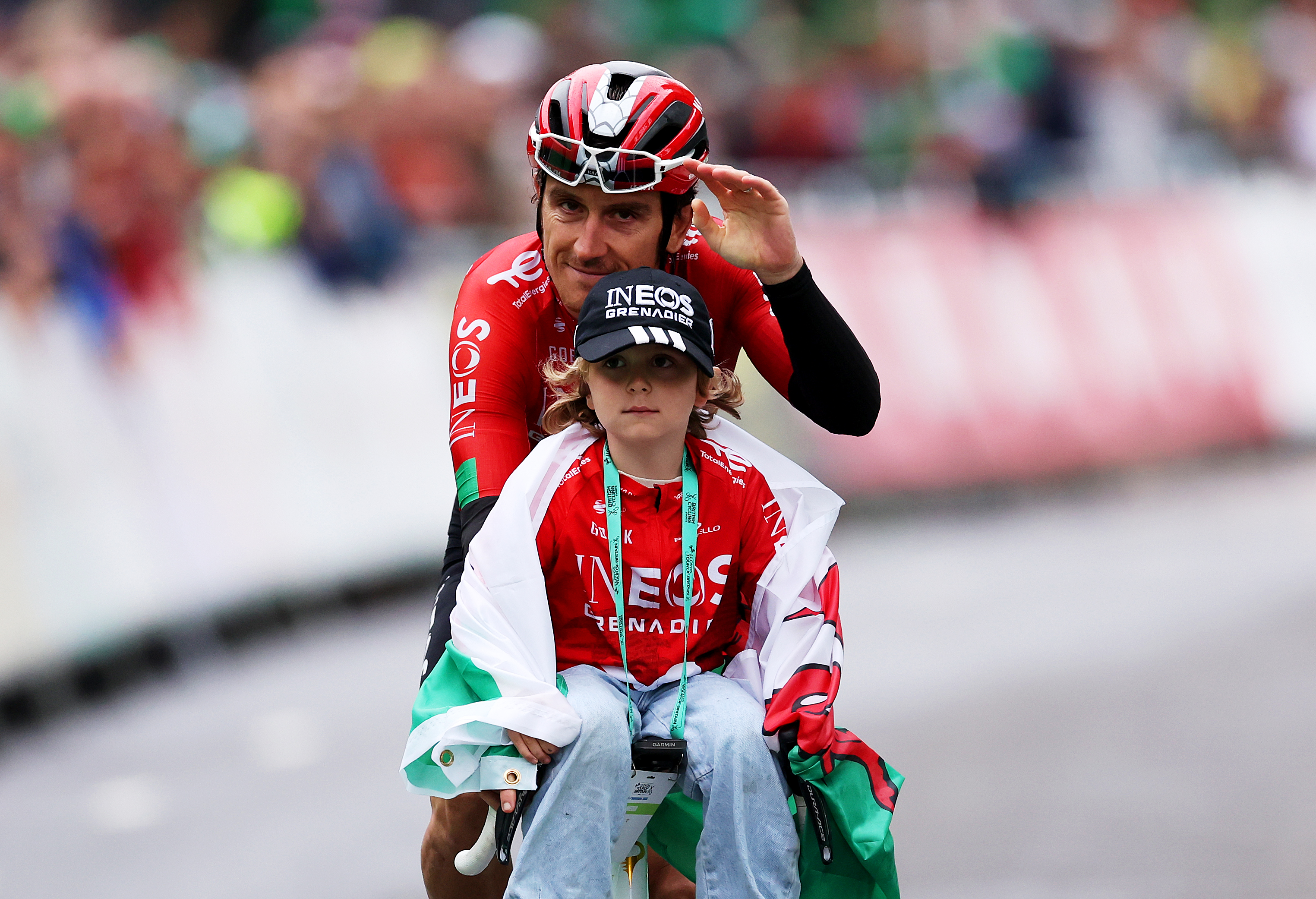
Geraint Thomas waved goodbye to the pro peloton in September this year (Image credit: Getty Images)
In terms of post-career planning, in the men’s sport, teams must provide a pension that is a minimum of 12% of the annual gross salary. The Cyclistes Professionels Associés (CPA) is also responsible for support as part of their Transition Fund, financial aid granted to riders moving out of the sport. It receives its income from a 5% levy on race prize money.
However, it is not always quickly forthcoming: in 2020, retired riders failed to be paid fully for over two years. Bookwalter was a board member of the North American Pro Riders’ union (ANAPRC) and says that the “broken” pension system was one of the first things brought up when they met with the CPA. He feels the money was sitting there, losing value and not forecasting for forthcoming withdrawals.
Meanwhile, Brown says that she only got paid a pension on FDJ-Suez because of French employment law. “That’s something that I think should change,” Brown says. “There aren’t many careers these days where you’re not putting money aside. It’s particularly an issue in these teams where it’s self-employed contracts, because there’s basically no obligation to pay on top of the salary any social security.”
Brown believes most women’s pro teams would not pay one currently. A 2023 Cyclists’ Alliance (TCA) survey revealed that only 40% of the employed WorldTour riders confirmed they had a pension plan.
It is another crucial piece of a big picture that surely does not cross the mind of 20-year-old cyclists new to the circuit.
Bookwalter hopes more athletes and teams will treat retirement seriously and plan methodically for it: “Don’t wait, start now, touching on your self-identity, self-esteem, self-efficacy – those are also factors which contribute to performance, which you’ll get double payback on if you work on them before retiring.”