
It’s the week for finalising plans, such as making lists of who’s coming when and who will eat what. It’s also the time for buying extra cheese, booze, chocolate and snacks – just in case.
But while everyone expects overindulgence at this time of year, it’s not just around the Christmas table that we turn a blind eye to big portions. To the detriment of our health, and certainly our waistlines, we’ve become increasingly used to mega-sized plates of food in restaurants and at home.
It’s undeniably one of the causes of the obesity epidemic – as Naveed Sattar, professor of metabolic medicine and Labour’s Obesity Tsar, explained this month in the The Lancet journal. Professor Sattar went even further, suggesting portion sizes at the likes of sandwich bars and cafes were especially big for women.
Servings, he said, ‘are typically calibrated to the average energy requirements of an adult male, making them oversized relative to energy needs for women and children [and those of a shorter stature]’.
To stop us eating too much, he suggested, restaurants should offer at least two sizes of sandwich, slice of cake, mug of latte and so on, ‘differing by around 25 per cent’, so women and shorter men can pick the smaller one if they want.
Whether you’re offended by that or not, it’s undeniable that many snack foods have been supersized. Pop into your local supermarket or garage and you’ll see shelves of giant cookies, mega bars of Dairy Milk and grab bags of crisps.
Eating out is even worse. Decide to treat yourself to a Sunday roast at the local pub and the Yorkshire will be the size of a hat.
As for the office lunch, it’s all too easy to blow a sizeable chunk of your daily recommended calories – 2,500 for men and 2,000 for women – on a meal that’s inhaled at your desk in five minutes. The Pret Christmas Lunch sandwich – turkey, stuffing, spinach and crispy onions slathered with cranberry sauce and mayo – is 566 calories, after all.
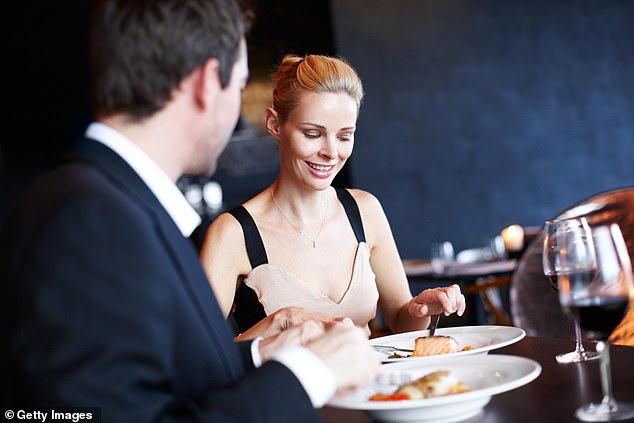
Some two-thirds of UK adults are overweight or obese, with generous portions now prevalent
Even in at home, we regularly serve portions that leave us full. The British Heart Foundation revealed that nearly nine out of ten of us fill our bowls with more than the 30g of cornflakes recommended as a ‘correct’ portion size. Other studies have shown that four in ten finish everything on their plate even if they are full. And that’s on dinner plates that are a third bigger than they were in the 1960s.
Exactly how big your portion should be…
Potatoes
175g – stick to a portion the size of computer mouse
Pasta or rice
150g – stick to a portion the size of a tennis ball
Piece of meat
90g – stick to a portion the size of a deck of cards
Chunk of cheese
30g – stick to a portion the size of a small box of matches
(Source Food Standards Agency)
<!- – ad: https://mads.dailymail.co.uk/v8/us/lifestyle/lifestylefooddrink/article/other/mpu_factbox.html?id=mpu_factbox_1 – ->
Advertisement
No wonder two-thirds of adults in the UK are now overweight or obese.
So used are we to being generous with our portions, we’ve lost track of what normal amounts should look like.
‘A big load of food can look standard to a person, while a sensible portion can look small or stingy,’ says Bini Suresh, head of dietetics at the Cleveland Clinic in London. ‘Studies show that when people are given larger portions, most of us eat more without realising it, even if it’s 20-30 per cent extra.’
But there is good news; you can reset your thinking. Being mindful about the amounts you serve at home and adjusting the way you eat can change your habits in weeks.
‘Our brains and bodies are surprisingly adaptable,’ says Suresh. ‘Eat less and you will quickly be satisfied by smaller amounts. It will become your new comfortable normal.
‘Generally, men will require slightly larger portions because they tend to have a higher body weight, greater muscle mass and increased energy needs, but it’s important to remember that we’re all individuals. A very active woman may need more than a sedentary man, for example.’
To avoid portion distortion, here’s our forensic guide to the amounts we should eat for Britain’s favourite meals.
The Christmas roast 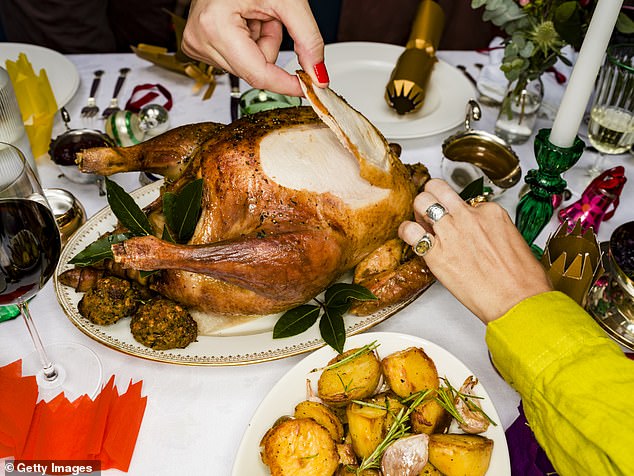
Bini Suresh insists she is not wagging a finger. ‘Look, Christmas Day is a special time for many people and it’s about having a fun time. The Christmas roast is a significant meal and there to be enjoyed. Rather than fixating on numbers, I encourage people to use visual cues – a palm-sized portion of protein [turkey], a cupped hand of carbs [potatoes] and half a plate of vegetables. Then, with the calorie-dense items like the stuffing and pigs in blankets, keep the portions smaller.
‘It’s also important to pay attention to hunger and fullness. You shouldn’t be feeling bloated at the end of the meal.’
Healthy tips: Turkey breast is the leaner cut of the bird, so a turkey crown is a good option. Roasting on a rack stops any fat accumulating around the bird. Think of healthier stuffing options such as mushrooms or lentils, or do half-and-half with the sausage meat.
You could also opt for leaner chicken or turkey chipolatas for your pigs in blankets. Choosing to roast your potatoes with a light spray of oil could mean having one or two more. You can always add herbs including thyme or rosemary for extra flavour.
The expert’s advice: ‘Make vegetables the star, filling at least half the plate with them, and be choosy with your extras, like cranberry sauce, which contains a lot of sugar,’ says Suresh.
The healthy portion for women
Women’s portion
100g turkey (2-3 fairly thin slices)
25-30g stuffing (a small ball or slice)
120g roast potatoes (2-3 egg-sized pieces)
1-2 pigs in blankets
180-220g of veg = 3 tbsp Brussell sprouts (80g), 3 tbsp carrots (80g), 1-2 tbsp roasted parsnips (40-60g)
30-40ml (3 tbsp) gravy
Cranberry sauce 1 tbsp
Bread sauce 1 tbsp
Calories: 750-900 kcal
<!- – ad: https://mads.dailymail.co.uk/v8/us/lifestyle/lifestylefooddrink/article/other/mpu_factbox.html?id=mpu_factbox_2 – ->
Advertisement
Men’s portion
150g turkey (3-4 slices)
50-60g stuffing (1-2 small balls or slices)
150-180g roast potatoes (3-4)
2-3 pigs in blankets
220-260g veg
30-40ml (3 tbsp) gravy
Cranberry sauce 1 tbsp
Bread sauce 1 tbsp
Calories: 950-1,150 kcal
<!- – ad: https://mads.dailymail.co.uk/v8/us/lifestyle/lifestylefooddrink/article/other/mpu_factbox.html?id=mpu_factbox_3 – ->
Advertisement
A bowl of spaghetti bolognese 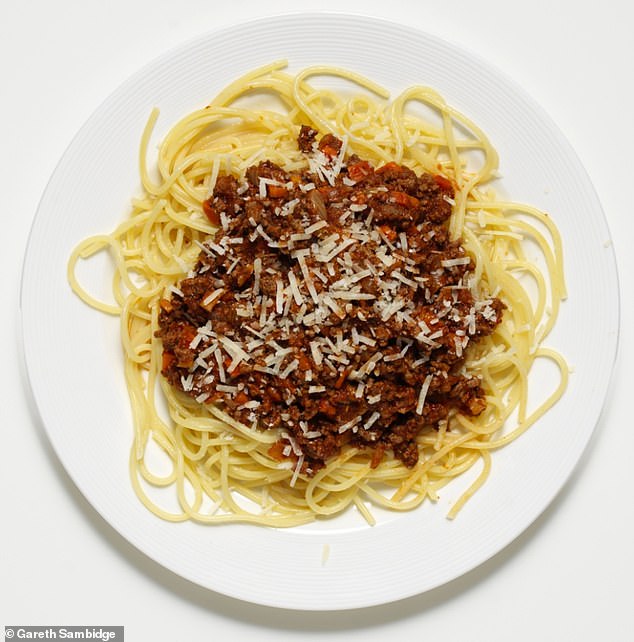
‘It’s tempting to overeat pasta,’ says Suresh. ‘It’s a comfort food that is easy to consume quickly. But it’s a refined carbohydrate, and when combined with rich sauces and cheese it can be very energy-dense.
‘Our brains also tend to see a big bowl of pasta as one portion, but often it’s actually enough for two. When it comes to the sauce, for most adults, a palm-sized portion of lean mince is plenty of protein; you could even bulk it out with lentils or mushrooms.’
Packaging guidance for a single portion of dry pasta is 75g (around 150g when cooked and 270 calories). If you are monitoring your intake, it’s worth keeping weighing scales handy and switching to a reduced plate size for your meals. You can trick the eye into thinking you are eating more if the (smaller) bowl looks full. And if you feel you’ve eaten enough, stop. You can always keep the leftovers for the next day or freeze it.
Healthy tips: Choose wholewheat pasta. Avoid jar sauces as they tend to be high in sugar. Opt for fresh chopped or tinned tomatoes, or passata, and flavour it with garlic or herbs such as basil or oregano.
The expert’s advice: ‘Boost the vegetable content by matching or exceeding the amount of mince. Onions, carrots, celery, mushrooms and peppers work well. You could even stir in a handful of spinach at the end. Go easy on the cheese – a light sprinkle of a strong cheese like parmesan will still add flavour.’
Women’s portion
60-70g dry pasta – no more than a fifth of a small 350g bag or a seventh of a bigger 500g bag. (150-180g cooked)
80-90g lean beef mince (5% fat or less) with tomato sauce
Light grating of parmesan
Calories: 550-700 kcal
<!- – ad: https://mads.dailymail.co.uk/v8/us/lifestyle/lifestylefooddrink/article/other/mpu_factbox.html?id=mpu_factbox_4 – ->
Advertisement
Men’s portion
75-90g dry pasta (190-220g cooked)
100-120g lean mince with tomato sauce
Light grating of parmesan
Calories: 700-900 kcal
<!- – ad: https://mads.dailymail.co.uk/v8/us/lifestyle/lifestylefooddrink/article/other/mpu_factbox.html?id=mpu_factbox_5 – ->
Advertisement
Fish and chips 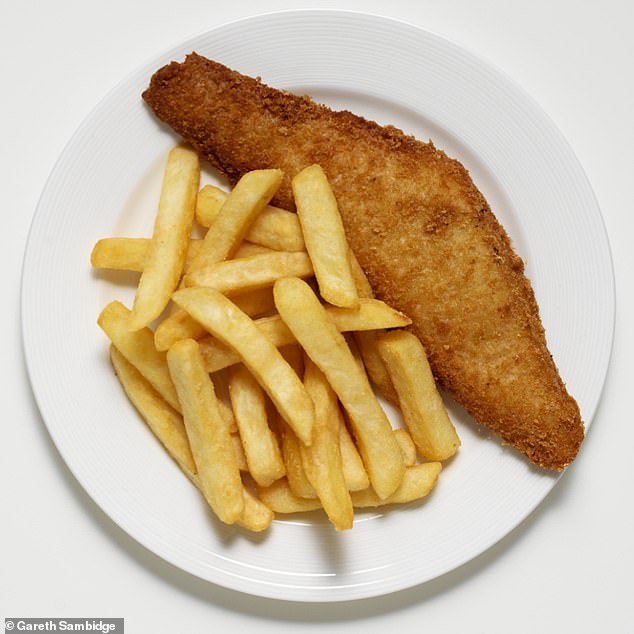
‘Traditional fish and chips is deep fried, which means both the batter and the chips absorb the hot oil, making them very energy-dense. Many takeaways use the same oil repeatedly, and often it’s high in saturated or trans fats. That means a lot of calories are packed into a relatively small volume of food,’ says Suresh.
‘Chip-shop portions are very generous and it’s easy for a single large portion of fish and chips to exceed 1,500 kcal. If possible, choosing grilled, baked or a lightly breaded fillet makes a noticeable difference compared with a thick batter.
‘I’d suggest sharing one portion of chips between two or asking for a small portion and padding out the meal with mushy peas which are filling and will contribute fibre, protein and micronutrients for relatively few calories.’
Healthy tips: If you’re at home, choose oven-baked fish and chips or use an air-fryer. Remember, thicker chips absorb less oil. Skip the buttered bread on the side and replace with salad or extra veg, and just say no to tartare sauce – a squeeze of lemon or a sprinkle of garlic powder is just as tasty.
Rather than getting bogged down with calories (you know something fried is going to be more kcals), keep portions reasonable by using the hand rule as a serving guide.
When it comes to protein, such as fish, it’s a palm-sized serving for women and two palm-sized portions for men. High-carb foods, including potatoes, is one cupped-hand portion for women and two for men. Vegetables can be roughly measured as a fist-sized portion for women and two for men.
Women’s portion
120-140g fish (roughly the size of your palm – not fingers)
150g chips (roughly a largish mugful)
Calories: 700-900 kcals
<!- – ad: https://mads.dailymail.co.uk/v8/us/lifestyle/lifestylefooddrink/article/other/mpu_factbox.html?id=mpu_factbox_6 – ->
Advertisement
Men’s portion
140-170g fish
200g chips
Calories: 900-1,150 kcals
<!- – ad: https://mads.dailymail.co.uk/v8/us/lifestyle/lifestylefooddrink/article/other/mpu_factbox.html?id=mpu_factbox_7 – ->
Advertisement