
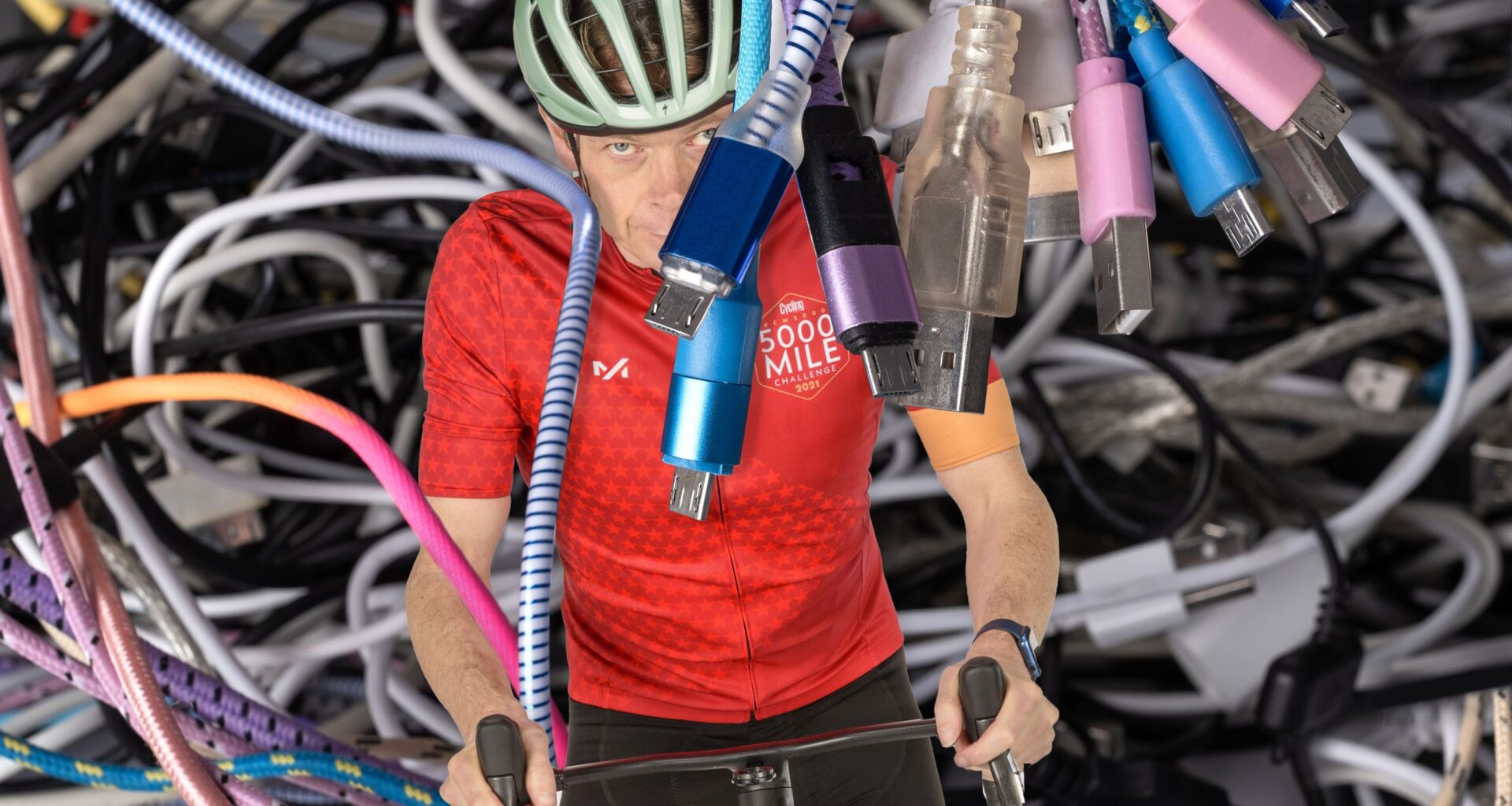
I was out for a ride recently with my friend Bernard. As happens rather frequently these days, my computer ran out of battery. It does not believe in giving me much notice of this – it flashes up a message, counts to ten in its head, and dies. It’s old and grouchy and it finds it hard to summon much energy these days. In many respects it and Bernard are fellow travellers.
I don’t think I did anything to give it away, but my friend noticed the screen had gone blank.
“Lost your little friend, have you?” he said. “How are you going to cope now? You won’t know what watts you’re doing.”
You may like
Multiple national road champion on the bike and award-winning author Michael Hutchinson writes for Cycling Weekly every week.
He’s quite hostile to a lot of modern technology. Basically he objects to anything that needs a battery, because cycling is about honest physical work. There’s an element of hypocrisy – he’ll use a TV remote control, and if you tried to interest him in the authenticity of our parents’ generation, where everyone either got up to change the channel or organised their family so that there was an eternal supply of seven-year-olds to do it for them, he’d think you were an idiot.
I’ll admit that I almost agree with him. There are days when I get in from a ride and have to carry out a sort of charging audit. Things I use regularly that need charging include a computer, a power meter, a heart rate monitor, front and rear lights, gears, phone, and (bone conduction) headphones.
Their charging demands slip in and out of phase so that some days I need charge nothing, some days I need to find eight charging cables, in types covering the last fifteen years of standards from USB micro to USB-C, plus the weird charger for the gears. I know an engineer who’s created a hydra-headed wiring loom so he can do everything at once while it’s still on the bike. It makes his bike look like it’s in intensive care.
It’s a dirty trick that the charging periods are so varied. My computer needs charging almost every day if I use the backlight. The front and rear lights are a matching set, but one needs to be charged 25% more often than the other. The Di2 gears need to be done maybe once or twice a season – honestly, it’s so rare that it’s more like a service issue. It’s designed to make you forget about it till it goes flat abruptly at the most amusing point of a ride, like halfway up Hardknott Pass.
I could never have made a success of a secret motor, because it would never have been charged. On the final climb of the Tour of Flanders I’d have hit the secret trigger and just got that bloop-bloop-bloop noise a pair of dying headphones makes.
I can understand where Bernard is coming from. I remember when the only thing on my bike that needed a battery was a little Cateye computer that took an LR44 button battery. It needed changed about every two years. And it didn’t matter if you forgot because the computer didn’t really work anyway. The most interesting thing you could do with it was wind the wire connecting the wheel sensor very carefully and artistically around the front brake cable, thus demonstrating your attention to detail.
Cycling then was no different from cycling now. I don’t think it was better or worse. The main downside was there was less data to obsess over. The main upside was there was less data to obsess over. And those cancel each other out.
You may like
But we are where we are, and I’m not luddite enough to go back on principle. Although I’m not quite ready to buy a rechargeable electric mini-pump. And when I finally get there (and let’s face it, I will) I won’t tell Bernard.
Great inventions of cycling: Normalized Power

(Image credit: Future)
Normalized Power was invented in 2006 by sports scientist Andy Coggan. It was not, contrary to the view of most power meter botherers, handed to Moses by God on the Holy Garmin of Sinai.
The idea of Normalized Power is to provide a more accurate assessment of the physical demands of a ride than you’d get from a simple average. That’s because the high-stress hard bits of a ride, from a physiological point of view, outweigh the low-stress easy bits. This is why an interval session is “harder” than an average of the session would suggest.
Normalized Power is easy to calculate if you have a bit of paper. Simply establish a 30-second rolling power average. Raise these values to the fourth power. Establish the average of those values, and take the fourth root.
Alternatively you can go for Hillbilly Normalisation, which is just to add 10% to your average, or 15% if you feel you deserve it.
There’s not really any proof of the concept’s validity – it’s not derived from actual physiology. But it has been widely accepted by the coaching and athlete communities, mainly because Normalized Power is almost invariably higher than a simple average, so it has made all of us feel a bit more successful. You can bet your last dollar that if Coggan’s mathematics produced a number that was lower than a simple average no one would ever have heard of it, no matter how clever it was.