
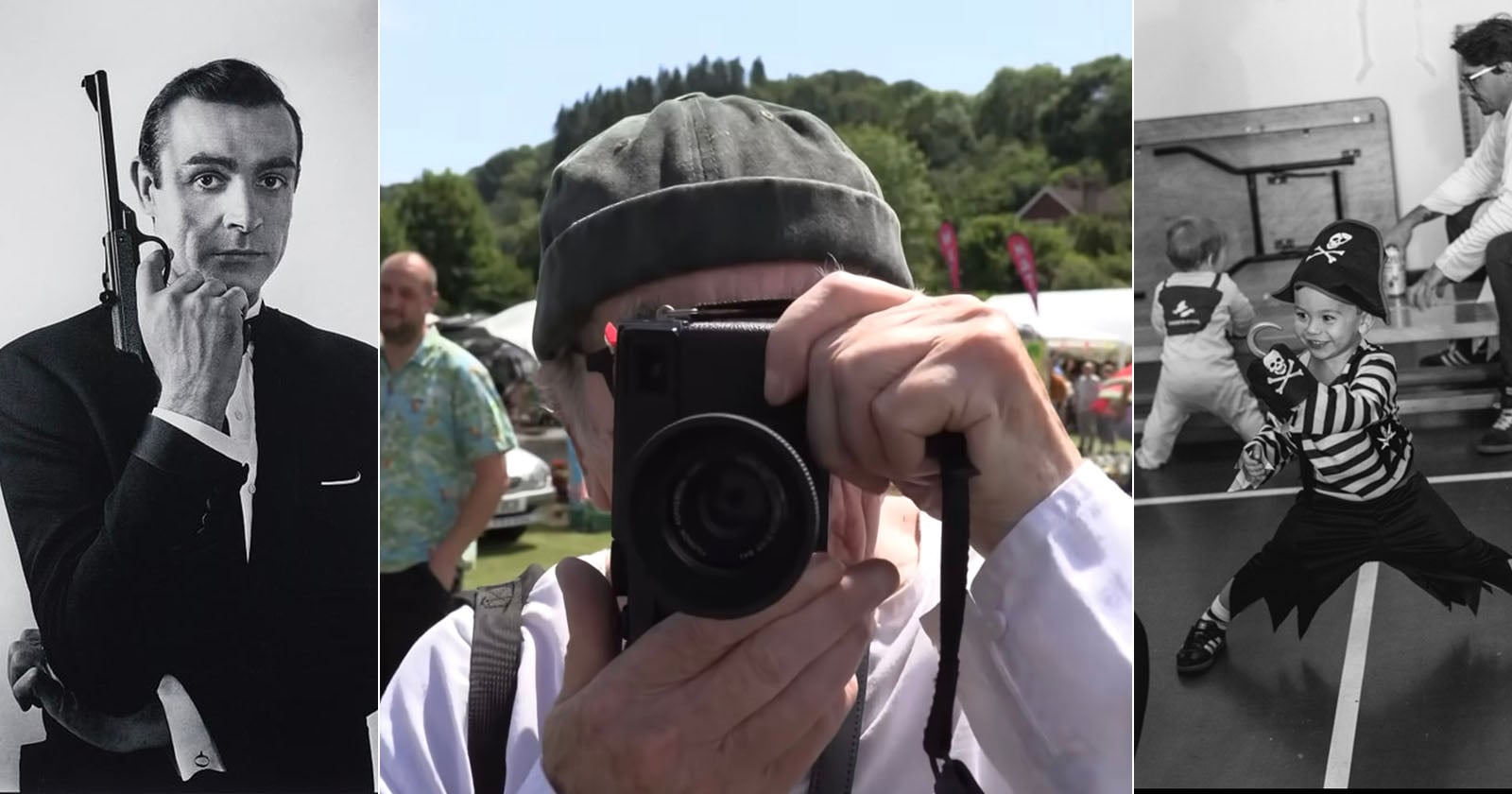
Just ahead of Christmas, here’s an inspiring story about David Hurn, a 91-year-old photographer who has captured some of the most iconic images of the past century, including the instantly recognizable portrait of Sean Connery as James Bond.
The segment was created by the British news network, ITV. In the feature, Hurn discusses his career, which began in Hungary in 1956 when he documented the 1956 revolution. Despite his age, Hurn has never put down his camera, an inspiration to other photographers worldwide.
“My main problem is I don’t want to give up shooting pictures. I like shooting pictures,” Hurn tells ITV.
After a lifetime of capturing defining news moments, world-famous stars like Sean Connery and The Beatles, Hurn wondered what he could keep doing “until he conked it,” as he charmingly puts it. He now photographs for his local community magazine, the Tintern News.
“And so, I suddenly thought if I become the village photographer, and I fall over, somebody who knows me will pick up,” Hurn laughs. “You know, it is as simple as that.”
Although it may seem like a real step down from a long career of capturing famous photos seen by people around the world, Hurn has a very different view on his latest endeavor.
“As far as I’m concerned, The Beatles are, for me, no more interesting than the village fete that I’m about to go and do, you know,” Hurn says.
Every month, one of Hurn’s photos graces the cover of the Tintern News, delivered every month by volunteers to around 200 homes in the small Welsh village.
“They don’t come up to [David] and ask for his autograph,” says Toni Harrey, editor for Tintern News. “They probably ought to.”
‘As far as I’m concerned, The Beatles are, for me, no more interesting than the village fete that I’m about to go and do.’
Hurn recalls his lengthy career with as much humility as he approaches his work today, describing photographing Beatlemania as a terrifying experience.
“I was scared stiff most of the time,” Hurn says, referring to the absolute insanity of Beatles fans at the height of their popularity. “They could have killed people. They were that fanatical.”
Today, in addition to photographing the community magazine, Hurn offers masterclasses to local photographers, delivering advice built on his decades of remarkable experience in exchange for help cleaning up his yard. While photographing Beatlemania may have been terrifying at times, and capturing famous portraits of celebrities was fun, Hurn is also an accomplished photojournalist who covered major news events, including tragedies.
Hurn photographed the Aberfan disaster in Wales in 1966, when a colliery spoil tip, a massive pile of waste from the local coal mining operation, collapsed down a slope onto the local village. The slurry engulfed a local school and a row of homes, killing 122 children and over two dozen adults.
Hurn describes the event as the most challenging assignment he has ever had.
“We’re talking about 122 kids, suffocated by crap sliding a mountain side,” Hurn says to a trio of photographers in his home. “And when one got there, the miners who were the parents of these children, were trying to dig their children out.”
Hurn says one of the more challenging parts of the job was being there when the people whose kids were killed didn’t want you there, but Hurn says he knew he had to be there because events like that have to be documented.
Just a decade prior, Hurn was headed to Hungary to document the Hungarian Revolution, though at the time, he admits he didn’t know what he was doing. He had a camera he didn’t know how to use, saying he didn’t even know how to load the film.
But Hurn befriended a group of Life Magazine journalists who were also there and hung around them, carefully observing and picking up the skills he needed. It set into motion an incredible career that continues to this very day.
‘My main problem is I don’t want to give up shooting pictures. I like shooting pictures.’
“I’m 91, and my body is fragile. You know, I have had a blissful life. As far as I’m concerned, when I die, I die,” Hurn says. “What I feel I do have which is enormous advantage is that I happen to do something which leaves something behind afterwards.”
Image credits: ITV News, David Hurn