
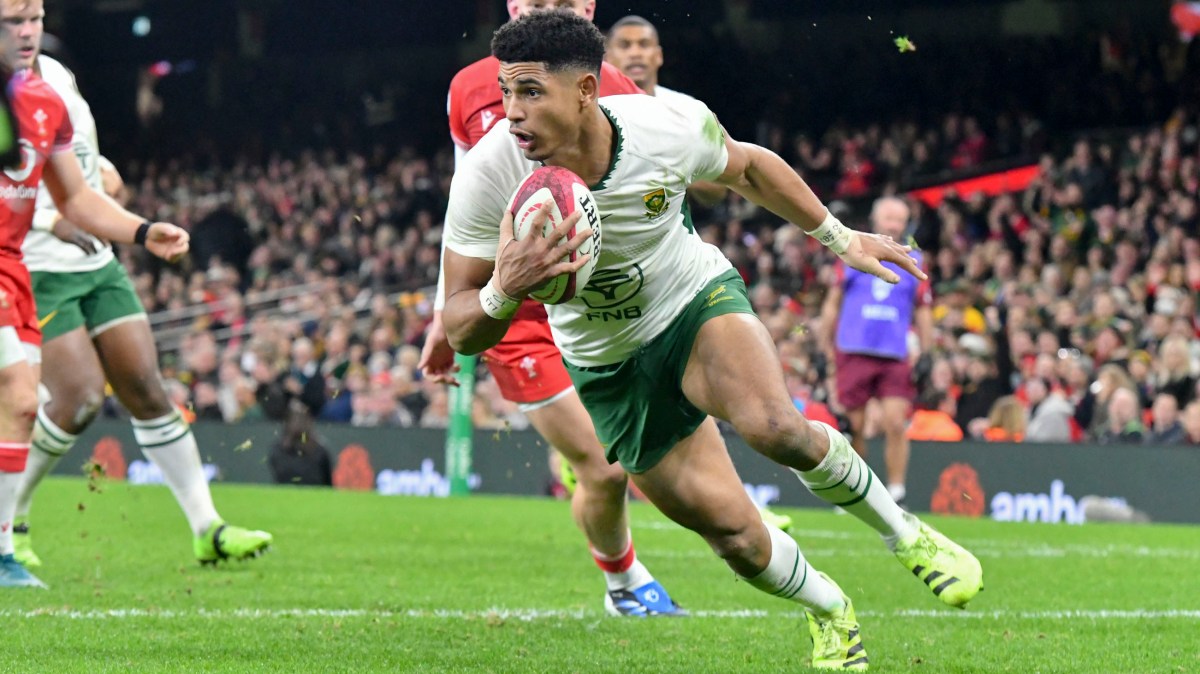
As he chats over Zoom from his home in Cape Town, Sacha Feinberg-Mngomezulu leans back and throws a tennis ball repeatedly from one hand to the other. This is the player whose natural sporting talent has landed like a meteor on the international rugby stage this year, a fly half blessed with such innate skill that he looks as though he was born with a ball in his hands or at his feet.
“To be honest,” he says with a smile, “what I really wanted to be was a footballer. I grew up in a neighbourhood environment where we were playing street cricket, football, rugby. Any sport you can think of, we were playing it.
“I loved my football and I played it similar to how I play rugby. When I went to trials with Ajax Cape Town, we weren’t allowed to wear metal studs, but I wore them anyway, and I used to love crunching guys in tackles. But I did have elements of finesse to my game as well.”
What position did he play? “Mainly central attacking midfield, but I could also mess around at centre back as well. Something like a Kevin De Bruyne and Eden Hazard mix, but also with a physical presence of someone like Michael Ballack.” Not a bad player, then? “I was solid,” he says. “It was always going to be either football or rugby for me. But the environment I grew up in shaped me to want to be a rugby player.
“In South Africa, with the developmental pathways for football and rugby, rugby was the no-brainer option. I’m very happy that I took this job.”
Every South African rugby fan is just as happy at the decision he made. The boy who, by the sound of things, could do a bit of everything on the football pitch, and had initially dreamed of playing for Chelsea, has matured into a 23-year-old playmaker on the rugby field with a similarly rare breadth of skills. Not only is he a gifted kicker and distributor, he also has the speed and footwork to be a potent running option and, at 6ft 1in and 15st, he poses a physical threat, too.
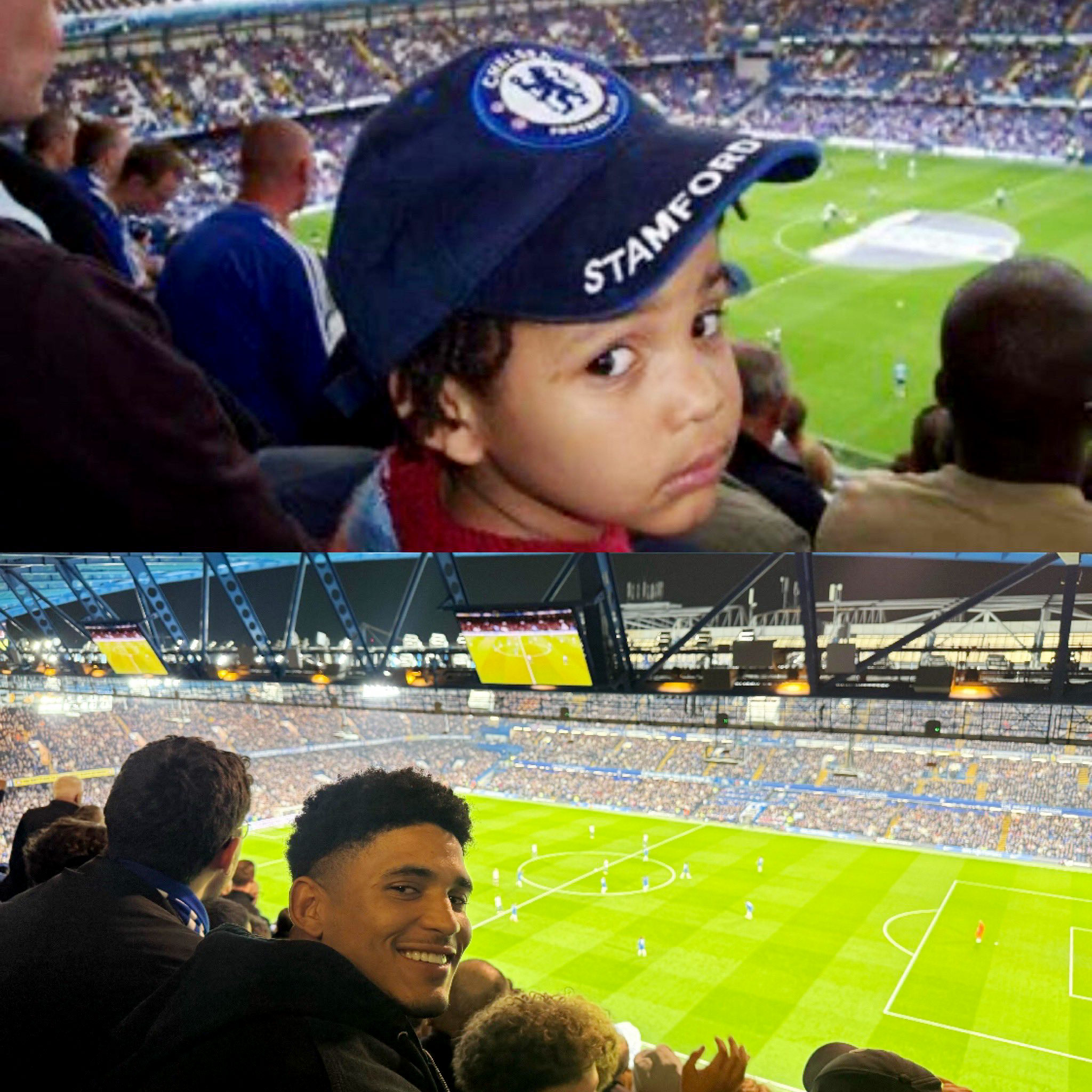
Feinberg-Mngomezulu as a child at Stamford Bridge and more recently in April this year in virtually the same seat
All of which has been central to the continued evolution of the Springboks this year as they plot a path towards their tilt at winning a third successive World Cup in 2027 under the coaching of Rassie Erasmus. They were victorious in the Rugby Championship, including a record 43-10 win away to New Zealand in Wellington and an astonishing performance from Feinberg-Mngomezulu against Argentina in Durban, where he scored 37 points, including three brilliant tries.
The Springboks were then unbeaten on their tour to Europe in the autumn, recording stirring victories over France and Ireland, and there is now clear water between Erasmus’s team, as the No1-ranked side in the world, and the rest of the chasing pack. The team whose power-based game was epitomised by the Bomb Squad now have multiple ways of unpicking opponents and the skills of Feinberg-Mngomezulu have been at the heart of that transformation.
The European tour in November was Feinberg-Mngomezulu’s first experience of international rugby in the northern hemisphere. He had travelled with the Springboks for experience in autumn 2022, aged 20, without playing a game, and missed the tour last year, shortly after making his international debut, through injury. Like any curious young traveller, he found the journey through different rugby cultures and environments a rewardingly eye-opening experience.
“There was a completely different feel to the games,” he says. “The conditions were so much more challenging, the balls are wet half the time, and there’s a load of uncontrollables that test your skill-set and your character.
“And the hostility of the crowds . . . in France, you could just feel the emotion of the crowd. They were so invested, so passionate and the noise, wow, you literally feel it on the field.”
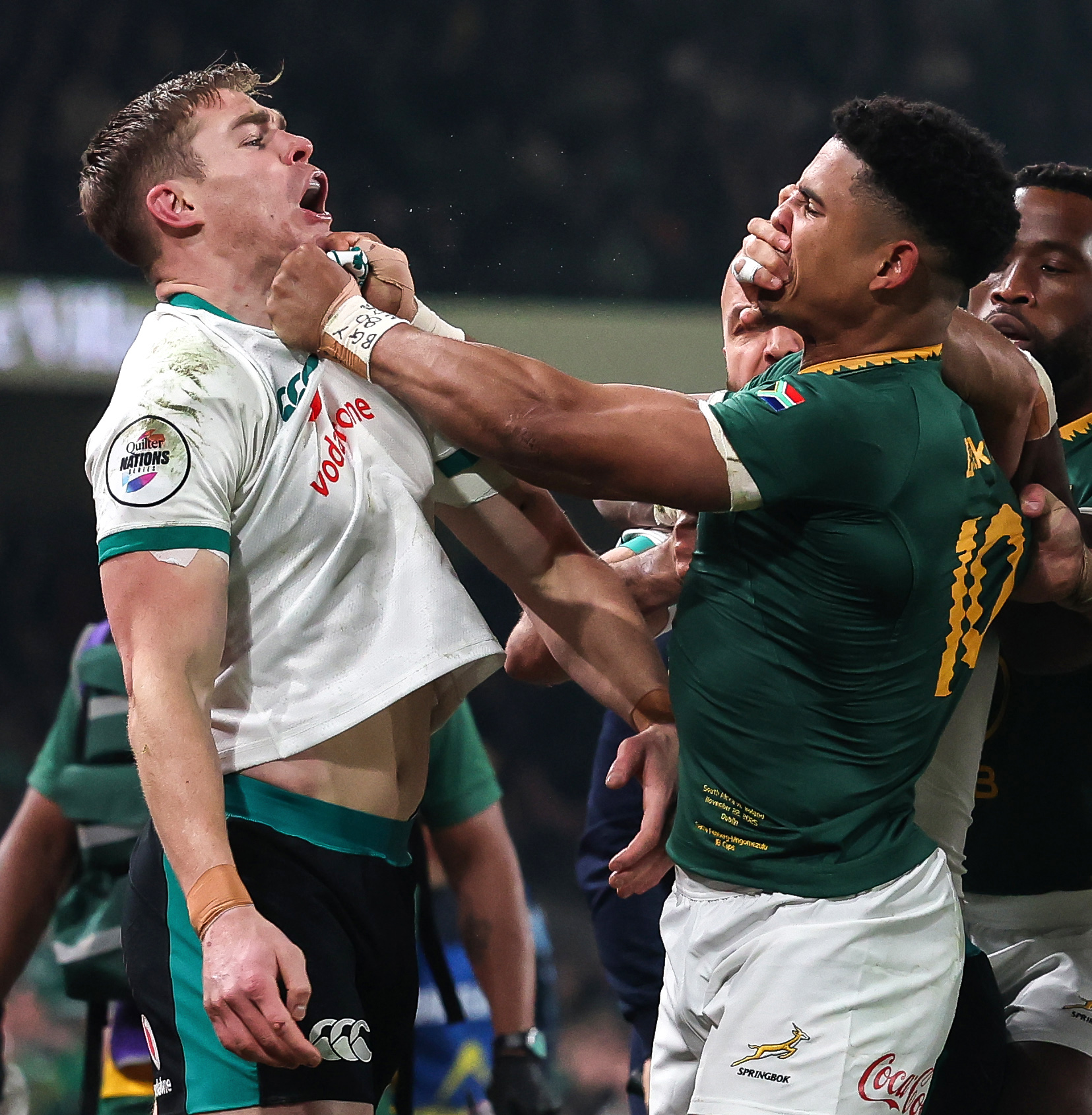
At 15st and 6ft 1in, Feinberg-Mngomezulu is not averse to the physical side of the game, as Garry Ringrose discovered in Dublin last month
GARY CARR/INPHO
In Dublin, by contrast, he experienced an alien sensation when lining up his kicks at goal. “When you’re kicking, it’s pin-drop silent, and I found that weird,” he says. “I know it’s trying to show respect, but ironically I just didn’t like that. It’s so quiet that it’s loud, you can pretty much hear anything.
“I’d prefer just the murmurs of noise I’d normally hear. But it all made for a really challenging and enjoyable month. You see what you’re about after that. It’s the best stage to prove yourself on and I loved it.”
Feinberg-Mngomezulu has certainly proved himself. After coming off the bench eight times in his first 12 matches for the Springboks, with Handré Pollard and Manie Libbok also on the scene, he has started in his past seven appearances and is now the clear first choice, with Erasmus keen to give his potential world-beater sufficient experience to make the most of his abundant talent by the time of the next World Cup.
As his profile has risen in recent months, he has noticed the attention on him beginning to build. Off the field, he has begun working with EMW Global, a marketing agency that has previously worked with the likes of Lionel Messi and Neymar, and he has become the face of products such as men’s fragrances and energy drinks.
“Because we won the Rugby Championship and there were some solid performances in the northern hemisphere, the collection of those successes has changed things for me a bit,” he says. “Just from a social media point of view, my brand, if you can call it that, is now different from what it was three or four months ago, and that’s off the back of those performances.
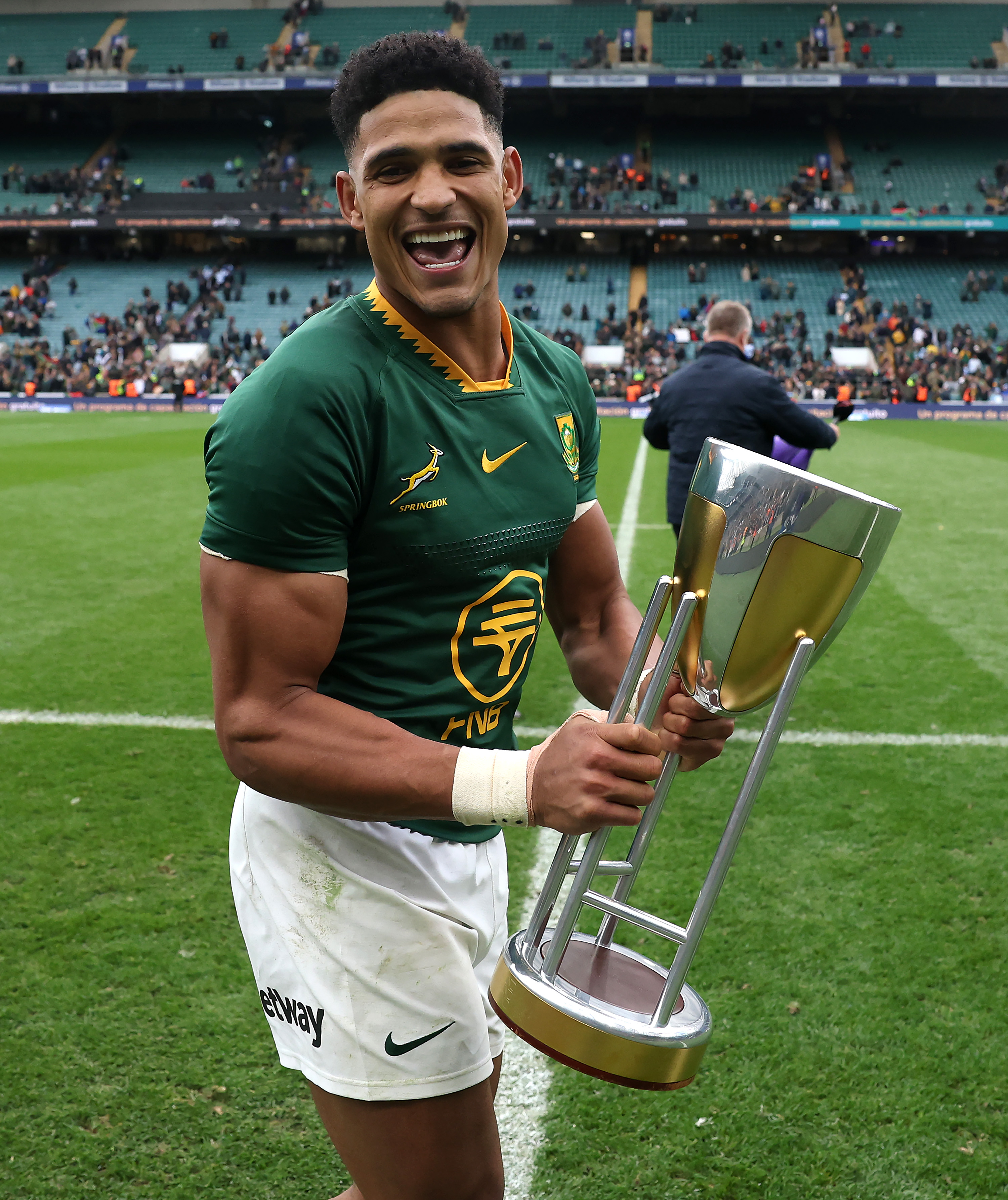
Feinberg-Mngomezulu celebrates with the Rugby Championship trophy after victory over Argentina at Twickenham in October
DAVID ROGERS/GETTY IMAGES
“What’s also changed is the level of expectation to back up those performances, which has been interesting. I’d say 99 per cent of the changes in my life have been for the good. And the expectation, well, I guess that’s part of the gig.”
The expectation on Feinberg-Mngomezulu has been building gradually since his sporting gifts became evident at an early age. He was born in Cape Town to Nick Feinberg, a radio personality, and Makhosazana Mngomezulu, a lawyer of Zulu descent. His father was born and raised in England, the son of Barry Feinberg, a white anti-apartheid activist who had been forced into exile in London in the early 1960s.
An author, poet and artist, Barry became part of a community of exiles who continued their struggle from afar, in his case producing clandestine literature and publicity that could be distributed back in South Africa. He was able to return to live in Cape Town only after the fall of the apartheid regime in 1991. Nick followed in 1994 and Sacha was born eight years later. His sporting abilities led to him attending Bishop’s Diocesan, the private school in Cape Town that has produced a number of Springboks including Francois Louw and Robbie Fleck, and it was there that rugby became Sacha’s primary focus.
Among the English links that Feinberg-Mngomezulu inherited from his father, the fondness for Chelsea remains particularly strong. “Since day one,” he says. “I was ten when they won the Champions League [in 2012], that header [from Didier Drogba] and the penalty to win it. What a day.”
His father’s background also made him eligible to play for England. Was that ever a consideration? “No, that was never a thought,” he says. “I did trips to the UK from a young age, so I’ve always been aware of the English links, but my dad fully integrated himself into the new South Africa to the point where it wasn’t an important thing.
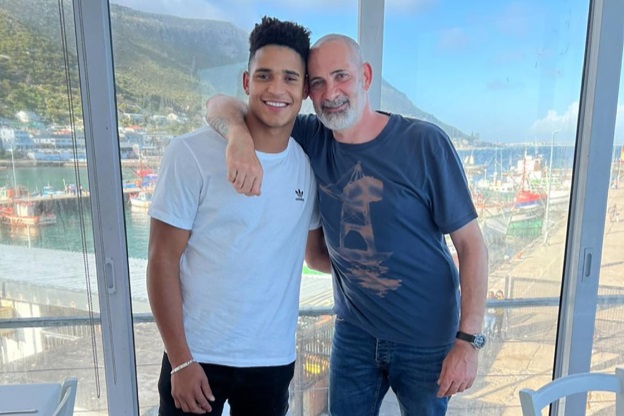
Feinberg-Mngomezulu with his father Nick, whose background made his son eligible to play for England
“Also, I’m very much of the position that you play for your own country. Much as England is where my dad’s from, it’s not my country. If you play for a country and you’re not from that place, it must be harder to dive deep down and find that extra willingness to fight for your team. I wouldn’t have been able to do that if I played for England.”
These comments tap into the patriotism for the new South Africa that Erasmus has made such a part of his team’s identity. In Europe, in front of hostile crowds, Feinberg-Mngomezulu experienced the power of such motivation.
“When you enter a venue to play against their national team, there’s hatred against you for 80 minutes, and that tests you,” he says. “It feels personal towards you and your country for those 80 minutes. So you end up loving your own country even more and you give everything.
“It’s such a confrontational sport, the closest thing to gladiatorial sport, apart from MMA or something like that. But you feel that rivalry between countries and it’s incredible to be a part of.”
The new South Africa is a concept so dear to his family. His grandfather died two years ago, nine months before Sacha made his debut in the Springbok shirt that became such a symbol of the nation’s reconciliation when it was worn by Nelson Mandela at the 1995 World Cup.
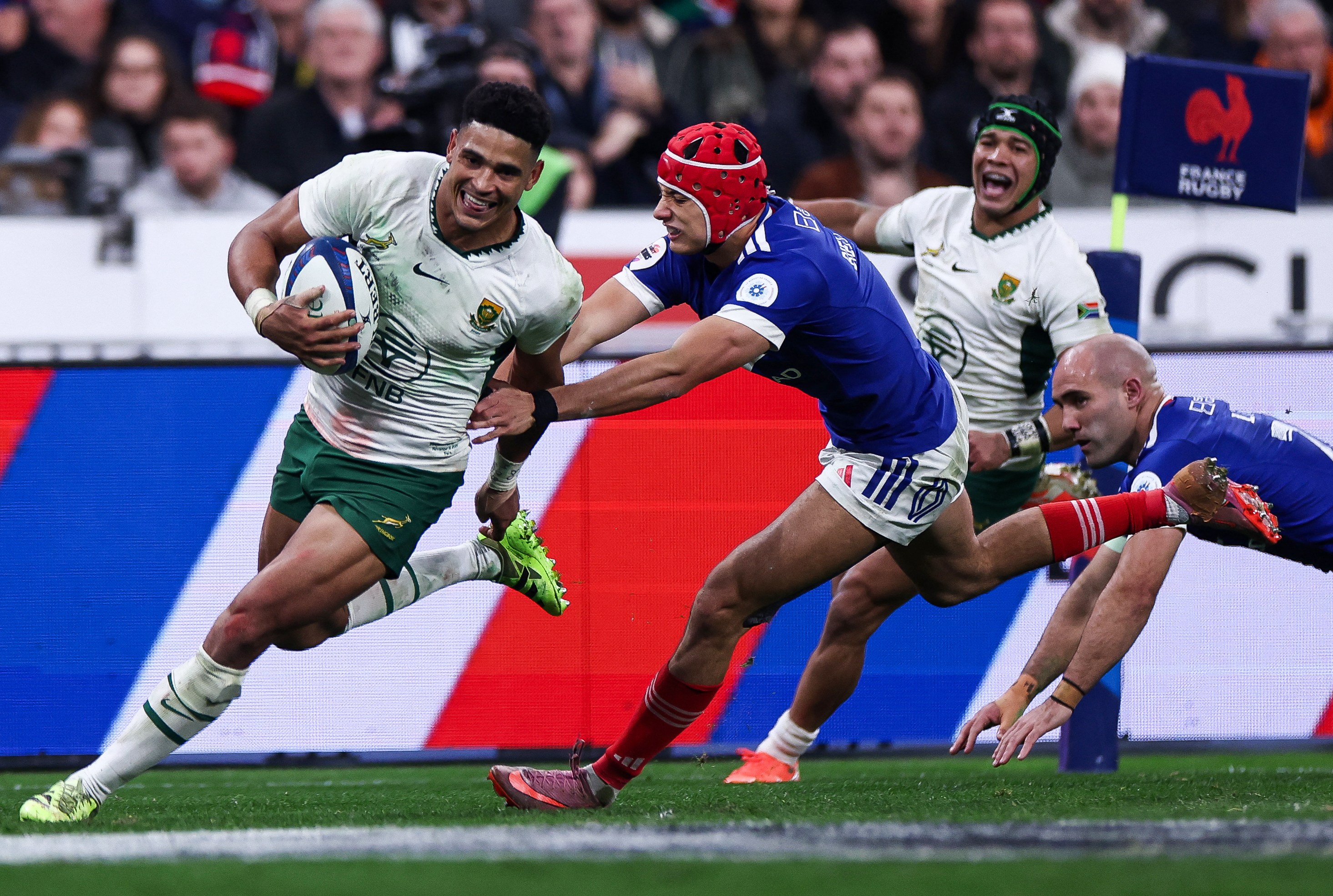
Feinberg-Mngomezulu was part of the 14-man Springbok side who sensationally beat France away from home last month
FRANCK FIFE/AFP VIA GETTY IMAGES
“I know how instrumental [his grandfather] was in helping us to progress as a country,” Feinberg-Mngomezulu says. “I know how much pressure he felt, exiling to the UK, and him being persistent with what he was doing, creating artwork and poetry and anything symbolic to the eye, just to keep the talking points going in South Africa.
“Even though it didn’t affect him [as a white man], the way he pushed on about it from a distance, at risk, was remarkable. My dad has fully embraced my grandfather’s perspective and that’s filtered down to me. Every time I read or hear something about him, man, it’s a very warming feeling.”
The notion of a multiracial South Africa team dominating rugby is a prospect, Sacha knows, that his grandfather relished. “It was everything he fought for,” he had said after winning his first cap. Erasmus has made their diversity a strength that unites them and now Feinberg-Mngomezulu is becoming the poster boy for a team aiming for an unprecedented third consecutive World Cup win. The Springboks head coach is nurturing his fly half carefully and ensuring he has the support he needs to continue improving.
“Rassie keeps me well grounded,” he says. “He’s put blocks in place around me with Felix Jones and Tony Brown [assistant coaches] and Handré Pollard [his experienced team-mate], all these guys are checking up on me and making sure my game’s developing.”
There will be bumps in the road and progress will not always come as readily as it has in his breakthrough years, but he knows where he is going and how he wants to get there. “The thought of the World Cup is super exciting,” he says. “But next year we’ve got England at home, some tough fixtures against the All Blacks. Developing my game next year will be so crucial to my output in the World Cup year.
“I need to nail down 2026 first, then the rest is going to follow.”