
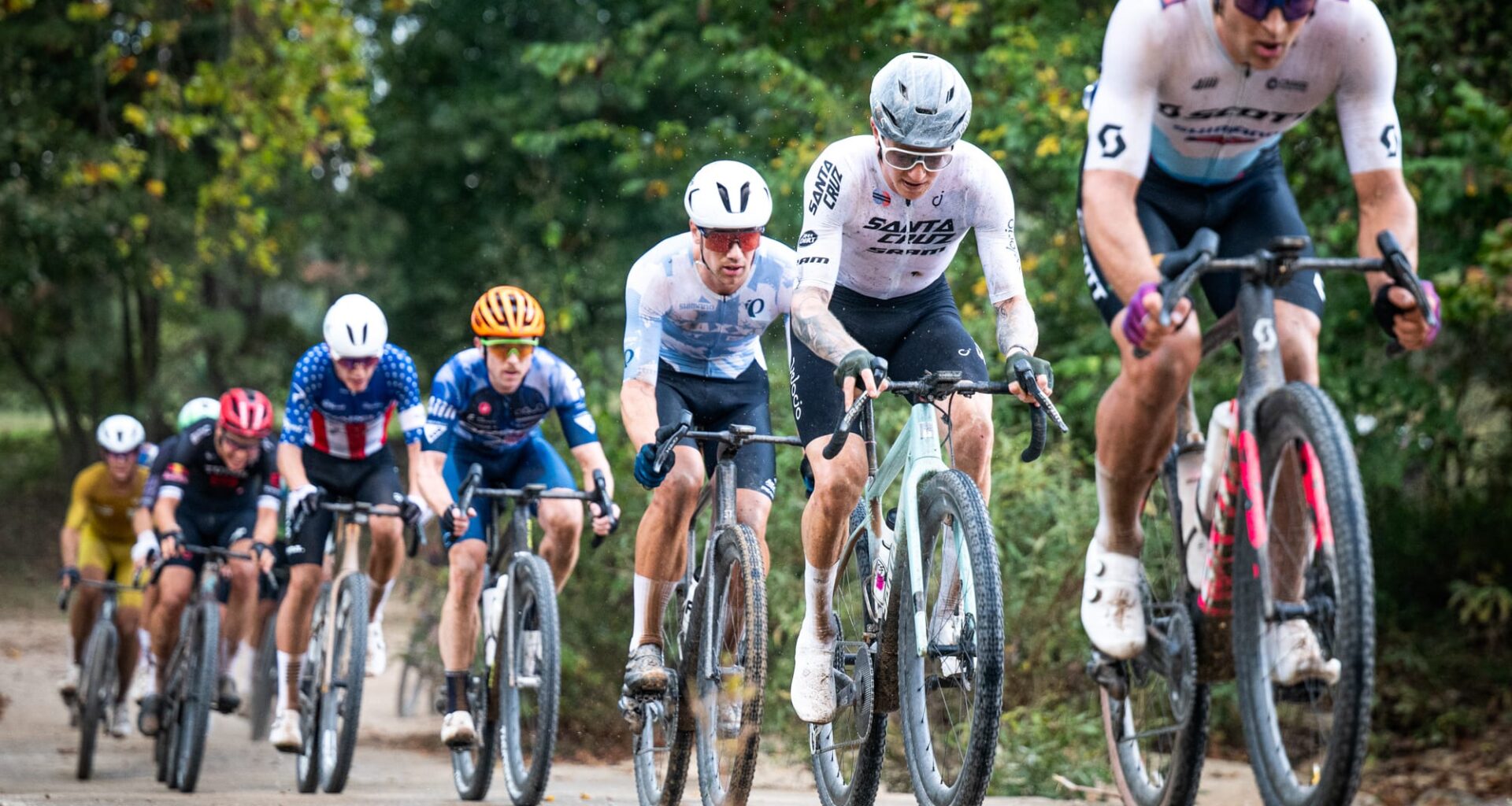

As we close the book on 2025 and with 2026 right around the corner, it’s a great time to ponder: Who are the best gravel racers in the world right now?
Thomas Euler is a gravel fanatic. Besides writing about gravel on Escape Collective, he has his own “gravel-coded” The Gravel Stack Substack. He also hosts the Gracing podcast, where he (p)reviews gravel races, often with the top pros who competed.
I set out to answer this question and rank the top 25 gravel racers from across the globe. In this piece, we will look at the men. The women’s ranking will follow soon. And if you’re interested in some deep cuts, the riders who sat on the bubble and just missed the top 25, make sure to subscribe to my newsletter The Gravel Stack.
Given the title, you may be wondering … What are power rankings? Glad you asked. First, let me tell you what they are not. They are not a GOAT (greatest of all time) ranking. Rather, they aim to capture who is best at this moment in time. They are a snapshot based on recent performances, not a comparison of the entire body of work that riders bring to the table. As you are about to find out, it’s not a simple exercise in the fragmented world of gravel racing, where riders can have vastly different programs. But that’s also the reason I consider it a worthwhile undertaking.
In the end, the rankings are an attempt to provide everyone interested in gravel an orientation on which riders are worth watching.
Creating gravel power rankings has been on my to-do list for a while, and now that we have all the data from the 2025 season, the timing to actually start the project seems perfect. I don’t have any races to cover, so why not prepare for the 2026 season that is about to start in about eight weeks?!
How the sausage is made
When you start such an undertaking, you first need to decide on a methodology. While these rankings are called Power Rankings, we are not looking at FTP numbers nor Critical Power data here. Watts certainly play an implicit role in the ranking you’re about to indulge in, but I’m not going for a science-y physiology data comparison piece. Rather, I’m basing these rankings on real-world performances and results.
While you can’t win gravel races without sufficient power, there are more facets that go into results, from bike handling skills to tire selection. And the most substantial – and actually available – dataset that allows us to infer the level of pro racers is race results. So we use these. And as we are interested in recent performances, I only collected 2025 results data.
Tiers of races
That leads to the first complicating factor. A basic reality of bike racing is that not all races are created equal. There are races with tough courses and stacked fields, say Unbound and The Traka, and there are local grassroots races. Then, there is the basic reality of data availability.
On the road, we have an established system with various designations. We have Monuments and Grand Tours, WorldTour races, 1.Pro, and so forth. In gravel, we do not have this officially, but luckily I already had started to develop a tool a while ago, the Five Tiers of Gravel Races. Based on the logic I laid out there, I put particular focus on riders’ results in the top two tiers of the pyramid, namely Gravel Monuments and Gravel Classics.
I introduced my Gravel Monuments list earlier this year and did not make any amendments to it. Thus, the five Monuments (which actually come down to six races, in an odd, gravely quirk) are:
Unbound 200The Traka (200 & 360)Lauf Gravel WorldsBWR CaliforniaThe Rift
While I did not yet release my complete list of Gravel Classics, I created a preliminary version for our purposes here:
SBT GRVLBig SugarThe GrallochSea Otter GravelRanxoThe Hills
(Mid South is also on the list, but it did not happen this year, and so doesn’t factor into the rankings.)
Official title races, too, fall in the category of races that matter more and, thus, are harder to win. This includes the UCI World Championships, Continental and National Championships. I also tracked those separately (and yes, the depth of national championship fields can vary immensely. I factored that in, to the extent it’s possible).
I also tracked stage race GC performances separately and factored them in.
Considered races
As these are gravel power rankings, I included only gravel races, as well as Life Time Grand Prix’s two “Xtreme Gravel” races, i.e. Leadville and Chequamegon.
As a data source, I relied on ProCyclingStats for the most part. PCS started collecting gravel race data a while ago and, by now, the site has a solid (though not complete) dataset. Thus, I included all results that made their way onto PCS. They have results from all major gravel races, including the LTGP gravel races, the Gravel Earth Series, and the UCI Gravel World Series (UGWS) races, as well as a fair number of independent race results from all over the world.
Because Leadville and Chequamegon are officially MTB races and, thus, not on PCS, I obtained those results from Athlinks. Lastly, I also included Crusher in the Tushar, using results from Athlinks.
While some minor races may be missing, I don’t think they’d impact the rankings significantly. After all, we are looking for the top 25. To be considered in that company, you need to perform on the sport’s biggest stages.
Win rates and other percentages
A key aspect of performance I wanted to understand is how consistently good a rider is. To express this in data, I created and tracked three stats for every rider:
Win rate: how many races did a rider win, as a percentage of their total race days?Podium rate: same as win rate, but additionally including all 2nd and 3rd placesTop 10 rate: All top 10 results as a percentage of all race days
As you will see, I treated those as interesting but, in their current form, not critical data points. So should you. Here’s why: To be really useful, these numbers would have to factor in a race’s relative difficulty level and weigh them accordingly. I haven’t yet developed that system and didn’t want to overload the piece with new, complex stats. It’s a future project. As of right now, every rider’s percentages can be created very differently; one rider’s excellent numbers may be based on lower-tier race results, another’s on only Monuments and classics. Keep that in mind when looking at the numbers.
Finally, let me point out two peculiarities regarding that data.
Number of race days: This number only includes gravel race days, no other disciplines. Notably, most gravel races apparently don’t report DNFs. So DNFed days are often not included. As this is consistently the case for all riders, that should be fine. But a few races did report DNFs and I counted those as race days. It didn’t distort the results. But it was relevant in one case, so I made a remark there.
GC results: As GC and stage results both matter when judging a rider’s level, I counted both. That’s also common practice in road racing. That, however, means that riders who participated in stage races can reach over 100% in their win/podium/top 10 rates. Assume a simple example of a rider having raced a two-day stage race, winning both stages and GC. He’d have three wins in two race days, for a 150% win rate. As some riders actually did have an above-100 top 10 rate, I also included their theoretical maximum.
Eligible riders
The goal of these power rankings is to identify who the best gravel racers are right now. To that end, I only included riders who race gravel at least somewhat regularly (sorry, Florian Vermeersch) and who we can expect to race gravel regularly next season again (sorry, Frits Biesterbos; but the WorldTour contract you likely got in part thanks to your excellent performance at UCI World Champs presumably takes the sting out of not being on my little list).
Momentum: Recency bias by design
While I included data from the entire 2025 season, I weighted results from later in the year more heavily than older performances. This recency bias is purposeful because we are interested in the current state of affairs. Form ebbs and flows, and so will the riders’ positions in these rankings. If a decision came down to a head-to-head comparison and one result was from February and the other from October, I regarded the latter as more important.
Top 25 Men
Without further ado…
25. Paul Voss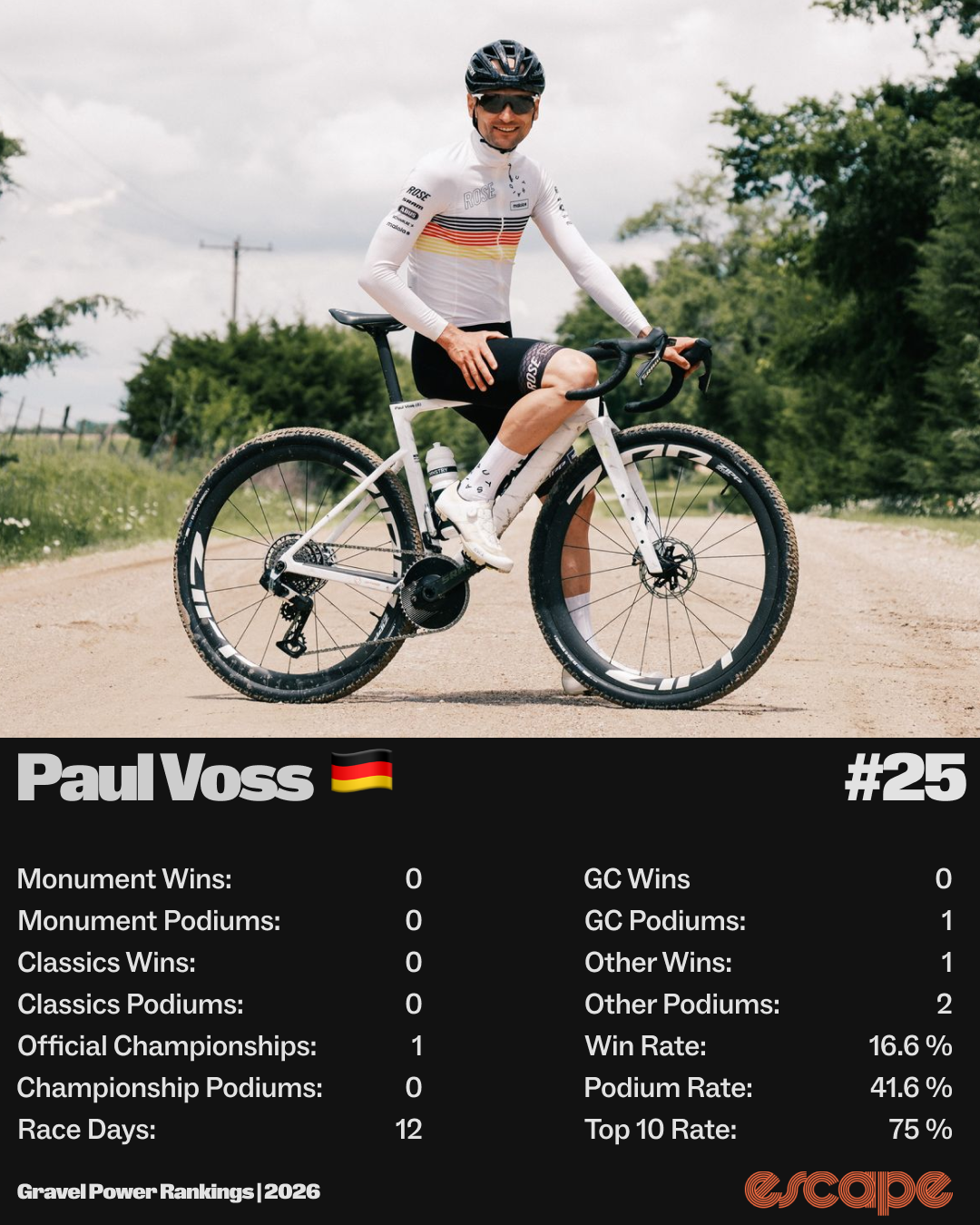 Photo: Pierre Barton
The former WorldTour pro’s season was somewhat derailed by health, injury, and tire mishaps. Still, Voss is one of the fastest guys on gravel. While he lacked an outstanding international result this year, he managed to defend his German national championship title against strong competition that included Frederik Raßmann (who was the winner of the 2024 edition of Traka 200 for approximately 15 minutes before being relegated thanks to an illegal feed) and Tim Wollenberg. His top level shone through earlier in the season when he was third at Santa Vall and eighth at Sea Otter. He also won the inaugural Rad am Ring Gravel Race. That may not be the biggest race, but winning basically any gravel event is hard these days. Thus, it matters. Even though Voss is approaching his 40th birthday, I anticipate he still has a few good results in his legs in 2026.
Full disclosure: I might be biased as Voss and I regularly podcast together and his Autsaid feed is the home of my Gracing pod.
24. Piotr Havik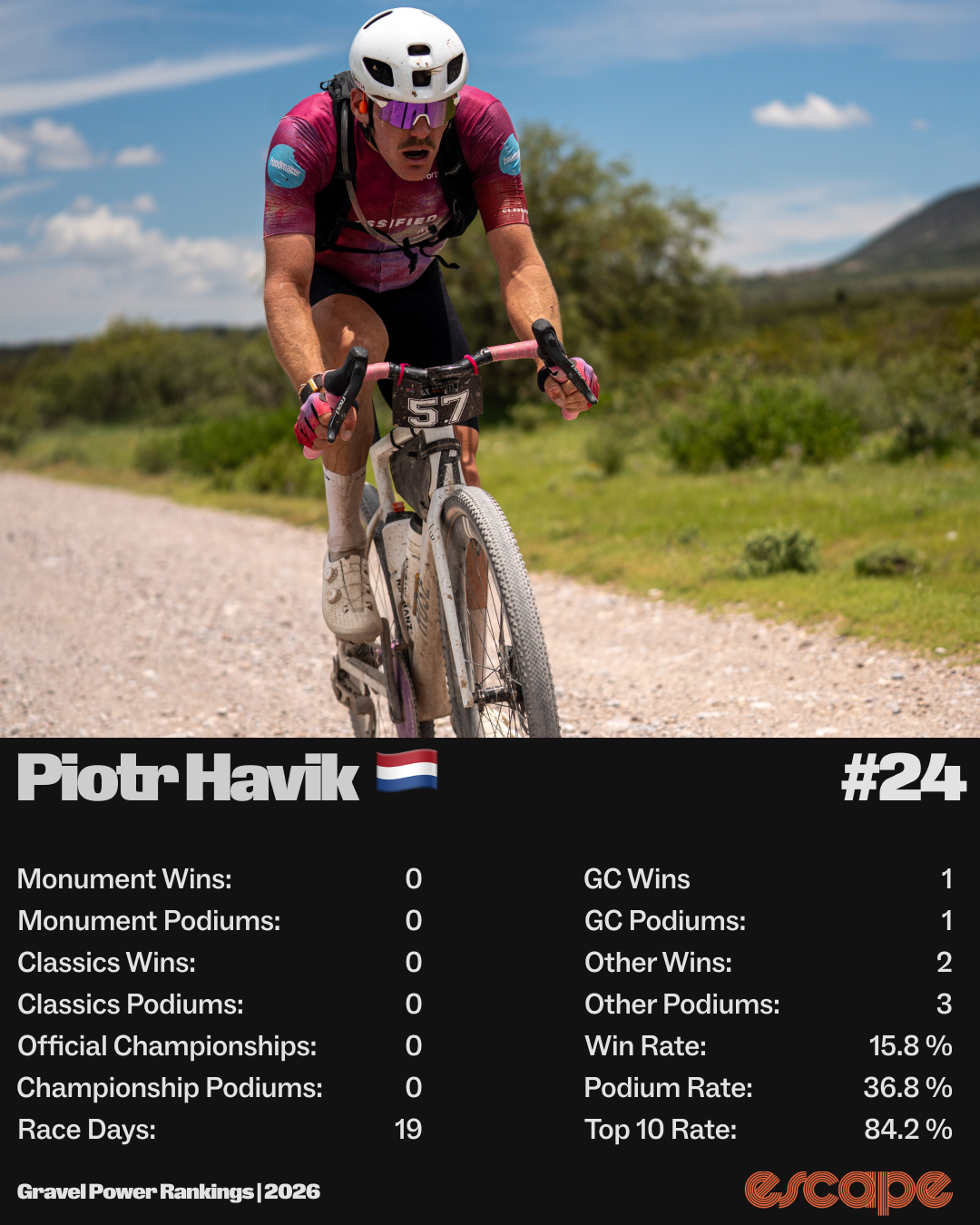 Photo: Gravel Earth Series – Gravel Mexico
The runner-up in this year’s edition of the Gravel Earth Series (GES) got there thanks to his good race selection. By focusing on some of the smaller events of the series – which have less stacked fields – and winning two of them in Gravel Mexico and Gravel Weekend Latvia (where he also won the GC), he collected a fair chunk of GES points. He also podiumed in GC and two stages at Tierra de Campos and at Megre Gravel. When he raced in fields packed with hitters, Havik was usually behind the pointy end of the races, which is why you don’t find him higher in the power rankings.
23. Tiago Ferreira 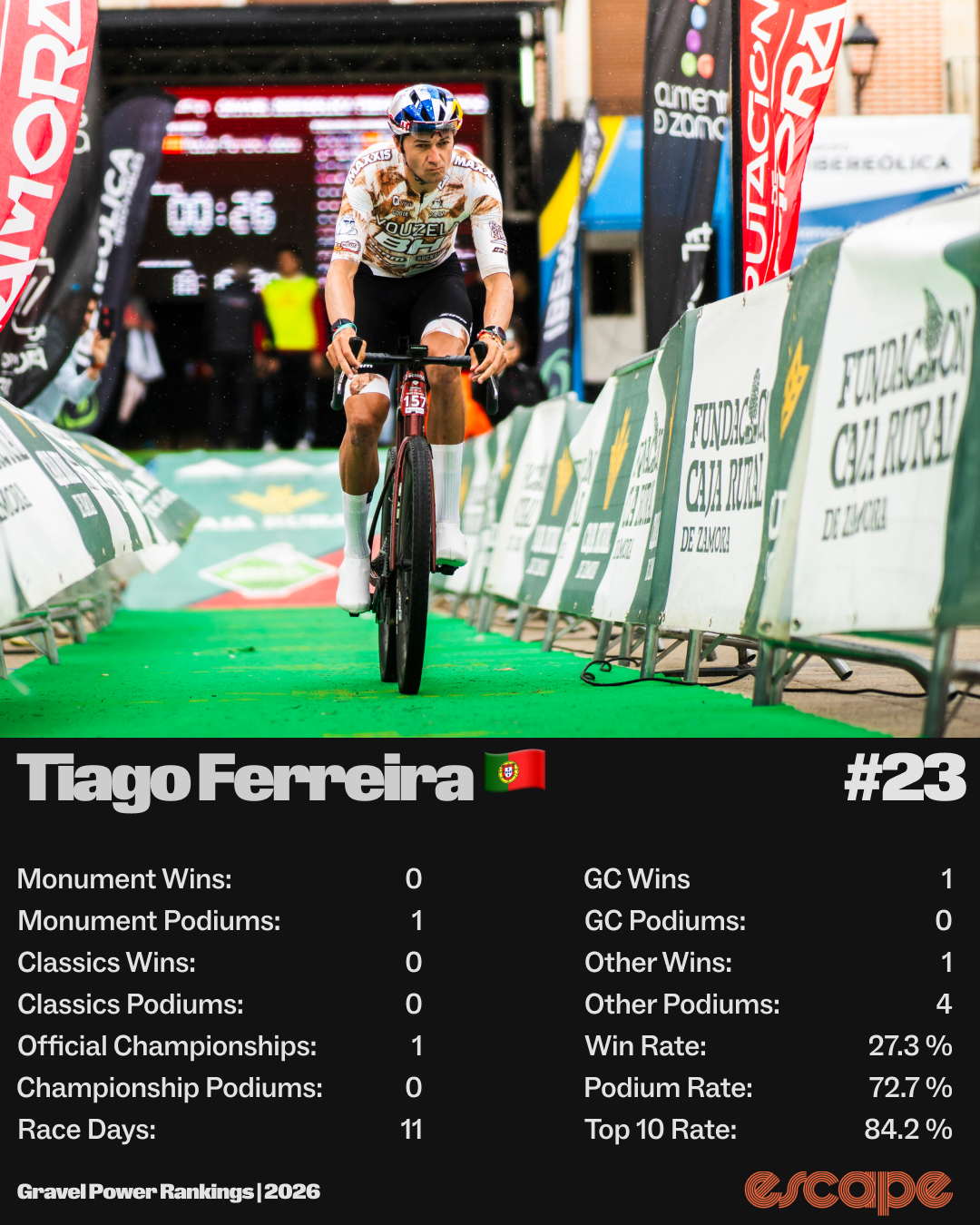 Photo: Gravel Earth Series – Tierra de Campos – Diego de la Iglesia Rodríguez
The Portuguese gravel pro – and Red Bull athlete – kicked off his season with two second places at the UCI Castellon Gravel Race (behind Alejandro Valverde) and at Utopia Gravel. He proceeded to win the Tierra de Campos stage race, part of GES, and took a stage win in the process. He also won the Portuguese National Championships.
His strongest result of the year was his (second consecutive) second-place finish at The Rift, for a gravel Monument podium. The only rider who managed to beat him in the Icelandic volcano landscape was Magnus Bak Klaris, while Ferreira finished ahead of riders like Petr Vakoč and Tobias Kongstad, both of whom rank much higher than him here. Given that The Rift has the shallowest field of all the Monuments, it does not catapult Ferreira higher up in the standings. Neither do his very solid podium and top 10 rates, as his strong Tierra de Campos showing, which did not feature top-level competition, inflates them.
This post is for subscribers only
Subscribe now
Already have an account? Sign in
Did we do a good job with this story?
👍Yep
👎Nope