
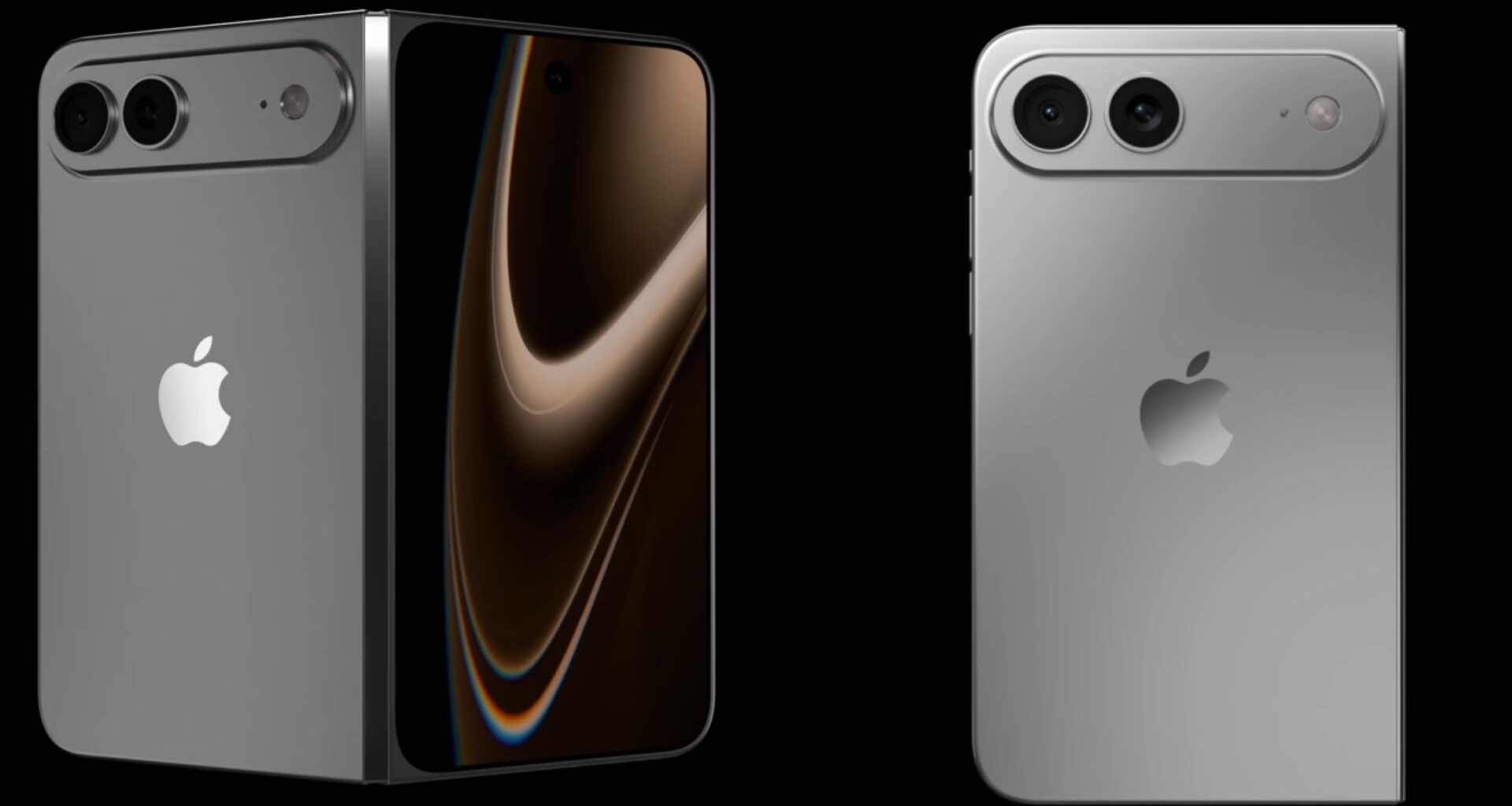
Apple has spent years watching its future leak out in public. This time, the leak cuts deeper.
On Christmas Eve, YouTuber Jon Prosser released a video claiming to show Apple’s long-rumored foldable iPhone.
The device, still unannounced, appears fully rendered in detailed 3D visuals. Prosser says Apple plans to launch it in fall 2026 alongside the iPhone 18 Pro lineup.
The timing matters. Apple sued Prosser earlier this year over leaked iOS 26 details. His latest video escalates that conflict.
Instead of software, he revealed hardware Apple has never acknowledged.
If accurate, the leak outlines Apple’s most radical iPhone redesign in more than a decade.
Prosser’s renders show a book-style foldable phone. It looks wider than it is tall when folded. When closed, it resembles a thick iPhone. When open, it becomes tablet-like.
The external display measures 5.5 inches.
A hole-punch camera sits at the top. Inside, a 7.8-inch folding display fills the frame. Another hole-punch camera appears in the upper corner.
The rear design includes two cameras on an elongated camera shelf. An LED flash sits apart. The layout mirrors Apple’s recent minimalist camera direction.
Prosser claims the phone measures 9mm thick when closed. Each half would be about 4.5mm. That would make it thinner than Apple’s already slim iPhone Air.
Those dimensions match several earlier supply-chain reports. They conflict with others. Apple has not confirmed any measurements.
Crease question
Foldable phones all share one flaw. The crease never fully disappears.
Samsung has reduced it. Google has refined it. No company has erased it.
Prosser says Apple has done what others could not. He claims the internal display shows no visible crease.
He attributes that to a metal plate beneath the screen.
The plate reportedly spreads bending stress evenly. A liquid-metal hinge supports the structure.
That claim carries weight but also skepticism. OLED panels deform under repeated folding. Physics does not bend easily.
The renders show a flawless screen. Renders, however, do not prove manufacturing success. Production hardware will decide the truth.
Prosser says Apple will price the foldable iPhone between $2,000 and $2,500. That would place it among the most expensive smartphones ever sold.
Apple plans limited color options. Black and white only. The company appears to favor control over customization.
Power button returns
The device reportedly drops Face ID.
Touch ID returns in the power button. Apple may favor reliability over facial scanning on a folding frame.
Internally, Prosser claims Apple uses its second-generation C2 modem. High-density batteries support the thin design.
A slimmer display driver helps free internal space.
Still, success remains uncertain. Foldables remain niche devices. Durability concerns persist. Price limits adoption.
Apple recently learned that engineering brilliance does not guarantee sales.
The iPhone Air impressed critics but failed commercially. Consumers favored battery life and cameras over thinness.
A foldable iPhone will draw attention. It will dominate headlines. Sales will deliver the final verdict.
Until then, Apple faces a familiar problem.
Its future continues to leak before it can introduce itself.