
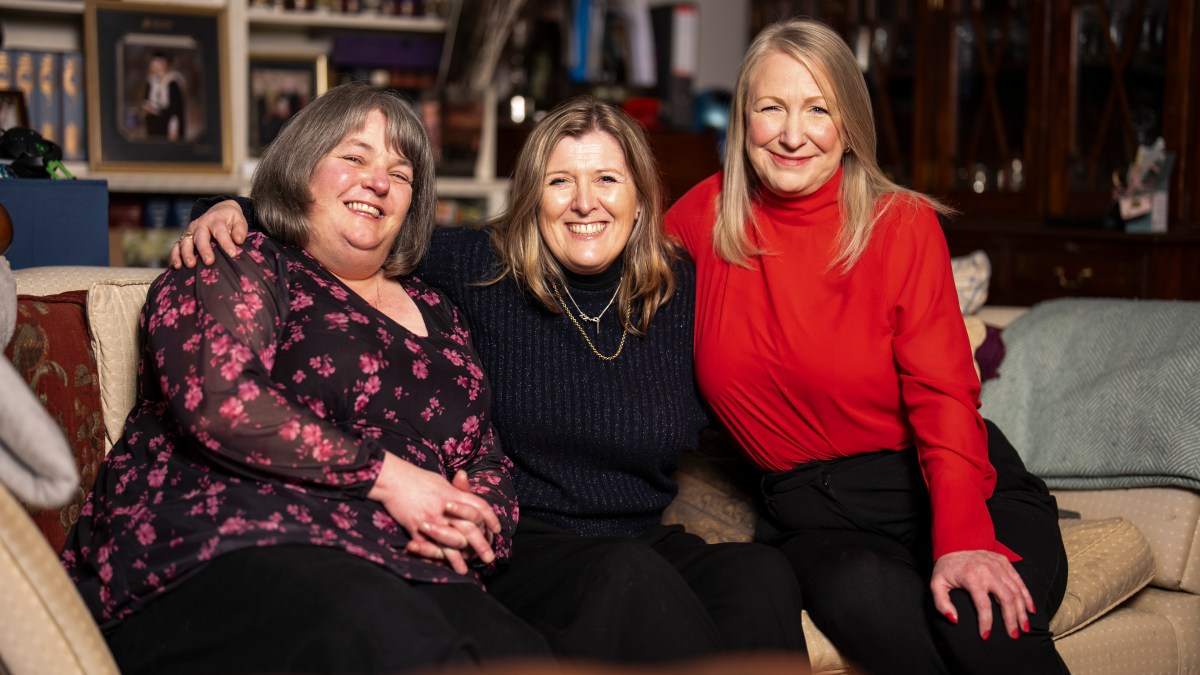
Politicians are “thwarting” the Supreme Court ruling on women’s rights and are putting women at risk, according to the feminist group For Women Scotland (FWS).
Ruling in favour of the campaigners, who brought the court case, the judges said in April that the term “sex” in the Equality Act refers to biological sex, when it comes to the provision of single sex spaces. This means the term “women” refers to — hold onto your hats — women, and women-only spaces are lawfully provided for women. The term does not mean, as the Scottish government insisted, and spent at least £374,000 arguing, a man who identifies as a woman, known as a trans woman.
Yet women, including the NHS nurse Sandie Peggie, are still being reprimanded by employers and employment tribunal judges for saying that males should not be in women’s toilets, changing rooms and other women’s only spaces.

Sandie Peggie, right, won a partial victory in her case against NHS Fife
JANE BARLOW/PA
Susan Smith, 53, a former financial adviser and one of FWS’s three founding members, says: “Both the Scottish government and the UK government claim they accept the Supreme Court ruling, but they have done nothing to implement it. Rather, they have gone out of their way to thwart it. Bridget Phillipson [the secretary for women and equalities] in particular is trying to fudge the law by sitting on the Equality and Human Rights Commission [EHRC] guidance, and it is having a serious impact on women.”
After the ruling, the EHRC drafted a code of practice advising businesses and public bodies how to maintain single-sex spaces, including hospital wards and prisons, in order to comply with the ruling, and urged the government to bring it to parliament “at speed”.
More than three months later, however, Phillipson is still refusing to sign it, saying she is concerned the guidance is “trans exclusive” — and if she means that it excludes males from women’s-only spaces, she is correct, because that is what flows from the court’s ruling.
“If Bridget Phillipson and Keir Starmer don’t like what the Supreme Court did, they have the power to change it. But they’re not going to do that, because they know it would be incredibly unpopular and stupid and they’d lose support. So instead they’re playing silly buggers and trying to change the law by stealth,” says Smith.
Phillipson claims that banning males from women’s single-sex spaces would mean a mother would not be able to bring her toddler son into a changing room. It’s an argument that is in equal parts fatuous and desperate, suggesting that a small child with his mother is analogous to a grown man who believes he is a woman.
Marion Calder, 54, an NHS worker and single mother, another of FWS’s founders, says: “Why should we ever listen to Phillipson again if she cannot make a decision about something as simple as this? She needs to ‘woman up’ and face down these men’s rights activists. It’s very simple: things are either single sex or they’re not. But if I had a penny for every time someone said, ‘Oh it’s terribly complicated’ I’d be richer than JK Rowling.”
Trina Budge, 54, a farmer from Caithness and FWS’s third founder, adds: “You know, we asked to meet with Phillipson just before the verdict last April, and she said no.”
Did Starmer contact them? They all burst out laughing at the thought.
• Trans civil servants can still use toilets of choice
Smith, Calder and Budge connected over Mumsnet in 2018 over the shared view that gender ideology is a deeply misogynistic movement, and one that was becoming alarmingly popular in Scottish public life.
The three women are rarely in the same room together. While Smith and Calder live close to one another, Budge lives a six-hour drive away to the north.
But today, they are all in Smith’s home on the outskirts of Edinburgh. The house is filled with Christmas decorations and piles of teenagers’ books and shoes, belonging to Smith’s three children. The only sign that the woman who lives here who changed history is a small photo in the front hall, half-hidden behind a pile of post, of Smith and Calder, grinning outside the Supreme Court after their victory.

HENRY NICHOLLS/AFP/GETTY IMAGES
And yet FWS will be starting 2026 back in court because — shockingly, if not surprisingly — the Scottish government still has not settled FWS’s legal expenses, for which it is liable. These expenses are estimated to exceed £417,000.
“That’s currently being covered by our regular small donations from supporters. And of course our far- right millions,” says Calder dryly, referring to the lies spread by trans activist groups that FWS is funded by far-right Americans. In fact, the group is funded by small direct-debit donations from individual supporters, most of which are less than £40. It relies entirely on volunteers and cannot afford an office, relying instead on a PO Box and Zoom calls.
“I wish I could get some of those far-right millions to fix the hole in my ceiling,” says Smith. “Well, it lets in the fresh air, I suppose.”
The Scottish government says it has not paid the costs because “there is an established process to be undertaken to agree the final costs for a legal case and these will be calculated and published in due course”.
FWS says it is stalling. “They are hoping that by depriving us of money, we won’t be able to take on further cases, because they knew we were going to go after them on prisons,” says Calder.
If that was the plan, it has failed. In February FWS will be suing the Scottish government — again — over guidance from the Scottish Prison Service (SPS) stating that if a male prisoner who identifies as a woman can be “safely accommodated” in a women’s prison, he will be, although this does not apply to male prisoners with a history of violence against women and girls.
“But it wouldn’t matter if they were in for shoplifting, they’re still a man and so shouldn’t be in a women’s prison,” says Smith. “It’s terribly complicated, of course,” says Calder, and rolls her eyes.
• SNP fights to keep trans women in female prisons
Whereas FWS subsists on donations, the Scottish government gave more than £1.1 million last year to organisations that promote gender ideology, including Stonewall Scotland, Scottish Trans and, in particular, Scotland’s Equality Network.
Founded in 1997, the Equality Network national organisation joined up with the Scottish Trans Alliance in 2007 and it focuses heavily on trans rights, offering training to employers about how to be “trans aware”.
The Equality Network still insists it is “likely to be unlawful” to exclude trans-identifying men from women-only spaces, contrary to the Supreme Court ruling. The chief executive of the Equality Network, Rebecca Don Kennedy, has described the fight against gender ideology as “a US import that’s anti-progress, anti-rights and anti-women’s rights”.
“We’re winning because our arguments are sound, not because we’re funded by some imaginary Americans,” says Smith. Last year the Scottish government gave the Equality Network £465,258.
“I’d like to ask these politicians, why are they giving money from the public purse to organisations which argue in favour of breaking the law? They wouldn’t do that to organisations that argue in favour of paying less than the minimum wage,” says Budge.
Freedom of information requests have shown Scottish politicians exchanging emails with activists from the Equality Network on how to draft bills that respect — in one example — “gender expression, through the medium of clothing”.
“It’s like politicians have outsourced their brains to the third sector so they don’t have to do their thinking, and it all becomes a circle jerk,” says Calder.
FWS says John Swinney, Scotland’s first minister, promised to meet them after the Supreme Court ruling. “But he never did, and now he’s making the excuse that he can’t because we’re taking them back to court about the costs. Well, we wouldn’t have to go to court if they just paid the costs,” says Smith.
Some MSPs did contact them after the Supreme Court verdict, says Budge. “But the conversations never went anywhere. It was just, ‘We’re setting up working groups to look into that.’ It felt like they were talking to us just so they could say, ‘OK, we talked to them, done now,’” says Smith.
Calder adds: “Part of the problem is that the SNP has been in power for 18 years. So to be awarded contracts and to move in polite society, you have to walk in lockstep with it.”
• Trans people could be banned from single-sex spaces based on how they look
Smith, Calder and I last met in April, the day after they won at the Supreme Court. Budge had stayed in Scotland to watch the verdict with FWS’s supporters, “which was much more fun, because we could scream and cheer, unlike in the court”, she says.
Shortly after the verdict, trans activists protested in Westminster by spraying graffiti on the statue of the feminist campaigner Millicent Fawcett and by carrying signs with slogans such as “Arm the dolls”, referring to men who identify as women.
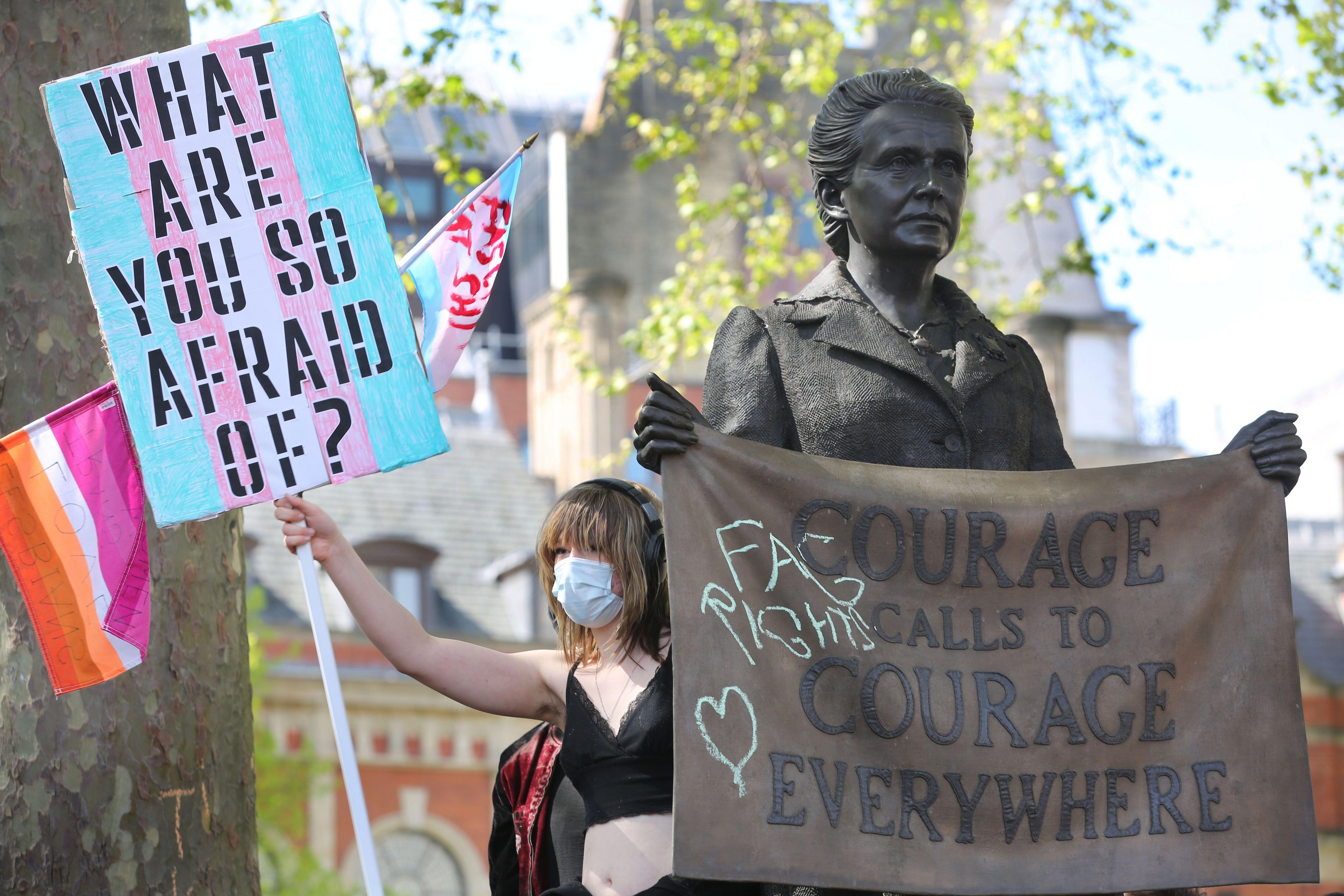
“A lot of these men are classic narcissistic abusive men and now that we’re starting to say no, they can’t come into our spaces, all of their entitlement and rage comes out,” says Smith.
Smith and Calder experienced that first hand when they took the train back to Edinburgh after the verdict and went with their supporters to celebrate “at ‘Spoons”, says Calder, referring to the pub chain Wetherspoons. Several members of staff there recognised them from the news and refused to serve them.
“So I phoned a local journalist and said, ‘You’ll never guess what’s happened here at Spoons. They then phoned the company’s communications team, who immediately phoned the manager, and that was that,” says Calder with satisfaction. And what happened to the protesting staff? “They left! And we got more drinks in.”
You know you live in grim times when Wetherspoons looks like a beacon of courage compared with other alleged adults in charge. This month Peggie won her claim that NHS Fife had harassed her by allowing Dr Beth Upton, a man who identifies as a woman, to use the women’s changing room.
However, Judge Alexander Kemp rejected Peggie’s claims of discrimination and victimisation, noting that Upton “presents in what is generally regarded as a feminine manner including as to having a long hairstyle worn in what is generally regarded as feminine in style”. This, Kemp wrote, proved Upton “presented as female”.
Smith shakes her head: “I really thought that after the Supreme Court, people would say, ‘OK, this is the law for single-sex spaces.’ I didn’t expect a judge to say, ‘OK, women-only spaces for women, but also for men with long hair.” Kemp also wrote that Peggie “had in some of her remarks impermissibly manifested her gender-critical beliefs”.
Only a few days earlier, another Scottish woman, Maria Kelly, lost her discrimination claim against the aerospace firm Leonardo UK for allowing men who identify as women in the women’s toilets. The judge ruled against Kelly in part because not enough other female employees had complained. “So women lose if they complain about men in their spaces, and they lose if they don’t. What are women supposed to do?” asks Smith. “Cry prettily,” replies Calder.
This brings us back to Phillipson and the delayed guidance. Without that, FWS say, activists can continue to “muddy the water” and employment tribunal judges can keep getting the law wrong. “Although none of it changes the law –— the Supreme Court verdict is still the law, whatever the Equality Network says,” says Smith.
But the real problem, Calder adds, isn’t the government: “It’s the civil service, and [gender ideology] is so deeply embedded there. So it doesn’t matter who the heck you’re voting in because they remain in post and a lot of the bills are going through them.” FWS saw this for themselves when they met civil servants at a time when Nicola Sturgeon, as first minister, was trying to jam through gender recognition reform in 2022. The proposal said a man could become a woman by saying he was, better known as “self-ID”.
“We met this one extremely senior civil servant who was putting the bill together. I was trying to talk to him about self-ID, and he responded with, ‘I have met trans people and they were super nice and I have shaken their hand.’ I said, ‘And what’s that got to do with the price of cheese?’,” says Calder.
But FWS are optimistic. They know there’s a “definite quiet majority” in Scotland who agree with them, many of whom whisper thanks to them when they see them in the street. “I’m rural with no neighbours, but even I’ve had people come up to me in my local café to say, ‘Well done,’” says Budge.
They still receive “lots and lots” of abusive emails, but they’re not threatened in the street. “I know there’s an activist who lives near me who sends us threatening messages. I just pass him in the street, and he doesn’t even see me,” says Calder. “There’s a lot to be said for being a woman of a certain age, you know. You’re invisible. And then you’re not.”