
AMAN VERMA
[email protected]
Fear often dominates conversations about humans living alongside wildlife—especially snakes, which provoke strong reactions in rural and forest-edge communities. Misunderstandings and misinformation have painted snakes as dangerous predators, often blamed for incidents without full context. Yet, wildlife expert and Goa’s renowned snake rescuer, Benhail Antao, demonstrates that coexistence is not only possible but practised. In parts of the Mhadei landscape, around 250 people live close to wildlife habitats, sharing space with animals through awareness and understanding rather than confrontation—a way of life, not just a theoretical concept.
Snakes, Antao explained, communicate differently from humans. They rely on scent, body posture, and tactile cues rather than vocalisations. During mating, snakes may nudge or rub against each other—a form of communication rarely observed by humans. Vocal sounds, like hissing, are defensive, not aggressive. “Snakes don’t make noise unless they feel threatened,” he said, noting that hissing is a warning, a plea for distance, not an attack signal.
Russell’s vipers exemplify widespread misunderstanding. Active during mating season, they are often sighted more frequently, heightening fear. However, most bites result from humans accidentally stepping into their space, especially in farming areas. “They’re scared animals,” Antao said. “Not aggressive hunters of people.”
Understanding danger without exaggeration
India records thousands of snakebite deaths annually, and the risk is real. Antao stresses clarity over panic. The country faces a severe snakebite crisis, with an estimated 50,000 to 58,000 deaths yearly—nearly half of global snakebite fatalities. Rural populations, limited healthcare access, and reliance on traditional remedies amplify the problem. The “Big Four”—cobra, krait, Russell’s viper, and saw-scaled viper—further increase vulnerability. Yet outcomes depend heavily on immediate response. First aid, such as immobilising the limb and reaching a hospital quickly, can save lives, while practices like tourniquets or cutting wounds often worsen outcomes.
Pangolins: Silent residents of the forest
Beyond snakes, the conversation shifted to pangolins, among the world’s most trafficked and least understood mammals. Despite their presence in parts of Goa, sightings are rare. Antao has rescued only four in his career. “They’re slow, harmless, and incredibly vulnerable,” he noted. Targeted for illegal trade, pangolins’ low reproductive rate makes population recovery difficult. Their quiet survival in Goa’s forests highlights that coexistence thrives when humans minimise interference and respect wildlife rhythms.
Learning to slow down in the forest
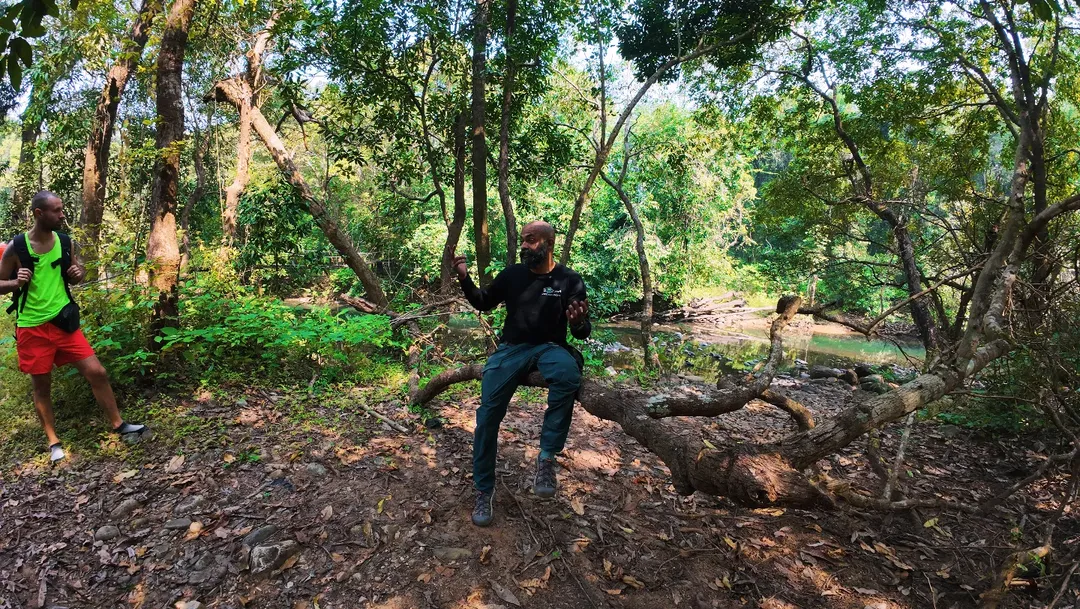
Antao’s work emphasises slowing down in natural spaces. With over two decades in wildlife rescue and conservation education, he views forests as living systems requiring patience and observation. Camping or trekking with him is intentionally unhurried: what could be completed in hours stretches over two days, combining shelter with immersive learning. Sessions explore snakes, forest ecology, and wildlife behaviour, alongside stargazing and early morning bird walks. “The idea is not to rush people through the wild,” he explained. “It’s to help them understand it fully.” Awareness of animal behaviour reduces fear, as humans realise that wildlife never invaded their space—it is human expansion that has encroached upon forests.
Life inside the forest
In the Mhadei landscape, coexistence is evident. Residents manage life near forests, adapting routines around wildlife movements. They store food carefully, choose walking paths thoughtfully, and move with awareness. Far from romanticising this life, Antao recognises its limitations, adjustments, and responsibilities. Yet, local voices emphasise calmness and rhythm. A resident described life as peaceful, despite limited hospital access and patchy network coverage. “We manage,” she said, reflecting acceptance and adaptation, not ignorance.
This balance—awareness, patience, and respect—forms the foundation of functional coexistence. Forest health, wildlife survival, and human well-being are deeply interconnected. Degraded forests force animals closer to human settlements; wildlife decline weakens ecosystems; ignoring these links escalates conflict. Antao’s efforts, whether through rescue or education, exemplify this interconnection, showing that shared space is preferable to strict separation.
The dominant narrative often highlights human–wildlife conflict, overshadowing quieter examples of coexistence. In Goa, humans live, farm, and raise families alongside wildlife, while snakes, pangolins, and other creatures continue to move, hunt, and breed. Risks remain, but shared space, built on understanding, patience, and responsible action, is achievable.