
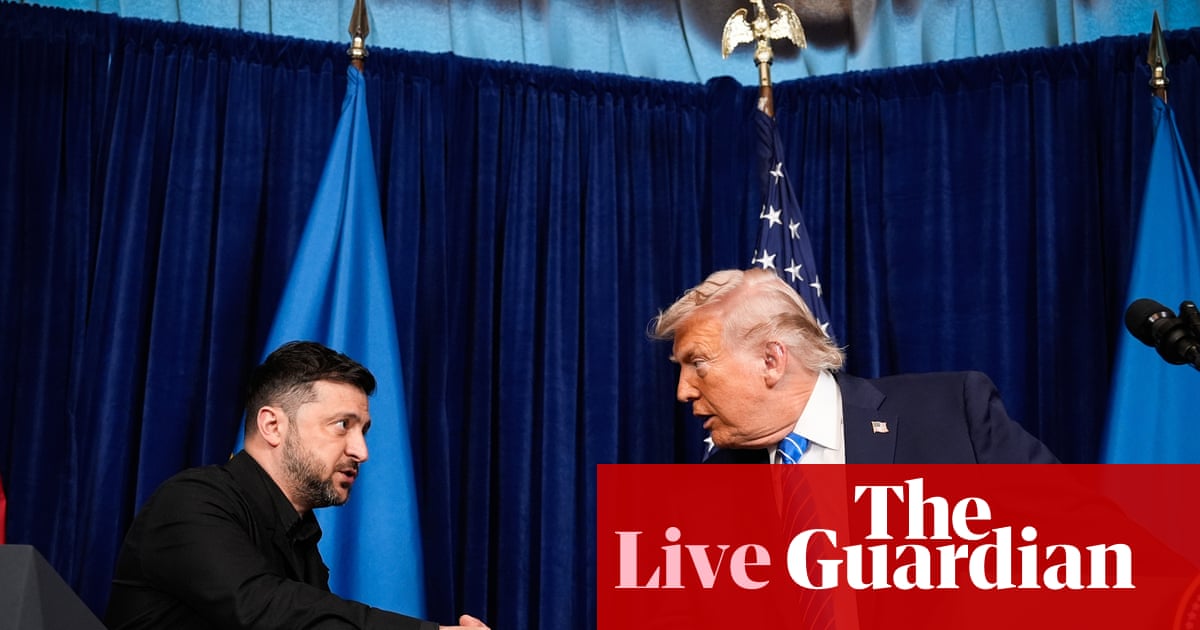
Zelenskyy says foreign troops in Ukraine are necessary part of security guarantees
Ukrainian President Volodymyr Zelenskyy said on Monday he considered the presence of foreign troops in Ukraine to be a necessary part of security guarantees for Kyiv as part of any deal to end the war.
“I believe that the presence of international troops is a real security guarantee, it is a strengthening of the security guarantees that our partners are already offering us,” Zelenskyy told reporters.
European leaders said earlier this month that Europe is ready to lead a “multinational force” in Ukraine as part of a US proposal for a peace agreement.
The leaders of the UK, France, Germany and eight other European countries said troops from a “coalition of the willing” with US support could “assist in the regeneration of Ukraine’s forces, in securing Ukraine’s skies, and in supporting safer seas, including through operating inside Ukraine”.
In an interview with the Russian state news agency Tass published on Sunday, Russia’s foreign minister, Sergei Lavrov, said any European troop contingents sent to Ukraine would be considered by Russian forces as legitimate military targets.
Lavrov said:
These ambitions (of European officials) have literally blinded them. Not only do they not care about the Ukrainians but they do not care about their people either.
This is the only way to explain the fact that there is still talk in Europe about sending military forces to Ukraine as part of the so-called coalition of the willing. We have said many times that in this case our armed forces would view them as a legitimate target.
Updated at 06.51 EST
Key events
Show key events only
Please turn on JavaScript to use this feature
As the Guardian’s defence and security editor, Dan Sabbagh, notes in this story, Russia has held the initiative since 2024, but only gaining territory incrementally, largely because it constantly throws people into the “meat grinder” of the frontline.
During 2025, Russian advances amounted to 176 sq miles a month to the end of November, but at an estimated cost of 382,000 killed and injured.
Ukraine is pushing for robust security guarantees from the west in order to deter future Russian attacks. The war, close to reaching its fourth year next February, has had a huge human cost to both sides and conscription is needed to mobilise people to fight.
The Russian defence ministry has said that the autumn 2025 military conscription has now ended, with 135,000 people drafted, Russian state news agency Tass reports.
“The 2025 autumn call-up of citizens for military service is over. Pursuant to Decree No. 690 of September 29, 2025 issued by the president of Russia, 135,000 conscripts were called up for military service in the Russian Armed Forces and other troops and military formations in the fall of this year,” the ministry said in a statement.
“Most conscripts were assigned to training units and military formations where they will learn to operate modern military hardware and get a military specialty … Special attention was paid to manning scientific and research-production units, and also sports companies. A total of 680 recruits were assigned to scientific and research-production units while 240 conscripts from the country’s national teams in Olympic disciplines joined sports companies,” the ministry said.
Russia calls up conscripts in the spring and autumn. In 2023, the Russian parliament voted to raise the maximum age at which men can be conscripted to 30 from 27, increasing the number of young men liable for a year of compulsory military service.
In the autumn of 2022, tens of thousands of men fled Russia after Vladimir Putin announced a mobilisation of 300,000 reservists to prop up Moscow’s forces in Ukraine.
ShareWhat we know so far on the security guarantees Frances Mao
Just a quick recap of what we learnt about the shape of the security guarantees in Zelenskyy and Trump’s talks on Sunday.
Zelenskyy said Trump had indicated he would consider extending US security guarantees beyond 15 years – the first indication of a time frame around them
Ukraine is looking for a longer commitment – up to 50 years – so that they can actually be an effective deterrent against more Russian aggression
Details of the security guarantees have not become public but Zelenskyy said they include how a peace deal would be monitored as well as the “presence” of partners. He didn’t elaborate.
For context, Russia has repeatedly said it would not accept the deployment to Ukraine of troops from NATO countries.
France’s Macron on Monday said Kyiv’s allies would meet in Paris likely next week to “finalise each country’s concrete contributions” to security guarantees
No comment from the US yet on the 15-year detail revealed by Zelenskyy.
Updated at 09.06 EST
Amid the recent peace overtures and diplomatic to-and-fro with the US, Russia has continued to relentlessly batter Ukraine, including attacks on Kyiv on the weekend.
Russia has pointedly targeted Ukraine’s energy facilities in winter- something Zelenskyy has raised time and time again. Many residents in Kyiv – suffering below freezing temperatures this week – were still without power today.
Several Ukrainians who spoke to Reuters news agency in Kyiv on Monday also voiced scepticism about the prospects for a lasting peace.
“Putin doesn’t need territory; he doesn’t need Donbas, he wants to destroy the Ukrainians. He destroys us as a nation,” said Nadiia Yevtushenko, a 57-year-old Kyiv resident.
Residents walk along a dark street during a power blackout two days after Christmas after critical infrastructure was hit by recent Russian missile and drone strikes Photograph: Valentyn Ogirenko/ReutersA man walks from a house destroyed after a Russian strike on Kyiv, Ukraine, on Saturday, Dec. 27, 2025. Photograph: Evgeniy Maloletka/APShare
Updated at 08.34 EST
 Luke Harding
My colleague Luke Harding has offered some analysis of the Trump-Zelenskyy meeting in Florida yesterday, in which there were no major breakthroughs and huge issues left unresolved, as well as the Trump-Putin phone call that was held before. Here is an extract from his story:
Speaking to reporters, the two leaders discussed the latest iteration of a 20-point peace plan and the unresolved question of the future of Ukraine’s eastern Donbas region. Standing next to Trump, Zelenskyy said US and Ukrainian negotiators had made good progress in recent weeks with “90%” of the draft agreed.
Writing on Truth Social before the meeting, Trump described his one-hour-15-minute call with Putin as “good and very productive”. Asked if Putin was serious about peace, Trump replied: “I think he is.”
There were no signs, however, that Russia was willing to drop any of its maximalist demands. According to Kremlin adviser Yuri Ushakov, Trump “listened carefully” on Sunday to Russia’s assessment of the conflict. Both sides agreed that a ceasefire proposed by Ukraine and Europe would only prolong the fighting “and is fraught with renewed hostilities”, Ushakov said.
Trump greeted Zelenskyy on the steps of his residence and offered him a businesslike handshake. There was no hug. US officials did not meet Zelenskyy when he arrived at Palm Beach international airport, in contrast to the red carpet reception given to Putin by an applauding Trump at their summit in August in Alaska.
A handout photo made available by the Presidential Press Service shows Trump meeting with Zelensky. Photograph: Presidential Press Service Handout/EPA
One former Ukrainian diplomat, Maria Drutska, said Putin was trying to “sabotage things” by ringing Trump before he saw Zelenskyy. During their previous meeting in October in the White House, Trump rowed back on the delivery of long-range Tomahawk missiles to Ukraine after a similar call to Moscow.
Updated at 08.14 EST
Germany says it welcomes Donald Trump’s efforts toward achieving a lasting peace in Ukraine, but added this could only happen with Russian involvement.
The government spokesperson also said there was a discrepancy between Russia’s public statements and its actions on the ground, the Reuters news agency reported.
Germany is one of Ukraine’s staunchest EU allies, hosting over one million Ukrainian refugees since the full-scale Russian invasion was launched in Feburary 2022, and is reported to be Ukraine’s largest donor of military aid, after the US, in absolute terms.
The German chancellor, Friedrich Merz, has cut a much more assertive figure on Berlin’s backing for Ukraine than his predecessor, Olaf Scholz, and has said he wants Germany to play a leading role internationally (as the US retreats from its security role in Europe and French President Emmanuel Macron – who used to be widely seen as the most powerful European leader – becomes weakened domestically).
Friedrich Merz speaks at a press conference after the European Council meeting in Brussels, Belgium on 19 December 2025. Photograph: John Thys/AFP/Getty ImagesShare
Updated at 08.09 EST
French President Emmanuel Macron, a leading part of the ‘coalition of the willing’ alongside British prime minister Keir Starmer, has said Kyiv’s allies would meet in Paris in January to discuss security guarantees.
Updated at 07.08 EST
Zelenskyy says foreign troops in Ukraine are necessary part of security guarantees
Ukrainian President Volodymyr Zelenskyy said on Monday he considered the presence of foreign troops in Ukraine to be a necessary part of security guarantees for Kyiv as part of any deal to end the war.
“I believe that the presence of international troops is a real security guarantee, it is a strengthening of the security guarantees that our partners are already offering us,” Zelenskyy told reporters.
European leaders said earlier this month that Europe is ready to lead a “multinational force” in Ukraine as part of a US proposal for a peace agreement.
The leaders of the UK, France, Germany and eight other European countries said troops from a “coalition of the willing” with US support could “assist in the regeneration of Ukraine’s forces, in securing Ukraine’s skies, and in supporting safer seas, including through operating inside Ukraine”.
In an interview with the Russian state news agency Tass published on Sunday, Russia’s foreign minister, Sergei Lavrov, said any European troop contingents sent to Ukraine would be considered by Russian forces as legitimate military targets.
Lavrov said:
These ambitions (of European officials) have literally blinded them. Not only do they not care about the Ukrainians but they do not care about their people either.
This is the only way to explain the fact that there is still talk in Europe about sending military forces to Ukraine as part of the so-called coalition of the willing. We have said many times that in this case our armed forces would view them as a legitimate target.
Updated at 06.51 EST
The Mariupol Drama Theatre, destroyed in a Russian airstrike in 2022 while hundreds of civilians were sheltering in its basement, has reopened (you can read more about the strike and the importance of its reconstruction to the Kremlin in this story). Here are some pictures showing the building’s dramatic transformation:
A view of the Mariupol Drama Theatre as it re-opened its doors for the first time in more than three years. Photograph: APSpectators sit at auditorium of the Mariupol Drama Theatre in the Russian-controlled Donetsk region of eastern Ukraine. Photograph: APWorkers take part in the reconstruction of a theatre building, which was destroyed in 2022. Photograph: Alexander Ermochenko/ReutersA picture taken during a visit to Mariupol organised by the Russian military shows a Russian serviceman securing the area inside the destroyed Drama Theatre in Mariupol, on 12 April 2022. Photograph: Sergei Ilnitsky/EPAShare
Kyiv will lift martial law only when Russia’s full-scale invasion ends and after Ukraine receives security guarantees from the west, Volodymyr Zelenskyy said on Monday.
“First of all, we all want the war to end, and only then will martial law be lifted. That is the only way. However, the lifting of martial law will occur at the moment when Ukraine obtains security guarantees,” Zelenskyy was quoted as having told journalists.
“Without security guarantees, this war cannot be considered truly over. We cannot acknowledge that it has ended, because with such a neighbour there remains a risk of renewed aggression.”
Under martial law, Ukrainian men aged between 18 and 60, with some exceptions, are prohibited from leaving the country because they might be called up for military service (men aged 25 to 60 can be conscripted into the armed forces). Martial law also prevents regular parliamentary and presidential elections being held.
Zelenskyy’s five-year term as president was due to end in May 2024, but the Ukrainian constitution prohibits elections in wartime (due to security, logistical and political considerations). Moscow claims, without evidence, that Zelenksyy is an illegitimate president, despite the Ukrainian leader winning the 2019 election with over 70% of the vote. Donald Trump has accused him of clinging on to power.
Updated at 07.49 EST