
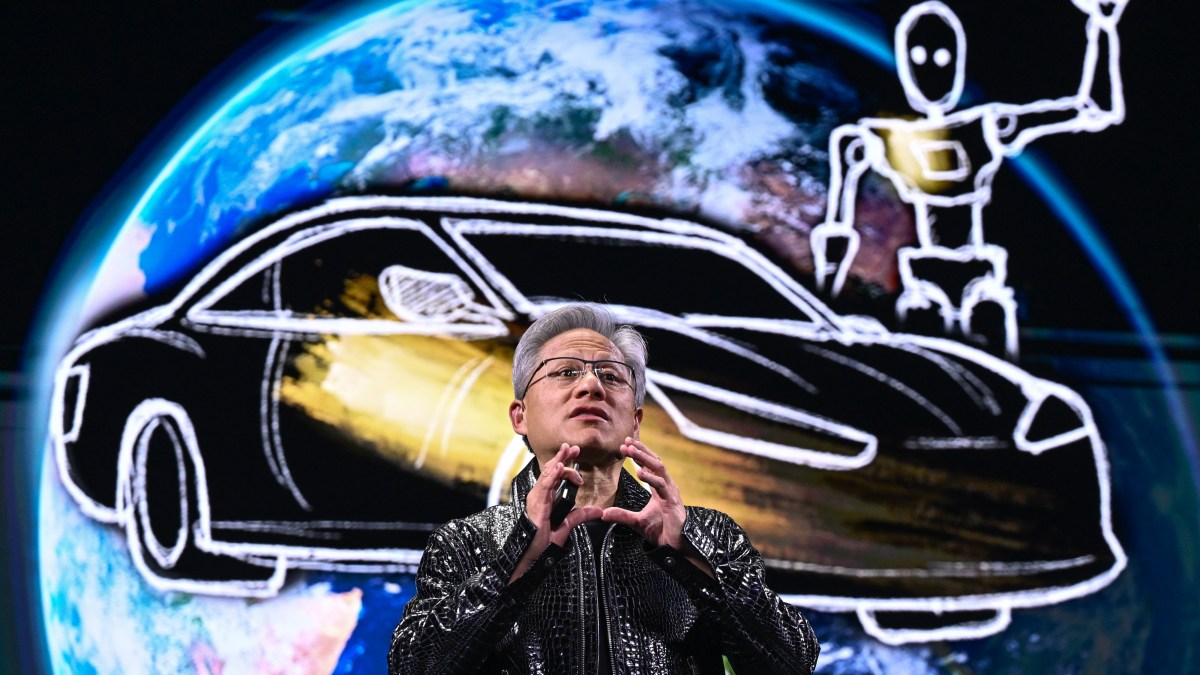
From driverless cars to humanoid robots, there are very few technological pies that Jensen Huang, the chief executive and founder of Nvidia, does not have his fingers in.
The titan of the artificial intelligence industry made his fortune from the powerful processors (GPUs) which are enabling the AI revolution but this year in particular he has become involved in every corner of the technology — it is hard to find anything AI-related that Nvidia is not involved in.
Under Huang’s leadership, Nvidia has agreed major deals with an array of companies from OpenAI, the world’s most valuable frontier AI company, to Intel and Nokia.
Asked by The Times a few months ago how he felt about his powerful position, Huang said: “This is probably the most impactful technology of all time. The ability to manufacture intelligence is quite an extraordinary thing. It’s a great privilege to be working in the company at the centre of that.”
Like the proverbial spider, Nvidia and Huang, are so much at the heart of the AI web that some have questioned whether the business is now too big to fail, so entangled is it with the entire AI machine, not to mention the stock market.
Together, the Magnificent Seven stocks, with Nvidia at the front of the pack, make up 35 per cent of the weighting of the S&P 500. This had led bears to warn about concentration risk in the hands of a small club of tech names.
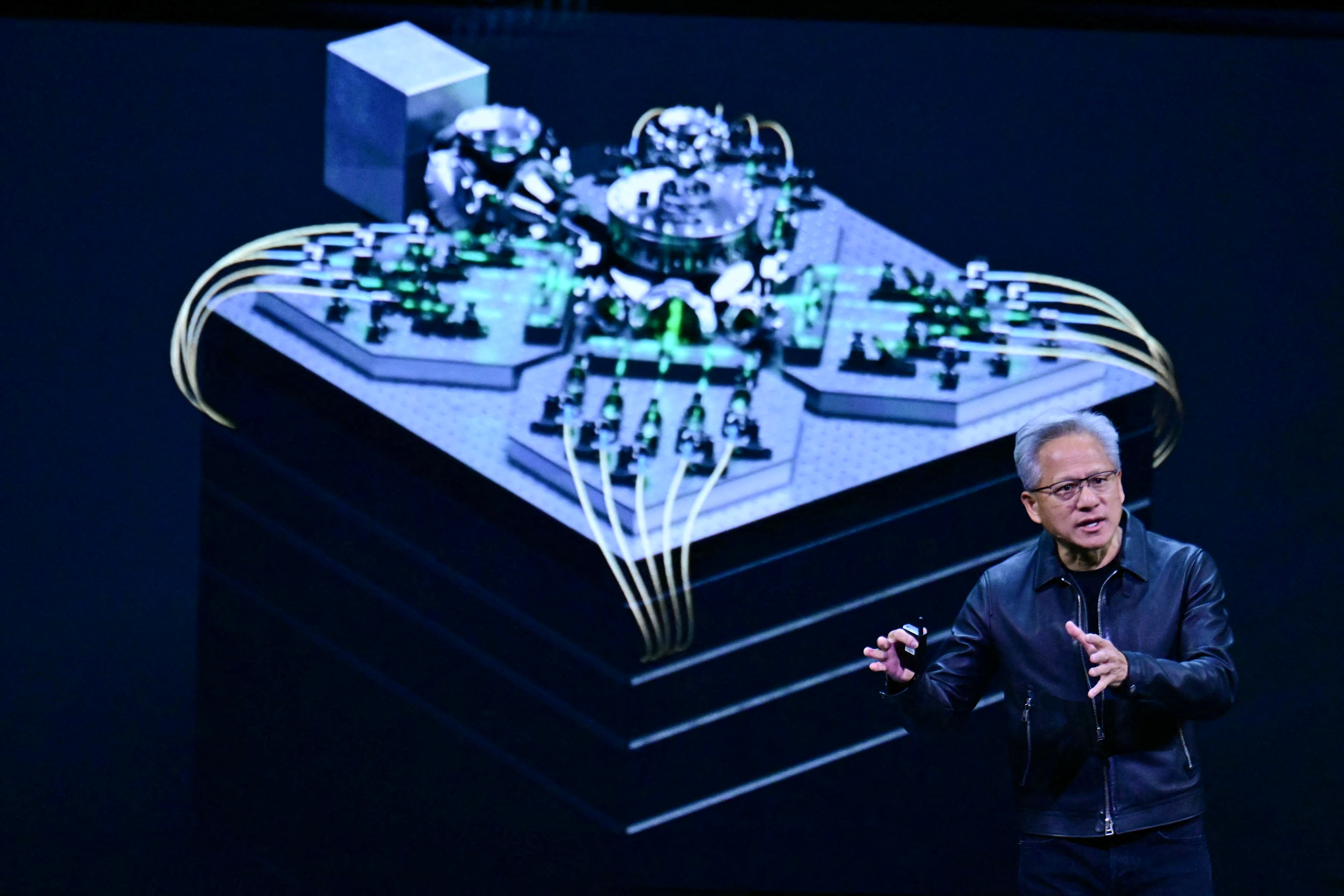
JIM WATSON / AFP VIA GETTY IMAGES
If Nvidia crashed, it could lead to a hit to indices such as the S&P and the Nasdaq as well as to pension funds. The Bank of England and the International Monetary Fund are among those who have spoken out about the impact of a “sharp correction” to the megacap tech stocks, as a risk to financial stability.
Bulls argue that these companies are delivering real returns from their AI investments, as demonstrated by their soaring revenues.
Nvidia became the world’s most valuable company, for the first time, on June 18, 2024, when it overtook Microsoft. This year, just when it seemed as though the share price could not get any higher, it smashed through a $5 trillion valuation in October.
Each quarter, Nvidia delivers forecast-beating results which seem to stick two fingers up to those who talk of bubbles. “From our vantage point, we see something very different,” Huang said when asked about this during his most recent earnings call.
The company’s revenue for the three months to October jumped 62 per cent to $57 billion. It is expecting orders of more than $500 billion through 2026.
One outlet for the cash generated by this financial success is Nvidia’s venture capital arm NVentures, which stitches the company even more tightly into the AI ecosystem.
It has been on a tear this year, signing more than 50 deals with AI start–ups, focusing on areas from humanoid robots, with investments in Figure AI, to self-driving cars such as Nuro and Waabi, to infrastructure with Scale AI, CoreWeave and Lambda and enterprise AI companies including Cohere, Perplexity and Hippocratic AI.
British businesses have been big winners from Huang’s beneficence.
In the past year Nvidia backed some of Britain’s top AI companies including ElevenLabs, Wayve, PolyAI and Revolut as part of a round which valued the latter at $75 billion.
Huang also partnered with Nscale, a new infrastructure business, to deliver Britain’s version of “Stargate”, planning to deploy about 60,000 GPUs in the UK.
This rate of deal-making and some of Nvidia’s larger investments, which include reciprocal arrangements where companies get backing from Nvidia and agree to buy its GPUs, have led to concerns in the market about “circularity”. It has raised comparisons with the “vector financing” of the dotcom boom.
Analysts at Morgan Stanley wrote a report puzzling over this, which included a now infamous diagram highlighting the messy and interconnected relationships between Silicon Valley’s AI businesses. It was referred to as resembling a “plate of spaghetti”.
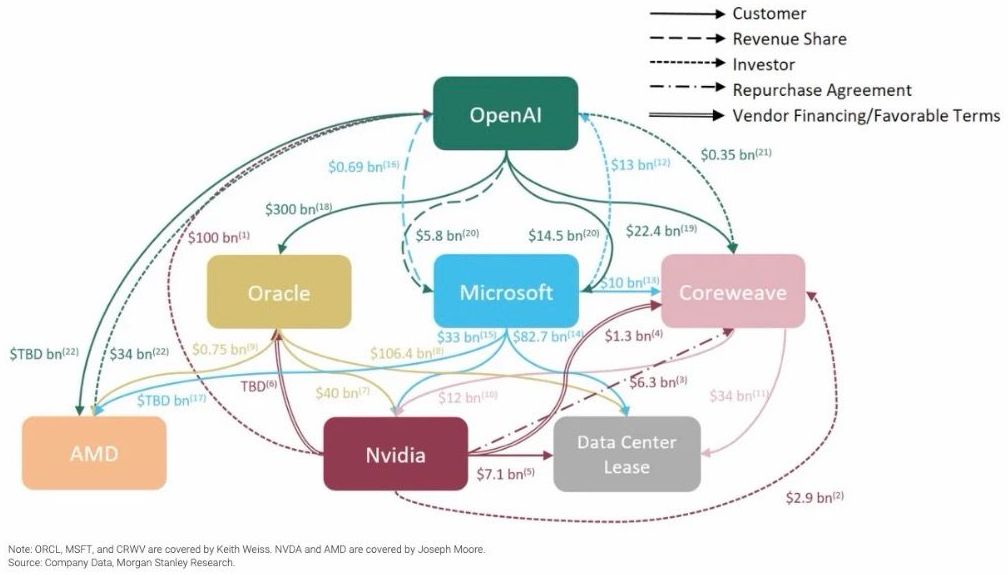
One particular deal which Nvidia struck that raised these “spaghetti” fears was with OpenAI, which said it would buy millions of Nvidia’s AI processors from the end of next year, which could generate hundreds of billions of dollars in revenue for the chipmaker.
OpenAI is expected to pay Nvidia in cash for chips, and Nvidia could invest in OpenAI for non-controlling shares. The first $10 billion of Nvidia’s investment will begin when the two companies reach a definitive agreement for OpenAI to buy its chips.
In another deal in December, Nvidia bought about $2 billion of shares in Synopsys, the chip-design software company, as part of a deep AI-tools partnership for chip design and “digital twins”.
Returning to the cacophony of concerns about a bubble: there is no doubt that Nvidia is throwing off cash, but there are worries that its customers may not be able to sustain this spending.
If they cannot, what does that mean for Nvidia and for demand for its products?
As well as the centre of AI, Huang has been thrust into a central role in geopolitics in 2025.
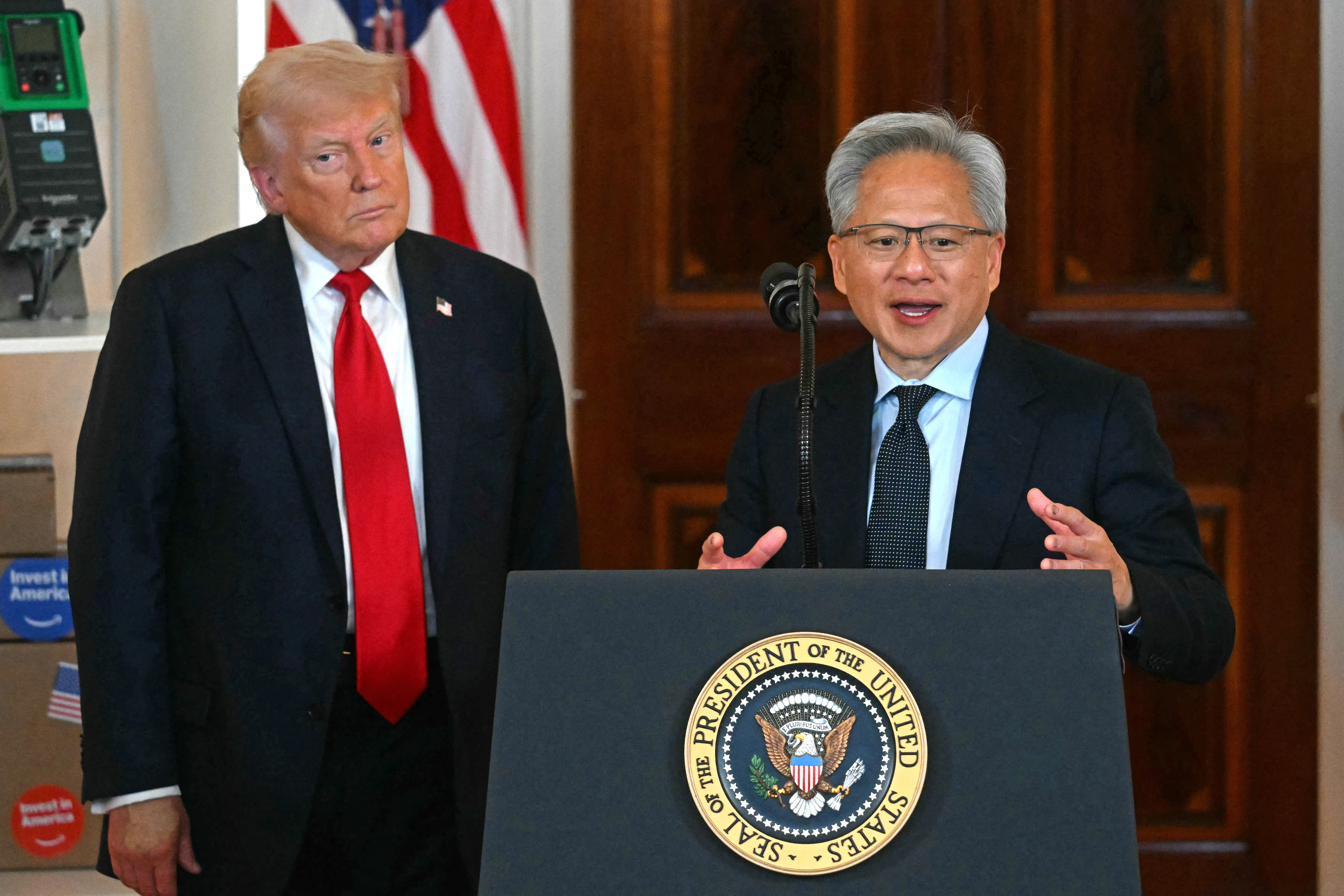
President Trump has described Huang as a “smart man”
JIM WATSON/AFP/GETTY IMAGES
When President Trump flew to Britain for a state visit, Huang was one of those by his side and chosen to take a seat at the (enormous) table in the banqueting hall at Windsor Castle with the King.
He has consistently pushed the importance of AI sovereignty, countries owning their AI infrastructure, and spent time with many world leaders including President Macron in France, where Huang is an investor in European frontier AI company, Mistral.
Once again with Trump and alongside the billionaire Elon Musk, Huang spoke at the Investment Forum when the US signed a “Strategic Artificial Intelligence Partnership” with the kingdom in November. Musk and Huang announced a deal with Saudi Arabia’s AI company Humain to build a 500MW data centre.
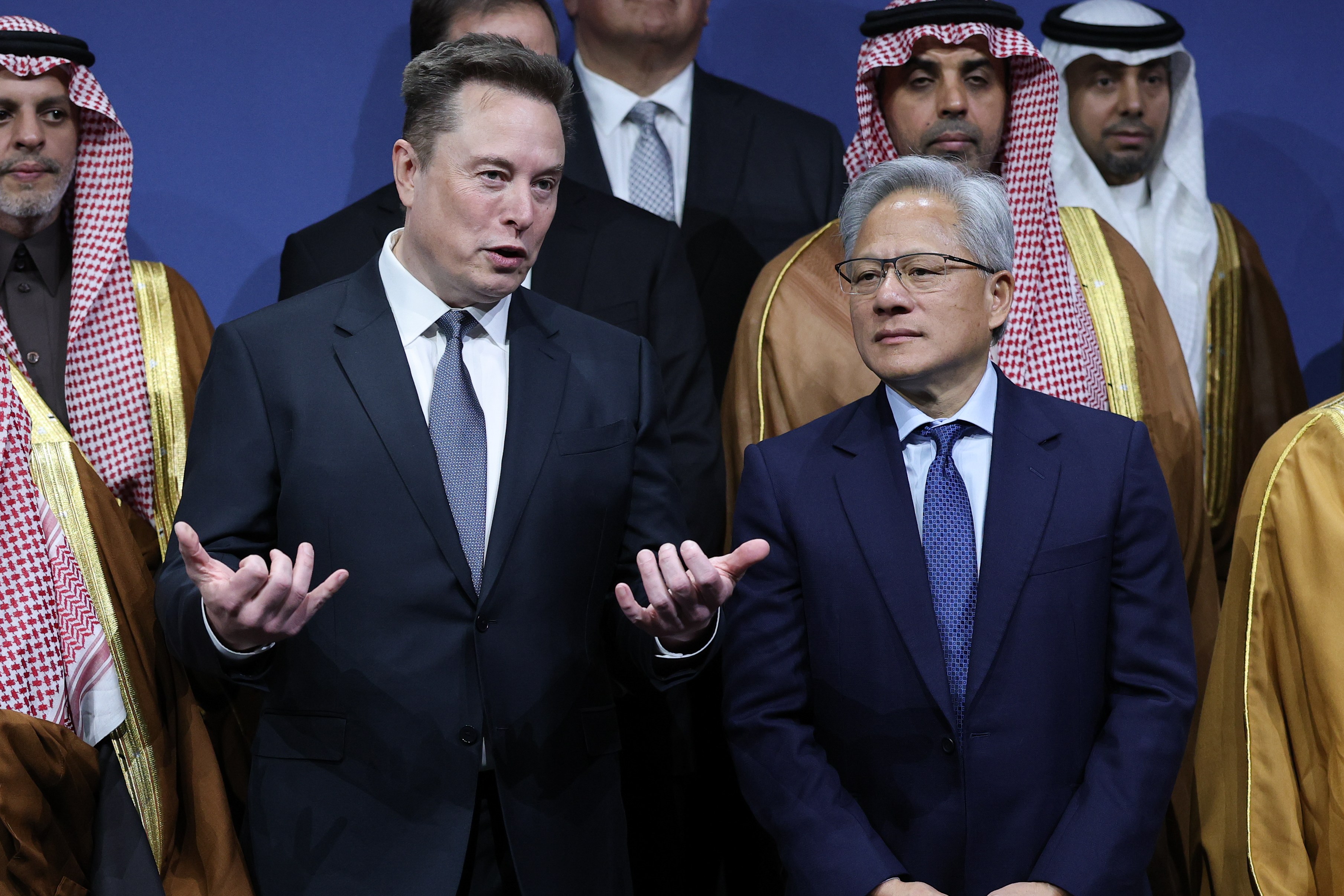
Huang and Elon Musk at the US-Saudi Investment Forum in Washington
WIN MCNAMEE/GETTY IMAGES
While Huang has cemented many new international deals in the past year, one important relationship has fractured: with China.
Nvidia’s chips are treated as strategic infrastructure and the US government looks closely at which Nvidia AI chips can be sold to China and under what conditions, precisely because they are seen as crucial to AI leadership and security.
Huang would like to keep the lucrative market in China open. Not least because the company is also in a race against Beijing’s homegrown AI ambitions. The release of DeepSeek last January stunned the world, when the Chinese company produced a free AI assistant that purported to use lower-cost chips and less data than US rivals. As a result, Nvidia lost $590 million in value.
In a reprieve for the business, at the end of the year, Trump’s administration approved the sale of advanced Nvidia chips to China. The company has also developed a software feature with location verification technology that shows what country its chips are operating in, Reuters has reported — a step that may continue to mollify the White House.
This has demonstrated that while Nvidia may have the market for AI chips sewn up for now, there are plenty of aggressors trying to take that crown.
Alphabet shares rose dramatically this year as its Gemini models got rave reviews, trained on its own processors, called TPUs. Amazon is also making its own versions called Trainium.
The traditional semiconductor businesses are racing ahead too. One sign of this is that OpenAI is diversifying its chips base away from Nvidia and has struck deals with AMD and Broadcom for compute power. It too is working on its own systems.
Then there are AI chip start-ups such as Groq, whose language processing unit claims to make running large language models cheaper, and Britain’s Graphcore which was recently bought by Softbank, also the owner of the giant chip-architect, Arm.
Masa Son, chief executive of Softbank and one of the world’s top tech investors, said that he wept when he sold his Nvidia shares this year. He had to cash out in order to make more investments. Could others follow suit?
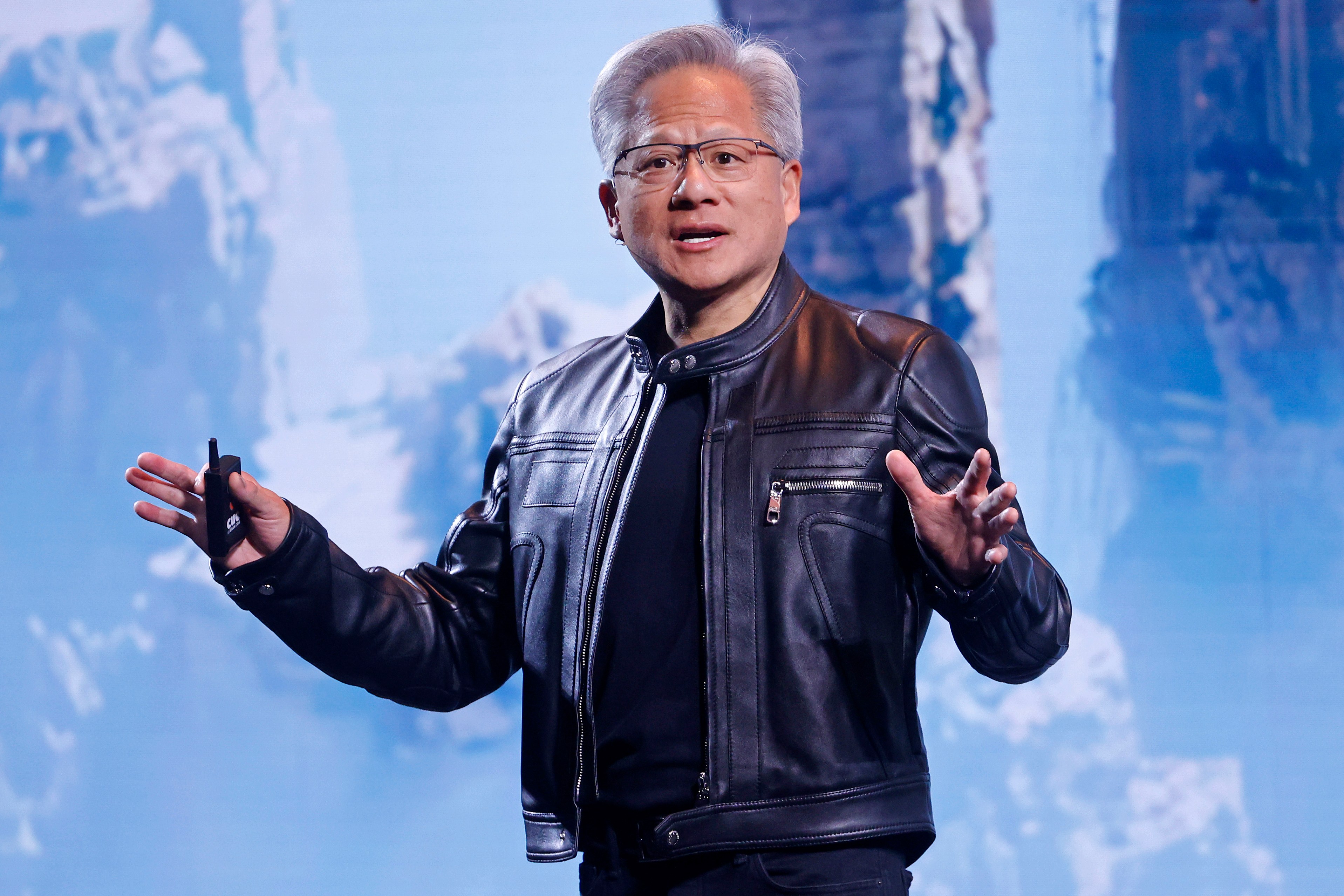
Travelling around the world, delivering his message about the impact of AI in his trademark leather jacket, Huang seems unfazed by talk of bubbles, by the threat of rivals and the naysayers. The year ahead presents a litany of challengers, but he is up for the fight.