
(Credits: Far Out / Alamy / Ante Brkan)
Thu 1 January 2026 16:15, UK
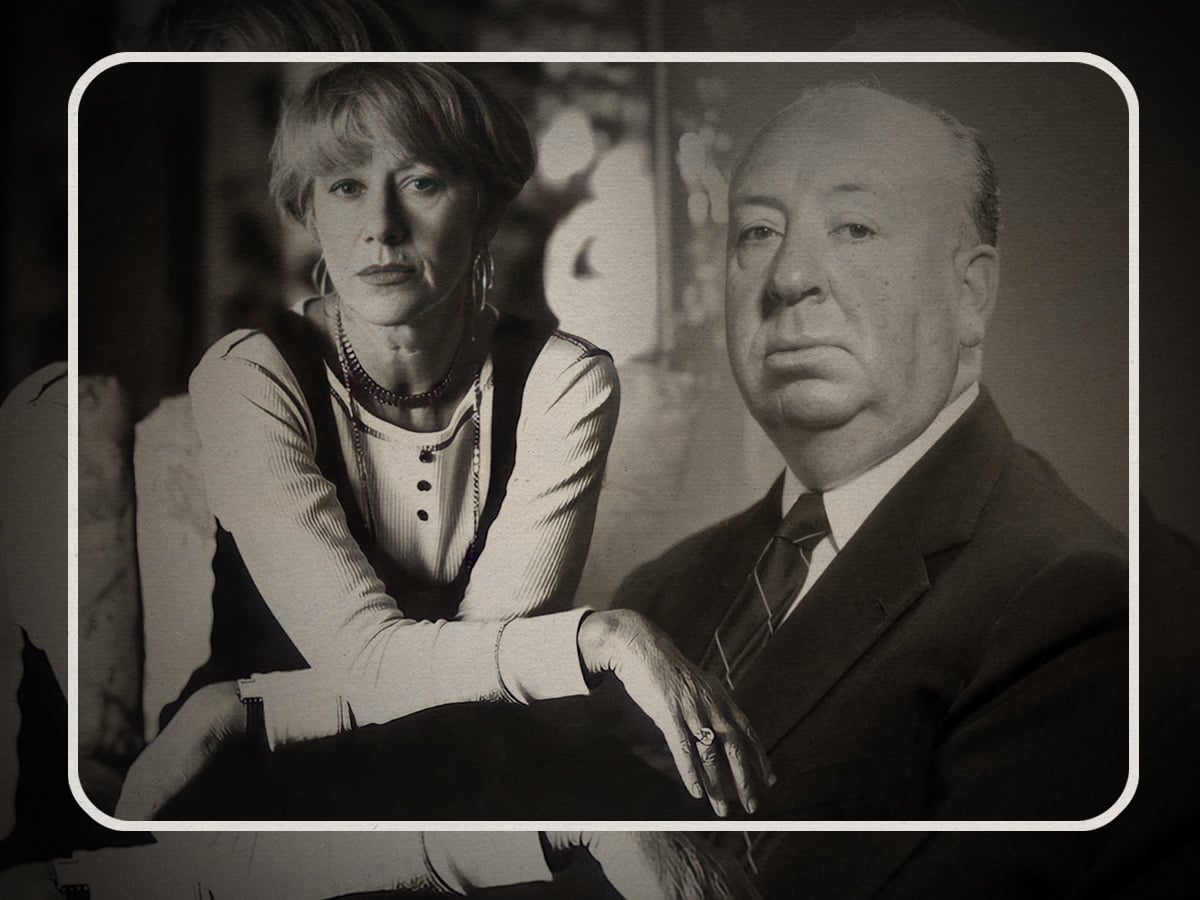
Helen Mirren and Alfred Hitchcock’s careers overlapped by a decade.
Mirren made her film debut in 1966 with the Robert Asher comedy Press for Time, and Hitchcock produced his final cinematic work in 1976 with Family Plot. Although she spent the earliest part of her career in the Royal Shakespeare Company alongside such luminaries as Patrick Stewart, Judi Dench, and Ian Richardson, Mirren’s film roles were of a much lower calibre. As a 20-something woman cursed with extreme beauty, she often played movie and TV characters who were there for the purposes of being leered at.
For this reason, she would have been ideal for Hitchcock, who, at the time, had moved beyond his illustrious Hollywood heights of high-budget, tightly wound, starry productions and towards more tawdry and inconsistent territory. 1966’s Torn Curtain had soured him on movie stars and studio control. He had resisted the casting of Julie Andrews in the lead female role and couldn’t stand working with Paul Newman, so it was hardly surprising that he largely worked with B-listers and newcomers afterwards.
Mirren fit the latter category, and it was perhaps for this reason that she was invited to audition for the fading director’s penultimate movie, Frenzy, in the early ‘70s. It was Hitchcock’s only film to receive an X certificate, which he achieved by centring the story on a serial killer who rapes and murders women. Mirren was auditioning for the role of one of the victims, and it was her rape scene that led to the BBFC’s rating.
Not surprisingly, she wasn’t particularly interested in playing a sexy barmaid who gets raped and strangled after having sex with the key suspect, nor, as it turns out, was she interested in working with Hitchcock. “He was just not my kind of film director,” she explained later. “I was into Federico Fellini, Pier Paolo Pasolini, Roberto Rossellini.” The Psycho director was a pioneer in his own way, but not by the standards of the 1960s.
Neither Mirren nor Hitchcock thought the meeting went well. “I didn’t really like him, and I know he didn’t like me very much,” she continued, adding, “He took one look at me and went, ‘Oh, good God. She’s going to be a nightmare.’” For her part, Mirren thought that the roles Hitchcock was offering “were horrible anyway.” The part went to Anna Massey, and Mirren ran in the opposite direction.
In fact, within a year of Frenzy’s release, she appeared in two movies that were directed by filmmakers who stood for everything Hitchcock didn’t. Savage Messiah was helmed by Ken Russell, one of the most iconoclastic and controversial British directors of the era, and O Lucky Man! was helmed by Lindsay Anderson, a pioneering figure in the British New Wave who had just caused an uproar with his blood-soaked class satire If… Mirren probably wasn’t intending to make a point to Hitchcock with these films, but the timing was excellent.
She did return to the director’s world, in a sense, in 2012 to play his wife, Alma Reville, in the film Hitchcock.
It was the ultimate last word on their brief feud, firstly because the director was dead and couldn’t do anything about it, and secondly because the film portrays Alma not just as a key collaborator, but as the most ballsy member of the Hitchcock household.
Related Topics