
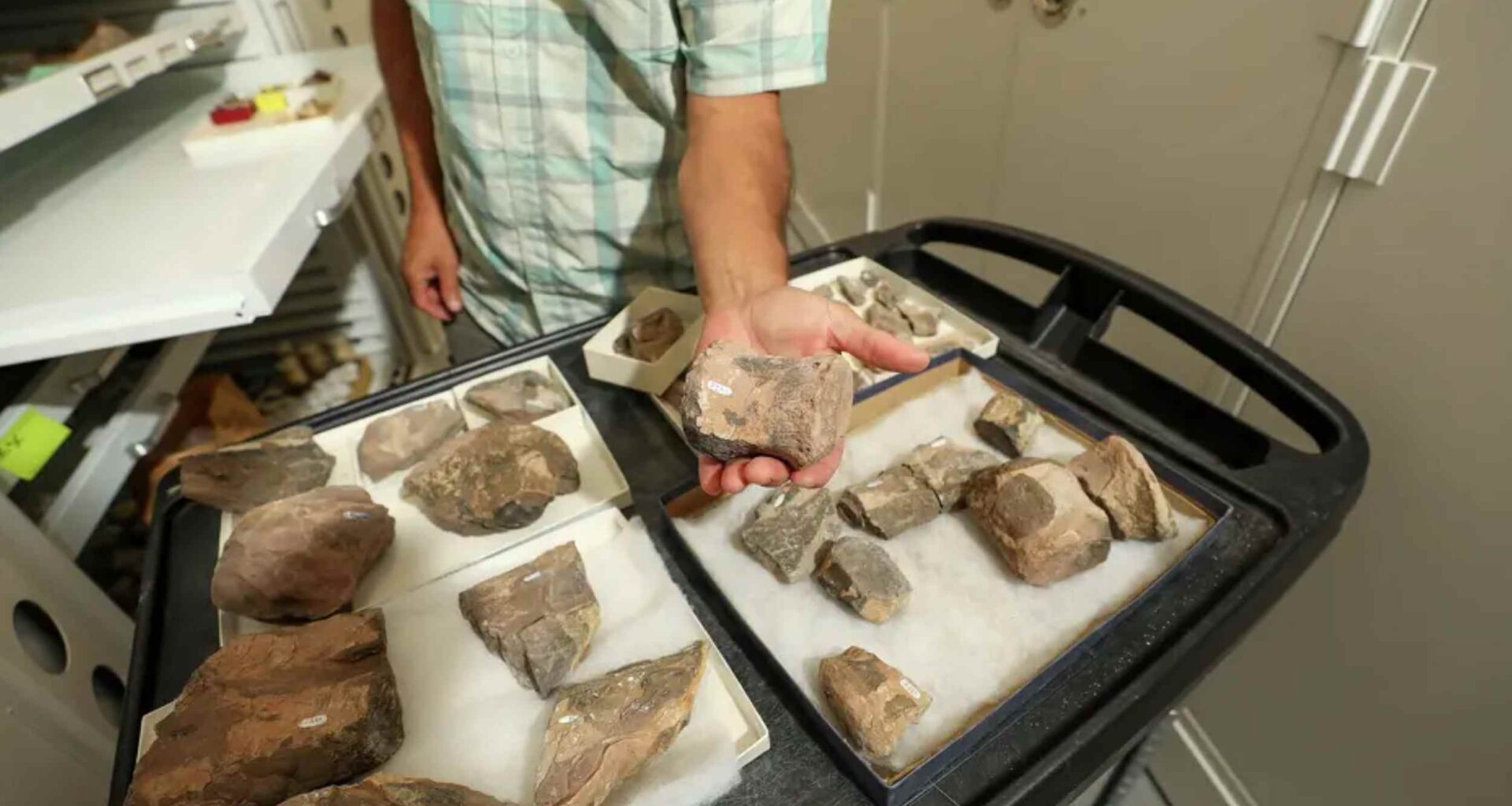
A routine day of mapping rocks in West Texas changed when geologist Jason W. Ricketts noticed strange bone fragments.
The fragments turned out to belong to Tenontosaurus, a plant-eating dinosaur that roamed the region about 115 million years ago.

The new fossils mark the southernmost record of Tenontosaurus yet found, pushing the animal’s known range into West Texas.
For paleontologists, the site reframes the early Cretaceous Southwest, filling a rare gap in the dinosaur fossil record.
Rocks that stood out
The work was led by Dr. Ricketts at The University of Texas at El Paso (UTEP). His research focuses on how rock layers, faults, and fossils together reveal the long geological history of the Southwest.
Dr. Ricketts was mapping sedimentary rock at the Indio Mountains Research Station, a field site about 26 miles southwest of Van Horn.
While hiking across soft shale during a long day in the field, he noticed darker pieces that didn’t look like the surrounding rock.
Identifying the plant-eating dinosaur
The scattered pieces came from the tail and leg of Tenontosaurus, a herbivore that could reach more than 20 feet long.
Paleontologists classify Tenontosaurus as an ornithopod, a two-legged, plant-eating dinosaur related to duck-billed forms.
Much of what we know about Tenontosaurus tilletti comes from a monograph describing Cloverly Formation fossils in Montana and Wyoming.
More recently, a high resolution cranial study used CT scanning to reconstruct the skull of Tenontosaurus in exceptional detail.
Elusive fossils from the early Cretaceous
Compared with later dinosaur-bearing rocks, early Cretaceous formations in North America yield few skeletons and often preserve only scattered bones.
Researchers studying the Western Interior have shown that Late Cretaceous dinosaur faunas are sampled more completely than older parts of the record.
That imbalance means new early Cretaceous finds like the West Texas bones carry more weight than their fragmentary appearance might suggest.
A recent quantitative analysis reveals a strong Late Cretaceous bias in fossil sampling, with earlier intervals poorly represented.
Yucca formation as river land
The bones weathered out of the Yucca Formation, a Lower Cretaceous rock unit that preserves ancient river systems in what is now West Texas.
In the Eagle Mountains, earlier work identified the Yucca Formation as the oldest Cretaceous unit in the area.
Recent carbon-isotope profile data show that Yucca Formation layers span the Aptian, an Early Cretaceous age used by geologists.
The results further indicate the Albian, the next Early Cretaceous age after the Aptian, within Yucca strata – placing their boundary near the upper part of the formation.
Pushing the dinosaur range southwest
The West Texas fossil is assigned to cf. Tenontosaurus sp., a designation indicating that the bones resemble Tenontosaurus but lack all of its diagnostic features.
A detailed paper describes the specimen and explains why it most closely resembles known Tenontosaurus skeletons.
Even with that careful identification, the new site lies hundreds of miles from previous tenontosaur finds in Arizona and north-central Texas.
Mapped across the Western Interior, Tenontosaurus now stretches from Cloverly sites along the Montana-Wyoming border down to far West Texas.
How a few bones tell a story
At the Indio Mountains site, the dinosaur is represented by three tail vertebrae and the end of a femur, plus smaller fragments.
Those bones include features such as tall hexagonal centra and a stout femur with distinctive condyles, closely matching better-known Tenontosaurus skeletons.
Because the bones came from carefully dated rock layers, they act as time stamps tying Tenontosaurus and the Yucca Formation together.
Together, the anatomy and the age data indicate that the West Texas animal fits within a wider population of early Cretaceous plant eaters.
Implications of the discovery
Tenontosaurus shared its world with large predators, smaller plant eaters, and early flowering plants that were just starting to diversify on land.
In other formations, Tenontosaurus bones occur alongside fossils of the predator Deinonychus and the giant carnivore Acrocanthosaurus, hinting at similar food webs.
Rivers and lakes in the Yucca Formation would have supplied vegetation, providing food for herds of medium-sized herbivores like Tenontosaurus.
Finding this dinosaur in far West Texas suggests those ecosystems extended farther south than many researchers expected for this Cretaceous interval.
Patience in the field
Dr. Ricketts first spotted the fossils while working with a graduate student, and then returned with his family to help collect the pieces.
“I wasn’t out looking for fossils that day. We were studying the rocks in the area when I noticed fragments weathering out of soft shale,” said Dr. Ricketts.
The discovery shows that carefully walking new exposures, even on land scientists have explored many times, can still reveal significant surprises.
Geologic mapping, which might look routine, often produces benefits for paleontology and other fields.
Each newly documented fossil locality at the Indio Mountains Research Station strengthens the case for protecting university research lands in the desert Southwest.
For scientists, the story is a reminder that patience in the field can lead to discoveries never predicted.
A piece of the Southwest puzzle
With the West Texas specimen, researchers can compare its age and setting to other Tenontosaurus sites across North America.
The comparisons may eventually reveal whether animals in the southern range lived with different climates, plants, or predators than their northern relatives.
Future work at the site could uncover teeth, additional limb bones, or trackways showing how Tenontosaurus moved across soft river margins.
The study is published in the New Mexico Museum of Natural History and Science Bulletin.
—–
Like what you read? Subscribe to our newsletter for engaging articles, exclusive content, and the latest updates.
Check us out on EarthSnap, a free app brought to you by Eric Ralls and Earth.com.
—–