
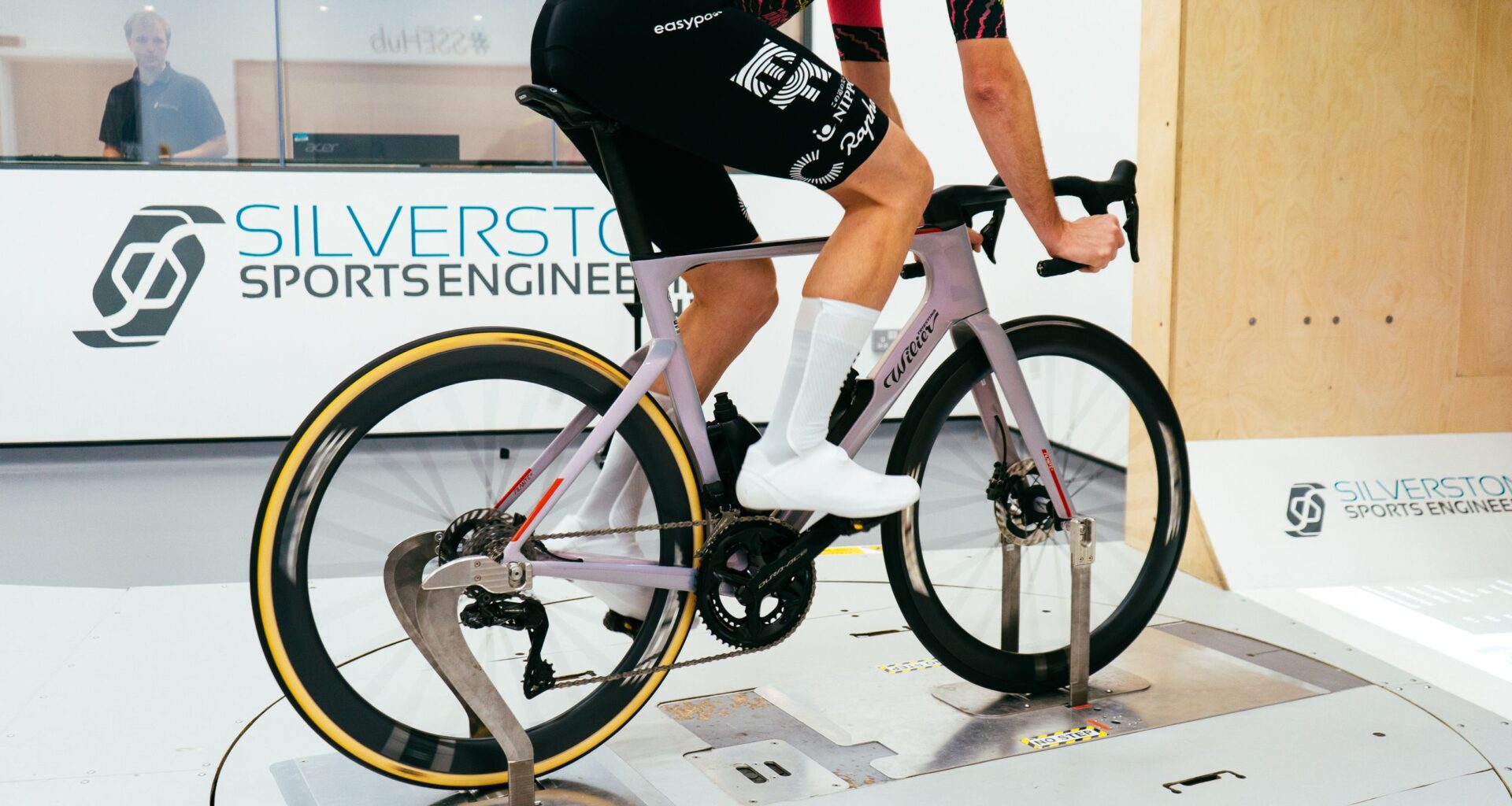
Launched late in the 2025 season, the Wilier Filante SLR ID2 came with it some lofty, albeit slightly unsubstantiated claims.
Two standout sentences from the brand’s release include that it “represents the ultimate evolution of Wilier’s racing bikes,” and that it is the “fastest in the WorldTour landscape.”
That’s not unusual, since brands don’t usually like to go to war with their competitors, but even ignoring the Factor One, which launched after the Filante, it needs to beat dedicated aero bikes like the Cervélo S5, the Colnago Y1Rs, the Canyon Aeroad, the Scott Foil and so on in order to stake that claim.
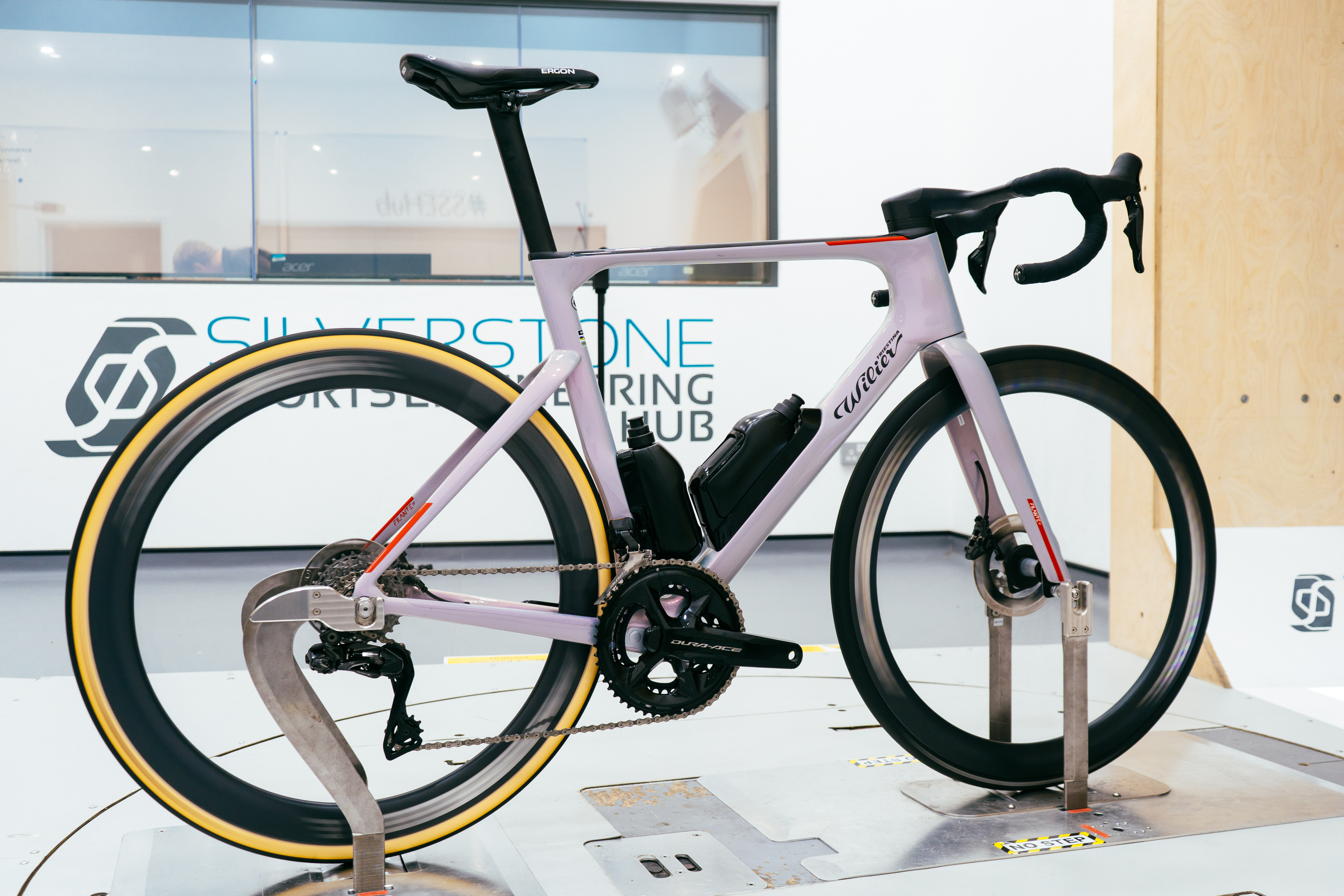
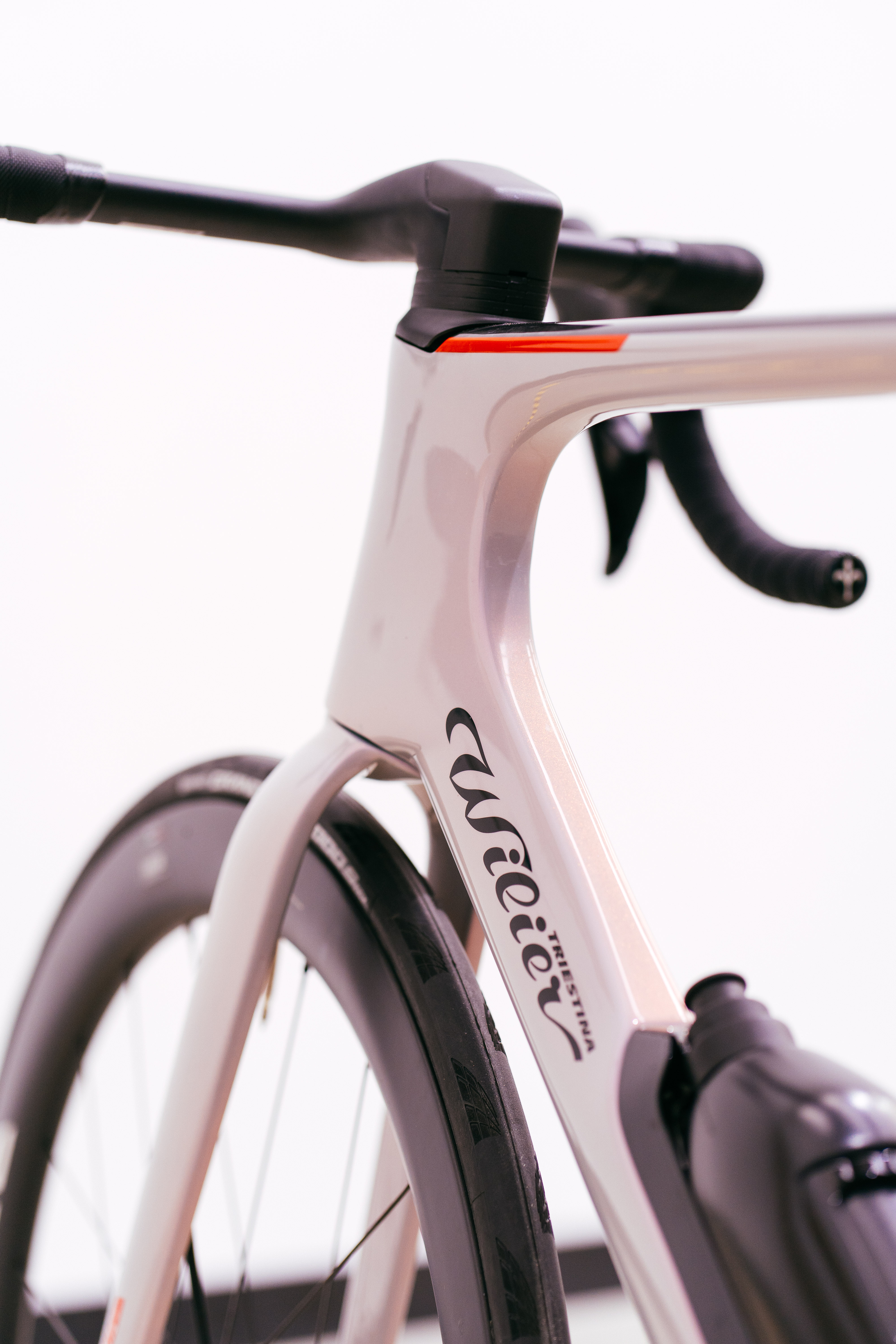
There are obvious aero intentions, but the design is a lot more understated than its competitors (Image credit: Will Jones)
At face value, using the ever-unreliable eyeball-wind-tunnel test, it’s hard to believe that it will. The Filante is clearly an aero bike, with fairly deep fork legs, a truncated aerofoil down tube, integrated aero bottles and so on, but it’s nowhere near as intentional in design as bikes like the Ridley Noah Fast, the Van Rysel RCR-F, or the Dare VA-AFO, each of which have extremely deep tube shapes throughout.
And it doesn’t do anything ‘weird’. Cervélo has its split cockpit, Factor has the wide fork and narrow head tube, Colnago has… well, everything, let’s be honest.
By comparison, the Filante SLR ID2 looks quite normal. The one-piece F-Bar ID2 cockpit is new and narrow, but visually understated. The seatpost is narrower than its predecessor but won’t turn heads. The 50mm wheels are unspectacular. The closed-off fork dropout is only a small detail.
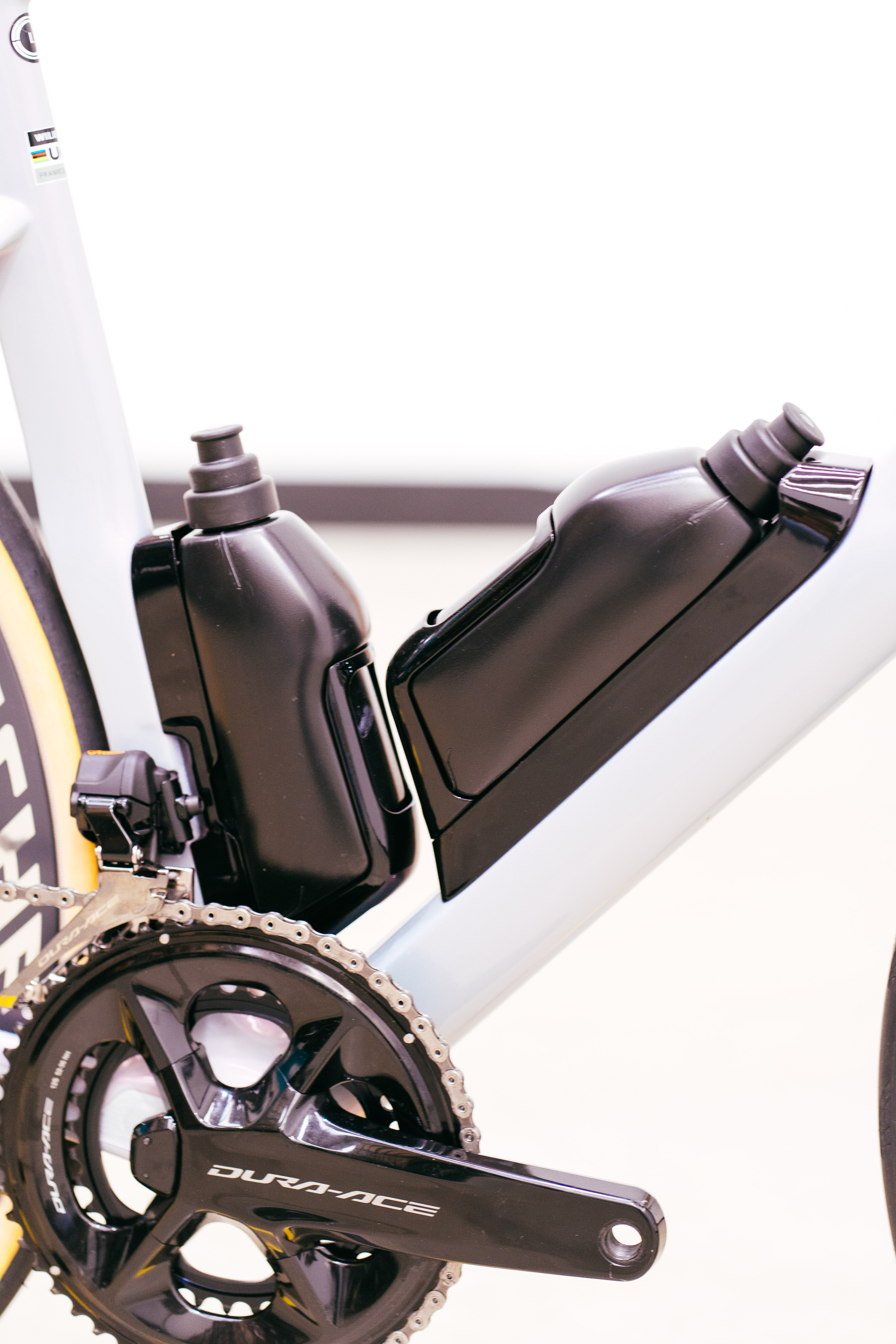
These bottles are arguably the biggest ‘look at me’ feature. Everything else is modest and understated. (Image credit: Will Jones)
Of all things, the standout visual feature is probably the integrated ‘Aerokit’ bottles, designed in conjunction with Elite. However, even these are deemed quite normal these days, thanks to BMC and Trek taking the lead in recent years.
Yet we’re not here to doubt claims baselessly. As we’re about to find out… fast doesn’t have to look ‘weird’.
In our eternal bid to challenge the industry’s claims and find the fastest equipment for our readers, the Cyclingnews tech team headed to the Silverstone Sports Engineering Hub wind tunnel to pit the new Filante SLR ID2 against its peers.
We tested it against our benchmark comparison bike – my old Trek Emonda ALR – which has also been tested against the aforementioned Factor, Cervelo, Colnago, et al.
So how does the Wilier fare against those aforementioned competitors? How does it fare against an everyday average bike? And how does it compare when we swap the wheels out in favour of our benchmark set of Enves?
Let’s get stuck in to find out.
The test protocols
For this test, to ensure maximum accuracy and the ability to compare across tests, we followed the same protocol as used in our two prior wind tunnel aero bike tests. Those include the 2024 test, which covered bikes like the S-Works Tarmac SL8, Trek Madone and Canyon Aeroad, and the 2025 test that covered dedicated aero bikes, such as the Cervelo S5, Colnago Y1Rs and Factor One.
That means we took the Filante SLR to the wind tunnel at the Silverstone Sports Engineering Hub, and tested it against our baseline bike; my very own 2015 Trek Emonda ALR, complete with rim brakes, external cables and round handlebars.
By keeping that baseline bike unchanged between each of our testing days, we’re able to quantify the ‘delta’ – or difference – irrespective of the atmospheric conditions that can affect the results.
And this in turn allows us to compare the delta of the S-Works Tarmac SL8, the Factor One, and the Wilier Filante SLR ID2, despite testing them all on separate days.
To be a tease, we also tested a handful of other bikes on the same day, including the Cinelli Aeroscoop, the X-Lab AD9, the Seka Spear, the Enve Melee, a Felt we can’t yet tell you about, and a second bike that we’re not even allowed to disclose the brand name of. Those will be published in the coming weeks.
To add to the confidence and completeness of our results, we test each bike in three different ways.
Bike-only: This offers repeatability and accuracy. You know the results here are a result of the bike, as there’s nothing else in the wind tunnel, but you lose some of the realism, given bikes can’t actually pedal themselves.With-rider: This adds the realism missing above, but with reduced accuracy, because the ability for a real human – me, in this case – to hold an exacting position repeatedly is hard work. We take steps to mitigate, but the variance is still approximately 2-3 watts higher than a bike-only test.Bike-only, standardised wheels: This allows an extra test to quantify whether the bike’s stock wheels are where the aero benefits actually lie, how well a frame works with another pair of wheels, and quantify the difference between framesets alone, rather than the complete package as sold by each brand.
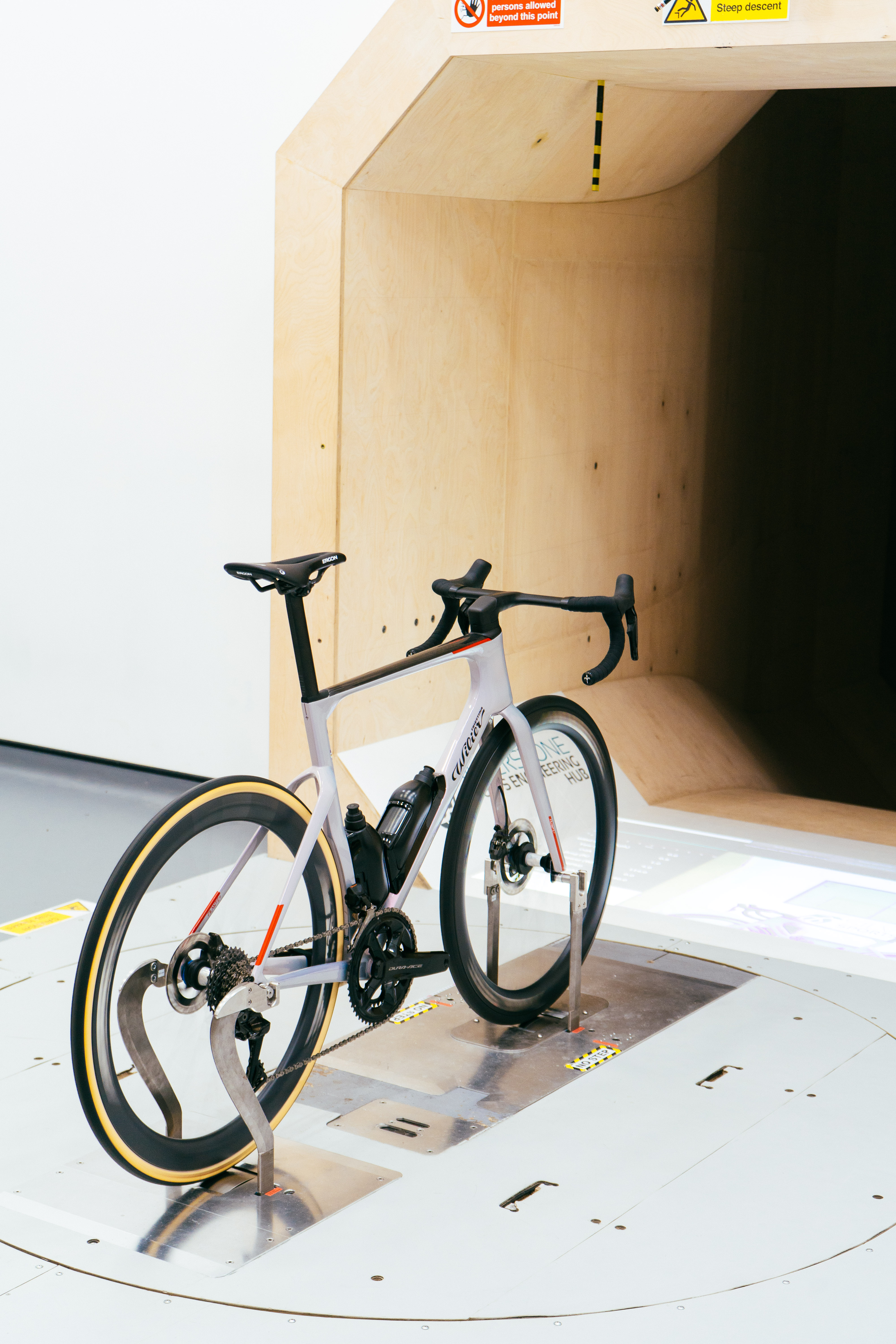
Each bike is tested with and without a rider (Image credit: Will Jones)
Each setup was tested at seven different ‘yaw angles’ – the angle of the wind, to you and me – which spanned from -15° through to +15° in five-degree increments.
We tested at 40km/h, which is the sort of average speed you’ll see in an amateur road race, road bike time trials, and longer breakaway days in the pro peloton. For bike-only tests, we ensured the wheels were spinning at the same speed, and for rider-on bike tests, we chose the closest optimal gear and ensured pedalling stayed at 90rpm.
For bike-only tests, we measured for 10 seconds per yaw, while the rider-on tests were captured for longer – 30 seconds – to ensure the results weren’t skewed by any accidental movements by the rider.
The wind tunnel, as ever, was tared – like a zero offset on your kitchen scales – before each test.
As per the previous tests, each bike was a 56cm or equivalent, and adjusted to fit as closely as possible to the baseline Trek Emonda ALR, which in turn is fitted to me (seemed like the sensible choice given I’m the one riding the bike!)
With different handlebar widths, different flares of the same width, and then the various geometries of each bike, the position does differ slightly across bikes. The differences here are small enough that we’re not concerned that they affect results unfairly.
Each bike was fitted with a 25mm Continental GP5000 S TR front tyre, to ensure the result wasn’t unfairly skewed by differences in tyre size. For the test with the Enve wheels, we ran a pair of 28mm GP5000 S TR.
Everything else you can think of was standardised too, including what I wore, bottles and cages, the computer mounts, and saddles.
With saddles, we were kindly sent a box full of Ergon SR Women Team saddles, which have exactly the same upper – both in shape and material – for both round and carbon railed versions, meaning we could standardise across all levels of bike today and in future.
(Image credit: Will Jones)
A few caveats
We ran multiple repeats of the Trek Emonda ALR to quantify what our repeatability was on the day, which in turn gave us a confidence margin that is applied to the results below.
That margin is as follows:
Swipe to scroll horizontally
Error
Bike
Rider
CdA (in M²)
0.0007
0.0034
Watts (at 40km/h)
0.58
2.80
Our error margin differed slightly on each testing day, which is why the data for some bikes have bigger variances than others when graphed out below.
This and all of our other tests are independent, impartial and entirely unbiased, and we hire the wind tunnel at the normal commercial rate.
A fair, honest and unbiased protocol is essential to the success of these tests. Even if we could maintain impartiality, you wouldn’t trust the result if it said it was sponsored by Wilier, so even though we’ve had multiple requests from various brands (not including Wilier, for what it’s worth), we’ve rejected them.
Importantly, the data below is merely the result of our day of testing, not the final word on whether the Wilier Filante SLR ID2 is a good, bad, fast or slow bike.
We hire a highly respected facility and test as accurately as we can using our set protocol, but we understand that you may see different results under different testing conditions or using different protocols, such as faster test speeds, using mannequins, or testing at different yaw angles.
We also understand that this is just one piece of a much bigger puzzle. There are countless other metrics that make up a bike’s performance, such as stiffness, weight and compliance, and unless you’re a pro cyclist, you should also consider how easy it is to live with, service, and how easy the brand is to do business with, in the case of an issue down the road.
(Image credit: Will Jones)
The results
Starting with the raw CdA data for each yaw point. This doesn’t necessarily give us much to go on in terms of comparing to the industry’s competitors, but it’s really interesting to see how a bike handles the wind. Some really struggle when the wind angle grows (to become more of a crosswind) and others actually get faster in crosswinds.
Using the baseline Emonda ALR as our example of a ‘bad’ aerodynamic bike, and the Factor One as the benchmark ‘good’ bike, you can see how the Filante SLR ID2 compares. The ‘V’ shape of the Emonda graph basically means that the further the wind comes from the side, the higher the aero drag. This is quite natural given more of the bike is in the line of the wind. The Factor harnesses the wind to ‘sail’, and actually gets faster at 10° and 15°.
The Filante SLR doesn’t quite sail as well as the Factor, but it’s a noticeably flatter line, so not a bad performance.
With the rider on the bike, that sail effect is much harder to achieve, given the wind has much more to hit, thanks to the human body being added into the equation. But interestingly, the Filante graph here is marginally flatter than both the Trek Emonda ALR and the Factor One. And as the wind angle increases, the performance seems to be maintained. It’s hard to say what’s causing this, but it could be a result of those aero bottles and cages, which sit in the turbulent air between the rider’s legs.
But what does that actually mean in terms of watts saved? Next up, we’ll look at the delta against our baseline, and how the Filante SLR ID2 slots in against the various other bikes we’ve tested.
The graph above shows that the Filante SLR sits very much mid-table, with an error margin that could see it climb as high as the Factor OSTRO VAM, or fall down to the Dogma F.
Specifically, it represents a 34.54-watt saving against our baseline Emonda. That’s 5.74 watts behind the best-on-test Factor One, and 10.32 watts better than the Look Blade 795 RS.
But of course, as we’re all aware, bikes can’t pedal themselves, so next we’ll look at the rider-on-bike test.
Here, the Filante SLR ID2 really climbs the table, into a respectable 3rd place, behind the Cervélo S5 and Factor One, but ahead of the Colnago Y1Rs and the Specialized Tarmac SL8.
It will save you a very respectable 24.5 watts against our baseline Trek Emonda ALR, but still falls three watts shy of the Cervélo and the Factor.
It’s important to acknowledge that the error margin here is about as big as the differences between the bikes, so it’s not the most conclusive result. But to put a positive spin on things, it does mean the Filante SLR ID2 can lay claim to the title of fastest bike in the WorldTour (although there are still a couple we’re yet to test).
Next up, we swapped out the wheels for our control wheelset to see how much of the performance was thanks to those Miche Kleos 50s.
This protocol was only added in 2025, so we don’t have data for our 2024 cohort of bikes, but you can see here that the Filante SLR sits in a similar position behind the Factor, Cervelo, Dare, Colnago, Ridley and others.
In fact, as we’ll see in the graph below, the performance improved slightly with the Enve wheels.
When swapping the Enves into play, the bike actually performed 1.04 watts better. That’s only a small saving, but if you’re on the fence about upgrading from Miche to another option, this might help sway your decision.
Conclusions
Taking this data and my colleague Tom’s experiences when reviewing the Wilier Filante SLR into account, my biggest takeaway is that the Filante is a bit of a surprise package.
It looks good, but in an unassuming way. There’s an obvious aero intention to it, especially given those ‘Aerokit’ bottle cages, but I wasn’t expecting it to land among bikes like the Factor One and Cervélo S5.
In the bike-only tests, it doesn’t manage to back up its fastest in the worldtour claims, and although it falls well short of a runaway victory with a rider on the bike too, its 3rd place finish is impressive given the competition it’s up against, and it even has a claim to top spot.
Whether that will help the likes of David Gaudu in his bid to reclaim the leadership role at Groupama FDJ United, or help prodigious French talent Romain Grégoire with his continued rise? We’ll have to wait and see.