
Paramount has made the first six episodes of ‘Star Trek: Starfleet Academy’ available to members of the media in advance of the January 15 premiere. They have allowed for early reviews to coincide with Tuesday night’s season premiere event at the Museum of Natural History in New York. The following has minor spoilers, and as per usual, TrekMovie will post extensive recap/reviews and podcast discussions for each individual episode, starting on Thursday, January 15.
First, a little backstory
The idea of doing a story set at Starfleet Academy has been bouncing around for quite a while. It came closest when 1980s Trek film producer Harve Bennett proposed a movie focusing on Kirk and Spock’s Academy days following Star Trek V: The Final Frontier. Needless to say, that never came to pass, and the idea’s been an intriguing “what if” for over three decades.
Since becoming Trek’s TV supremo, making a show about young cadets at Starfleet Academy has been a bit of a pet project of Alex Kurtzman. The idea has gone through a number of iterations and creatives, with Kurtzman finally landing on an concept developed by creator Gaia Violo. After almost two decades with the franchise since the 2009 Star Trek film, Alex has said he has put all he has learned from the ups and downs from multiple movies and TV series into this new series, with Trek’s TV future (and his own) on the line. No pressure.

Second from left front row: Gaia Violo, Noga Landau, and Alex Kurtzman along with the Starfleet Academy cast and Paramount execs at the world premiere on Tuesday in NYC (Photo by Roy Rochlin/Getty Images for Paramount+)
An unlikely duo
In the new incarnation, and as established in Discovery’s final season, Starfleet Academy has returned to its traditional home in San Francisco for the first time in over a century. Here, a new generation of cadets is set to be taught by some familiar and some not-so-familiar faces.
Chief among these is Holly Hunter’s Nahla Ake, both the chancellor of the Academy and captain of the USS Athena—the huge training ship that doubles as the campus. The casting of Hunter—an Oscar winner for The Piano—was a huge coup for the franchise and led to some speculation that her presence in the show would be limited to the occasional appearance. She’s front and center though, very much a lead character. Ake is part Lanthanite—an extremely long-lived species introduced on Strange New Worlds in the form of Carol Kane’s Pelia. Like Pelia, Ake is an unconventional, quirky character who may not be for everyone, but Hunter imbues her with an intelligence and gravitas that makes her a worthy addition to Trek’s pantheon of captains, and her folksy nature doesn’t diminish her authority one whit, even when she’s curled up on or draped over the furniture. She is a unique and worthy addition to the gallery of Star Trek captains.
The heart of the show is her relationship with Caleb Mir (newcomer Sandro Rosta), who Ake encountered as a child; their brief interaction led to her leaving Starfleet. Now, talked back into service by Discovery’s Admiral Vance (Oded Fehr), she encourages the wayward Caleb to enroll in the Academy in the hope of turning his life around (and to keep him out of prison). Theirs is a fun relationship, although the casualness of it (Caleb is far from a standard cadet, and Ake isn’t a regular teacher or commanding officer) may initially rankle some, but there’s a reason for the nature of their interactions. Impressively, Rosta—in his first onscreen role—holds his own against the vastly more experienced Hunter.

Ake and Mir having one of what will be many conversations in the chancellor’s office (from NYCC trailer)
Yes, the ship is the school
The idea of a ship doubling as the campus is a novel one. Obviously taking cadets into space is a vital part of their training— it was a major plot point of The Wrath of Khan—but it’s an idea a show had yet to fully explore. From a production perspective, it’s obviously a good money saver, allowing the same sets to be utilized in both Earthbound and space-set stories. The Academy/Athena set is enormous (reputably the largest standing set in North America) and looks amazing, if a little sterile and impersonal and overly lit. (Even the floors are shiny.)

It’s a school. It’s a ship. It’s both! (Paramount+)
Meet the cadets
The new incoming Academy class numbers in the hundreds with a diverse group of aspiring Starfleet officers from across the galaxy, but the show focuses on a particular group of classmates who become fast friends. Besides Caleb, there’s Jay-Den Kraag (Karim Diané), an unconventional Klingon who aims to be a medical officer; Genesis Lythe (Bella Shepherd), the daughter of a Starfleet admiral; Darem Reymi (George Hawkins), an ultra-competitive jock from a wealthy family; and Sam—short for Series Acclimation Mil—(Kerrice Brooks), a newly created, highly advanced hologram who may have some hero worship issues concerning a certain doctor. There is also Tarima Sadal (Zoë Steiner), the daughter of the president Betazed who has some unusual (and potentially dangerous) powers.
In the first six episodes, we learn the most about Kraag and Sam, who stand out in the crowd. Kraag is a type of Klingon we’ve rarely seen; one who rejects his culture’s warrior ethos and desires to be a Starfleet medic—and seems, by nature, restrained. An episode focused on his backstory finally gives us our first look at what the Klingons are up to in the 32nd century, answering questions we’ve had since the USS Discovery leapt into its new time period and weaving in his personal history nicely.
Sam, meanwhile, may well have the potential to be the show’s breakout character. Although she appears to be in her late teens, she’s newly created, and Brooks plays her with the enthusiasm and curiosity of a small child. Admittedly, this may be irritating to some at first, but as the season progresses, she’ll likely grow on you, and a mid-season episode centered around her may well be the season’s standout installment.
The other cadets get less attention. Genesis and Darem both are ultra-competitive types with daddy issues; they’re also both species we haven’t seen before, so there’s a lot to learn. While they both aim to be captains, it’s Genesis who shows real leadership at her core, along with strong emotional intelligence. Darem starts out as the jerk you love to hate, then reveals there’s more to him than his frat boy persona, but whether they’ll both get more development remains to be seen. And Tarima Sadal, at least in the first six episodes, has a little of her own story beyond being a potential love interest for Caleb, but not much. But there seems to be some promise that her unusual Betazoid abilities will offer some story possibilities.

Kerrice Brooks, Romeo Carere, Karim Diané, Sandro Rosta, George Hawkins and Bella Shepard in season 1 , episode 5 (Brooke Palmer/Paramount+)
Fascinating (funny) faculty
Rounding out the main cast of teachers is Gina Yashere as Lura Thok, a half Jem’Hadar/half Klingon who serves as cadet master of the Academy, and second in command of the Athena. As you’d expect given the character’s parentage, she’s a strict taskmaster, and one whose harsh, militaristic attitude often seems at odds with Starfleet’s ways. Fortunately, Yashere—a British comedian—brings some much-needed humor to her performance, which lessens the character’s edge and lightens the mood. She’s already shown us some different shades of her personality in the first six episodes, and no doubt she will keep revealing more as the show moves along. She’s intriguing.

L-R: Gina Yashere as Lura Throk and Tig Notaro as Jett Reno in season 1, episode 3 (John Medland/Paramount+)
Speaking of humor, Stephen Colbert has a small part as the digital dean of the academy—a voice-only role limited to making witty daily announcements over the PA to the cadets, some of which work better than others. It’s a better role, however, than the one given to The OC’s Brit Marling, who is wasted as the voice of the Athena’s computer. She’s a talented actress (not to mention writer), and her presence is barely noticeable.
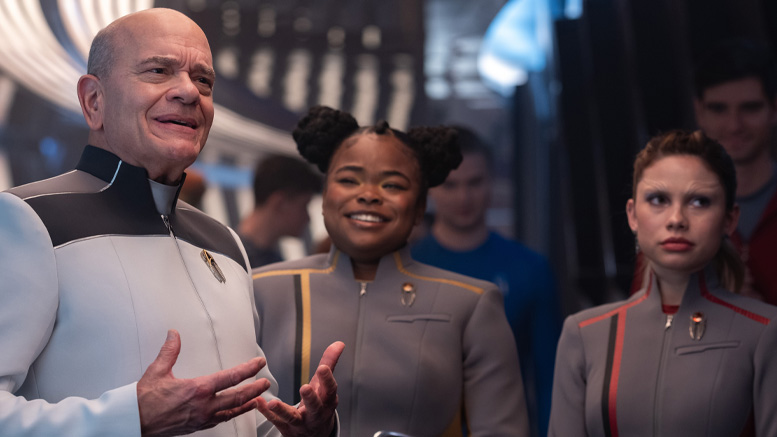
One surprise is the limited presence of Mary Wiseman’s Sylvia Tilly. Discovery heavily implied Tilly would be a major part of the show—she left the ship to teach at Starfleet Academy, after all. But in the six episodes made available for review, the popular character has yet to make an appearance. Although her presence is missed (we’re assured she is in the show eventually), Discovery’s Tig Notaro and Voyager/Prodigy’s Robert Picardo more than compensate. Notaro’s Jett Reno is as acerbic and witty as ever, while Picardo’s Doctor (in his first live-action Star Trek appearance in over two decades) delivers a new take on the character. The Doctor has been active since the 24th century, so he now has hundreds of years of “lived” experience, and Picardo’s new take on the character feels like a natural (and fascinating) evolution for him.

Sam (Kerrice Brooks) with The Doctor (Robert Picardo)
Scene stealing vets
The cast also features two little-known actors nobody’s probably ever heard of or seen in anything: Emmy-winner Tatiana Maslany and Oscar-nominee Paul Giamatti. The erstwhile She-Hulk has a small (so far) role as Caleb’s mother (but we expect to see her again), and Giamatti is the season’s main villain, Nus Braka, a half Klingon/half Tellarite pirate. Both have a connection to Ake and the incident that prompted her to leave Starfleet. Giamatti, a huge Trek fan, is clearly having the time of his life hamming it up (somewhat appropriate considering he’s half Tellarite). He strikes the delicate balance between fun and menacing, and the show wisely doesn’t overuse him, although his performance includes some scenery chewing in the season premiere.
For older fans, the cadet hijinks, rivalries, and romances might be a little much, but the adult characters get to play everything with more of a wink, without overdoing it. The most entertaining scenes provide a combination of both.

Paul Giamatti as Nus Braka and Holly Hunter as Chancellor Nahla Ake in season 1 , episode 1 (Brooke Palmer/Paramount+)
Finding the balance
As for the series itself, it’s a bit of a show of two halves. On the one hand, you’ve got good old ship-based fun—albeit of the Discovery type with battles, flashy effects, and lots of inspirational character moments. On the other, you’ve got a school show with well-worn teen issues (annoying roommates, practical jokes, and an abundance of hormones) including the cliche of a rivalry with a school sharing their space: the War College. The inclusion of this extra school is somewhat odd: the idea being that Starfleet needed a more militaristic approach following The Burn, hence a more militaristic school, which now exists alongside Starfleet Academy. It’s an odd inclusion and seems to exist primarily to create a bit of rivalry among cadets. To make a comparison to another popular franchise, they’re the Slytherin to the Academy’s Gryffindor. While there are clear comparisons to Discovery, the show’s structure has a more episodic structure, with some over reaching arcs, like the search for Caleb’s mother and the rebuilding of the Federation amidst various threats, like Braka’s pirates.
As for who the show is for, like most Kurtzman-era shows, its target audience is a demographic that hasn’t paid much attention to Star Trek. He’s described his desire to make different types of shows aimed at different markets, and it’s no secret that the franchise has struggled to gain traction with younger audiences in recent years. Discovery didn’t even try to capitalize on keeping the younger audience temporarily drawn in by the Kelvin movies, and Prodigy wasn’t the hit with children that Paramount and Nickelodeon hoped for. Ultimately, neither show really broke out, and the majority of the audience would seem to be, to be honest, existing Star Trek fans. Academy has plenty of elements designed to draw in a more youthful audience—a young, hot cast, plenty of humor, assorted teen issues, sex, and a lot of present day slang. But there’s plenty for Trek’s current and *ahem* more mature audience as well. There are characters we already love along with some good, Star Trek-y storylines, and, in case you needed more encouragement, fricking Holly Hunter and Paul Giamatti. Those two alone are more than worth the price of admission.

George Hawkins as Darem Reymi, Kerrice Brooks as Sam and Sandro Rosta as Caleb Mir in season 1 , episode 3 (John Medland/Paramount+)
The pilot, specifically, does a great job of setting up the characters and tones that will take us through the season. It juggles introducing new storylines and species with world-building as if we’ve been there the whole time, and somehow manages a deft balance of action, emotion, excitement, suspense, and genuinely funny comedy. The series does not require any prior knowledge of Star Trek, but is rife with references and connections, with Trek history literally part of the Academy itself. But these nods to the lore go beyond just Easter eggs, with some emotional moments that will pay off for longtime fans. While rooted deeply in the Discovery era stylistically, it also feels deeply connected to ’90s-era Star Trek, particularly Deep Space Nine. And it seems clear this team has learned something from both Discovery and Picard: The stakes don’t always have to be the entire universe.
Fans of “traditional” Trek may initially feel discouraged by the YA feeling of some of the earlier episodes. Our advice would be to persevere. Come mid-season, not only should the young cast grow on you, but your perseverance will be rewarded. (We’re not giving spoilers, but big shout-out to Beckett Mariner herself, Tawny Newsome—now a member of the Academy writers’ room—and Kirsten Beyer.)

Holly Hunter in season 1, episode 1 (Brooke Palmer/Paramount+)
Ultimately, if Kurtzman’s output hasn’t done it for you to date, it’s unlikely Academy will win you over, but not impossible. It sticks a bit closer to its Discovery origins than fellow spin-off Strange New Worlds (in particular in the show’s visual style) but it’s still very much its own show. With a new regime at Paramount, it may well be possible that the currently filming second season will be the show’s last. If so, it would be a shame. It would undoubtedly be fun to watch these raw cadets mature over several seasons, becoming Starfleet’s next generation.

Sandro Rosta in season 1, episode 3 (Brooke Palmer/Paramount+)
SFA blue carpet coverage coming from TrekMovie
TrekMovie spoke to quite a few members of the cast and crew of Starfleet Academy (and beyond) on the blue carpet, and at the press junket. Keep your eye out for them on the site and @trekmovie YouTube.
Keep up with news about the Star Trek Universe at TrekMovie.com.