
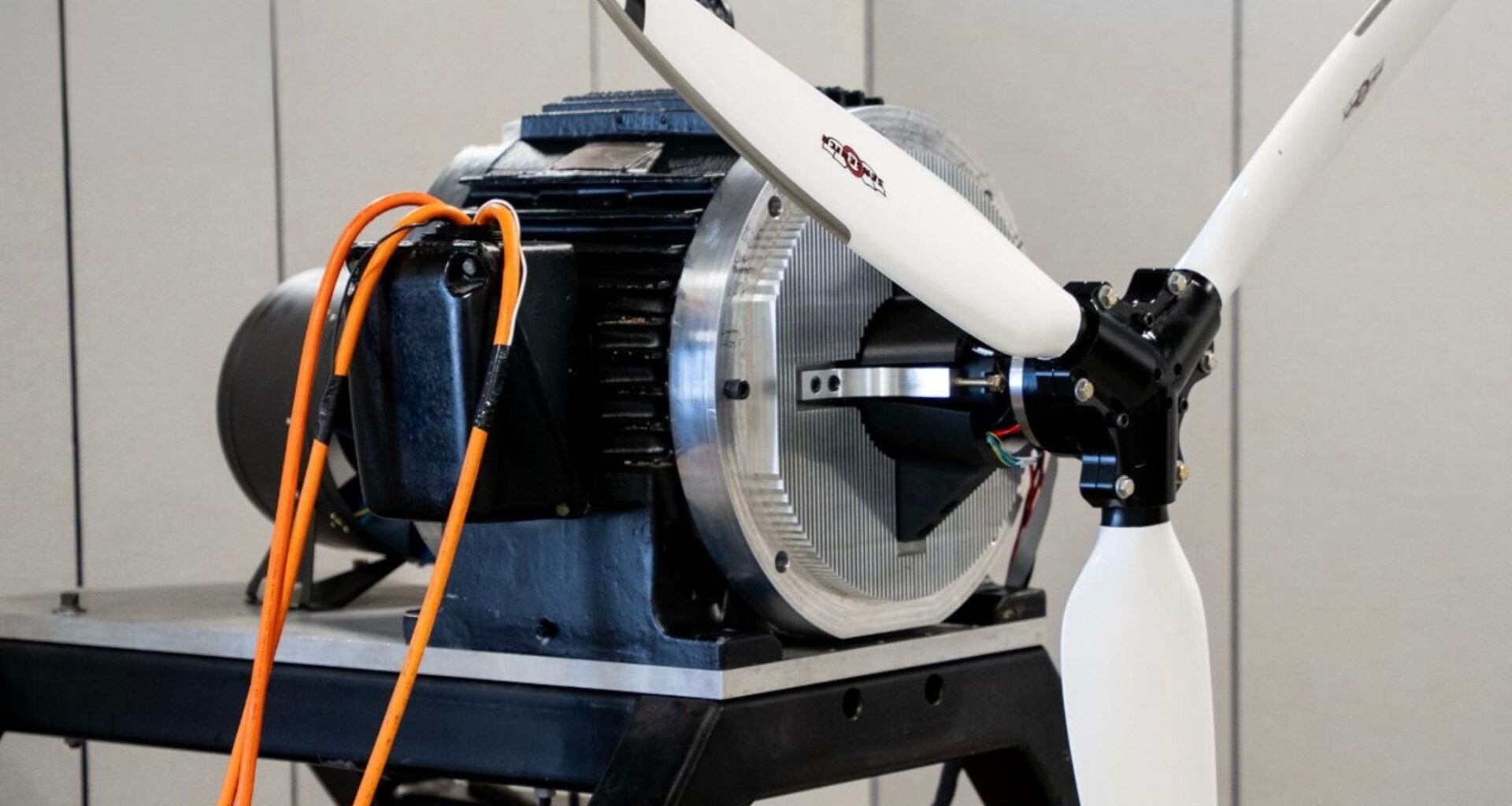
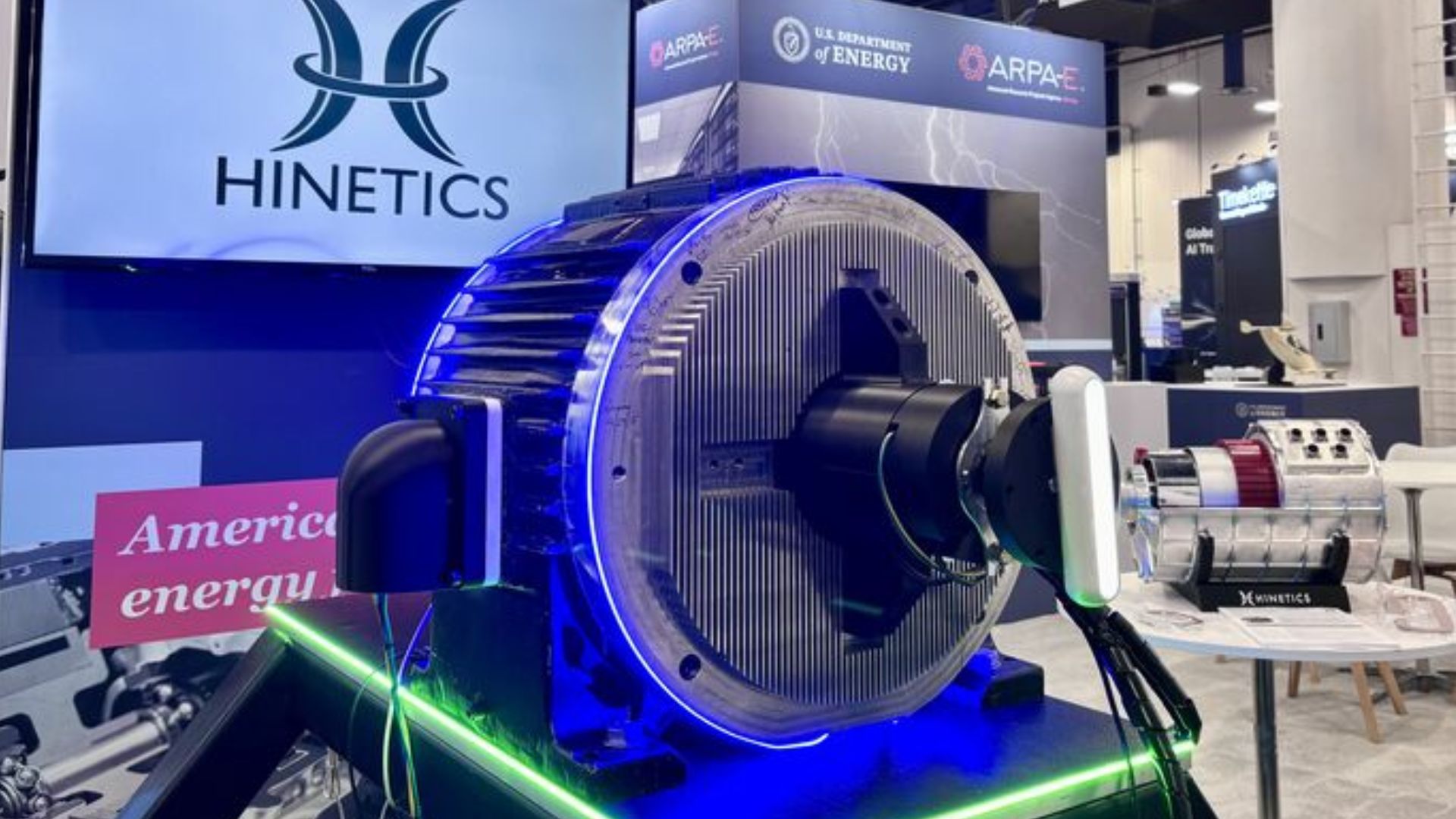
US startup Hinetics, a member of the POETS center, unveiled the world’s first fully integrated, cryogen-free superconducting motor at CES 2026. This project, funded by the US Department of Energy’s ARPA-E, is being developed for aerospace and AI data center applications.
In an interview with Interesting Engineering, Hinetics engineer Raatan Venkataraman described the unit as a practical proof-of-concept demonstrator representing three years of development.
“What you’re seeing here is a practical superconducting motor. It’s a small proof-of-concept demonstrator, but it represents all the technology we’ve developed over the past three years,” said Venkataraman.
While this specific unit is a scaled-down version, Hinetics is currently building toward a six-megawatt superconducting electric motor.
Venkataraman stated that the goal is to make superconducting technology feasible for near-term use. He identified the primary obstacle as the high cost of superconducting tape, though he noted that costs have dropped by half over the last three years.
“We expect a similar reduction over the next three years. That’s what will make superconducting machines more scalable and commercially viable,” he remarked.
Self-contained design
A distinguishing feature of this motor is its self-contained design. Venkataraman noted that other superconducting machines typically rely on bulky external cryogenic systems. The Hinetics system is cryogen-free and lacks external cryogenic loops.
“Based on our literature review, we could not find any fully self-contained superconducting machine like this,” noted Venkataraman.
The motor uses an onboard cryocooler with a cold finger that removes heat and ejects it into the atmosphere. This setup maintains the required low temperatures without the need for external liquid cryogen cooling.
Applications in AI and aerospace
The current demonstrator serves as a one-to-twenty scale version of a three-megawatt, 1,800-RPM machine presently under construction.
“This demonstrator isn’t designed for a specific power rating or speed,” he explained.
Beyond aerospace, Venkataraman highlighted power generation for AI data centers as a key application. AI data centers face high transient power demands that conventional generators struggle to manage, often requiring the use of batteries or power banks. Because this superconducting machine has very low inductance, it can respond to sudden power changes quickly.
“That allows us to meet transient loads directly from the shaft,” added the engineer.
Efficiency is another factor, with the system operating at approximately 99.5 percent efficiency. Venkataraman explained that at the megawatt scale, small efficiency gains translate into hundreds of kilowatts saved.
“Our goal has been to make superconducting technology not just possible, but practical and feasible in the near future,” Venkataraman concluded.
Project background
The CES debut follows the May 2025 demonstration of a prototype nicknamed “Baby Yoda.” That system proved that superconducting magnets could reach an operating temperature of -370 degrees Fahrenheit using a commercial Stirling-cycle cryocooler.
The technology uses a vacuum environment, thermally insulating Kevlar ropes for structural suspension, and aluminized mylar insulation to isolate magnets from external heat.
These features allow for a two- to threefold increase in magnetic field strength and a factor of 10 improvement in torque density compared to traditional machines, which is beneficial for aerospace and marine applications.