
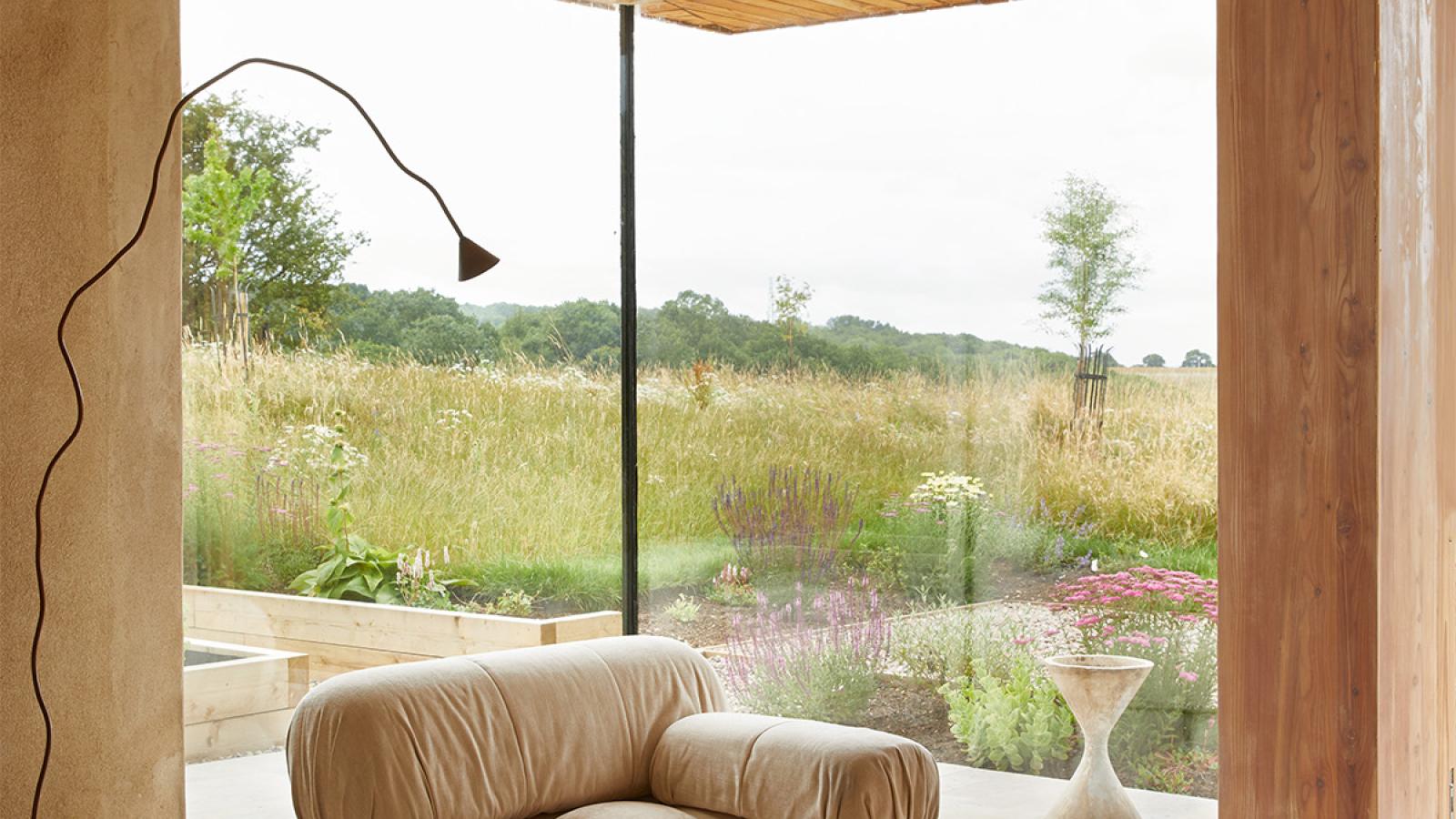
This barn is on a private plot flanked by a woodland forest that faces rolling hills and fields to the south. Previously, it was a derelict agricultural building, formerly used to keep farm animals. Being of masonry, concrete and asbestos construction, it was originally a simple structure – an outbuilding on the site used purely for shelter. It was in terrible condition and needed significant architectural improvements to make it habitable, which involved a full renovation, including part demolition.
The brief involved the construction of a new holiday retreat, The Makers Barn. Designed to blend in with its surroundings, the idea was for guests to feel lost in the rolling hills, grass paths and wildflower beds that cut through the landscape. It’s a secluded escape from the city with a calming, relaxing and welcoming atmosphere.
The design was to be sympathetic to its surrounding site in relation to materials, palette, scale and proportions, but also contemporary in character. Practically, it needed a fully operational kitchen so that guests could live there and be self-sufficient. It also needed to include enough storage so that guests could stay for up to a week, but not too much that it became overly dominant in the space given the building’s small footprint.
We designed this as one free-flowing space separated by a central fireplace and chimney. Rather than dividing the plan into compartmentalised rooms, or leave it as one open space – which ironically would make the space feel smaller – we inserted separate joinery elements and volumes within the barn to create glimpses and angled views through. A sunken bath and concrete shower under a skylight, and the bespoke elm timber joinery elements, segregate and distinguish different functions of The Makers Barn.
We maximised every possible space, even putting the windows and doors on the outer edge of the walls, creating larger internal cills, shelving areas and more space internally. We designed a single interconnected space so that from every position and point in the building, there is a framed view of the stunning hills and landscape, framed by the bespoke timber sliding doors and timber columns. It was also important in a small space to maintain a consistent and holistic design approach to materials so the space did not feel too busy or cramped.
The tones and shades are reflective of the English country. The older the barn gets, the more it belongs with its surroundings (for example, larch timber roof weathers grey). Designed to be timeless with organic, earthy raw tones borrowed from the landscape, we placed an emphasis on crafted, sustainable and natural materials including clay-plastered walls and ceilings, end grain parquet flooring and English elm joinery.
Combining hard and soft, rough and minimalist, are signatures of our contemporary, brutalist yet contextual approach. This gives a pared-back, atmospheric but still relaxing and comfortable outcome.
We see the interiors, furnishings (including the artwork) and styling as an extension of the architecture and as part of our multi-layered, full-service approach to design. To furnish and style, we sought out makers we felt echoed our design approach, including handmade wood-turned pieces from Ash & Plumb, ceramics from Jono Smart and forged kitchenware from blacksmith Alex Pole.
We used iconic pieces including Mario Bellini’s Camaleonda sofa; Sergio Calatroni’s Papiro floor lamp, Willy Guhl’s loop chair and planter amongst others. Swedish Cappelen Dimyr’s shaggy rug, By Molle’s natural linens and fabric pendants from Pinch bring warmth to the space.