
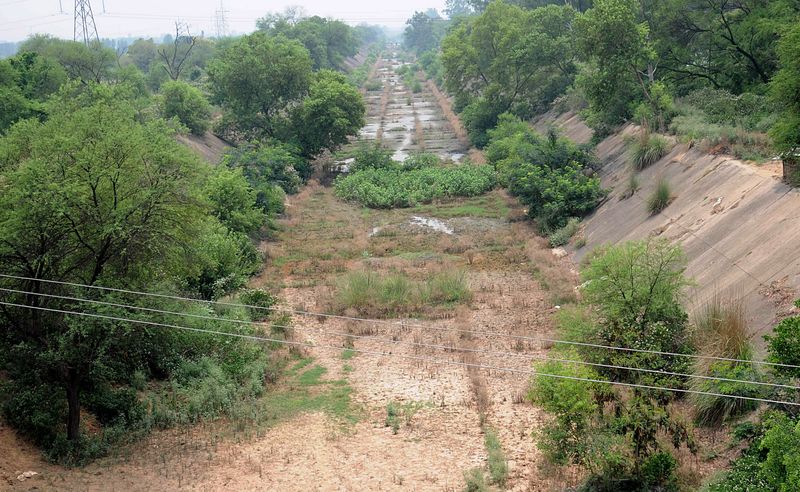
What would be the best way to mark the 60th anniversary of the formation of Haryana and the creation of Punjabi suba? I have a proposal. Let this historic occasion be used to resolve the water dispute between the states of Punjab and Haryana in an amicable way.
It would be a tribute to the shared culture and history of both these states. It would also reinforce the unity of the farmers of Punjab and Haryana who witnessed the historic farmers’ struggle.
I can already see many sane heads nodding, but also raising a question: How is this possible? Isn’t this a zero-sum game? Someone gains only when someone loses. Who would agree to be a loser? What kind of proposal would be acceptable to both sides, which are not willing to cede a drop of water?
I believe this is not quite true. Over the last decade, I have repeatedly argued (including on the pages of The Tribune) that a resolution to the Punjab-Haryana SYL dispute is not as impossible as it is made out to be. It is difficult, as all complex disputes always are. But it is resolvable, provided we have the right frame of mind.
The right frame of mind requires acknowledging some uncomfortable truths. First, this dispute can be resolved only by a negotiated settlement, not by a court order, nor by passing laws. The current stalemate exists because Haryana has a court order in its favour, but Punjab has the possession.
As any pragmatic farmer knows, possession is half ownership. It’s time to acknowledge that the 25-year-old Supreme Court order cannot be enforced against the popular will of the sensitive border state of Punjab.
The flip side of this point is to acknowledge that the state of Punjab cannot simply abrogate legally binding agreements or reverse land acquisition for the SYL canal. Such legal games from both sides can only sow the seeds of deep distrust, if not animosity, between the two neighbourly peoples in Punjab and Haryana. You can change everyone, but not your parents, not your neighbours.
The second uncomfortable truth is that political leaders in both the states have been pretty irresponsible and have stoked this dispute. It is understandable that regional parties like the Akali Dal in Punjab and the Indian National Lok Dal in Haryana would wish to play it up for political gains, while both their leaders have enjoyed excellent personal ties.
The really shocking part is the role of ‘national’ political parties, which have shown complete disregard for national interest. First the Congress, then the BJP and now the Aam Aadmi Party — all have sanctified political doublespeak. The Punjab and Haryana units of the same party take exactly the opposite stands while the national leadership watches and winks.
Finally, an ecologically uncomfortable truth. Both Punjab and Haryana are guilty of overstating their water requirements. The Green Revolution pushed the farmers in both the states into unsustainable water-use practices by growing water-intensive crops like paddy and sugarcane, which were unknown to and unsuitable for this agro-climatic zone.
It is pointless to blame the farmers or expect them to adopt crop diversification unless they can be assured of remunerative returns at the level that they receive today.
A realistic resolution must be grounded in a mutual appreciation of genuine concerns on all sides. The farmers of Punjab, especially in the Malwa region, have a legitimate concern about losing the water they have been using for irrigation for decades now.
Similarly, the Green Revolution patch in north Rajasthan is entirely dependent on water from the Ravi-Beas. These existing patterns of usage should be respected. At the same time, agriculture in south Haryana continues to be rainfed, desperately in need of canal irrigation. Parts of this region face a drinking water crisis that needs addressing.
Fortunately, the dispute is much smaller and clearly delimited than it is made out to be. There is no dispute about the internal allocation of the Sutlej waters, estimated to be 14.01 million acre feet (MAF). As per the original agreement, Punjab receives 8.15 MAF, while 4.4 MAF goes to Haryana and 1.46 MAF to Rajasthan. The dispute is about the remaining half, namely the sharing of the Ravi and Beas waters, estimated to be between 15.9 and 18.3 MAF.
Here, the share of Punjab was first fixed at 22 per cent in an unfair deal by then Prime Minister Indira Gandhi in 1976. This was subsequently revised to 25 per cent by mutual agreement of all chief ministers in 1981 and then to 28 per cent by the Eradi Commission in 1987. At the most, the dispute is about 1 MAF of water, just about 3 per cent of the shared waters of the Sutlej-Ravi-Beas. Here is a five-point framework for a negotiated settlement.
One, the dispute about the quantum of water available should be settled immediately by allowing the Ravi and Beas Waters Tribunal (erstwhile Eradi Tribunal) to finalise its technical report. Two, the Central government must step in to plug the massive leakage of India’s share of water to Pakistan so that the quantum of water to be shared increases.
Three, Haryana and Rajasthan should agree to give up a slice of their previously agreed share of the Ravi-Beas waters to Punjab in recognition of the usage of that water by the farmers in the Malwa region of Punjab. Four, in return, Punjab should agree to an assured time frame for the construction of the SYL canal and the unhindered passage of water through it thereafter. Five, the Centre should announce a special package for crop diversification in Punjab and Haryana, with a legal guarantee for remunerative returns for water-saving crops.
This is just a broad framework which points to the possibility and feasibility of an agreement. The specifics have to be worked out by experts. The Supreme Court has already offered an opening by asking both the governments to come to a negotiated settlement.
Perhaps a start can be made in this direction by well-meaning public intellectuals and well-wishers of farmers on both sides coming together to evolve a common ground before this is given the shape of negotiated settlement.